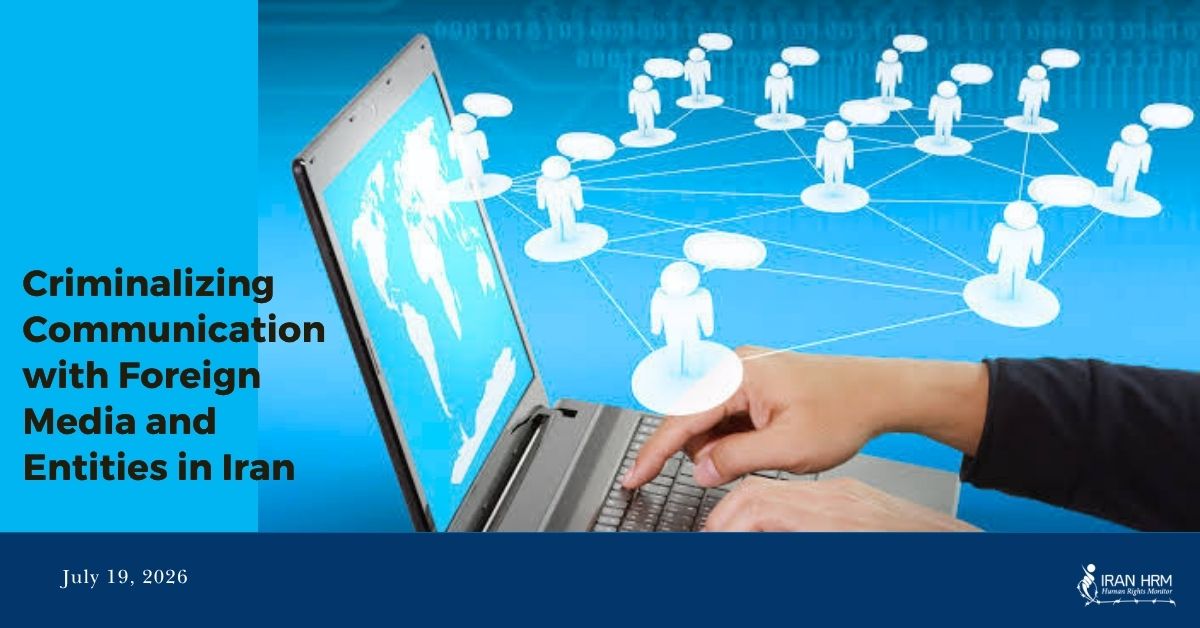
This report examines a bill whose general outlines have been passed by the Iranian Parliament, with the declared objective of “countering the influence of foreign intelligence services, foreign governments, or foreign entities.” Based on information published in domestic media, the bill encompasses the criminalization of contact with foreign media, restrictions on academic and scientific cooperation with overseas institutions, and severe penalties for various forms of communication and collaboration with foreign entities.

Focusing on the impact of this bill on freedom of expression, freedom of the media, freedom of association, and other fundamental rights, this report aims to provide a clear analysis of its potential consequences and evaluates it in light of Iran’s international obligations.
Background and Contents of the Bill
Approval of General Outlines in Parliament
On August 16, 2026, the Islamic Consultative Assembly (Iranian Parliament) approved the general outlines of the “Foreign Influence Counteraction Bill” with 183 votes in favor. Although the bill must still go through procedural article-by-article reviews and Guardian Council approval, the rapid passage of its general principles reflects the regime’s definitive commitment to institutionalizing structural repression and completely severing information flows. Highlighting this legislative stage is not intended to appeal to a regime that systematically dismisses public opinion and escalates violence, but rather to urgently alert the international community, impose immediate diplomatic costs, and counter any normalization of a government that officially criminalizes freedom of expression.
Criminalization of Contact with “Hostile” Media
Under the provisions of the bill, conducting interviews, participating in discussions, appearing on programs, or engaging in any form of communication with media outlets categorized as “hostile” or “subversive” is designated as a crime. American and Israeli media, alongside entities funded by these governments, are explicitly identified as hostile outlets. Engaging in communication with such platforms carries a penalty of Grade 6 imprisonment (ranging from more than six months to two years).
Mandatory Reporting to Security Entities for Other Foreign Media
According to the text of the bill, communicating with any other foreign media without prior notification to the Ministry of Intelligence is prohibited. Citizens and media workers are required to register any planned interview or interaction with foreign media on a designated portal created by the Ministry of Intelligence prior to the engagement; failure to register this communication may also result in imprisonment.
Restrictions on Communication with Foreign Embassies and Entities
The bill imposes strict limitations on interaction with foreign embassies, organizational offices, and non-Iranian entities. Any contact extending beyond routine administrative matters (such as civil registry or vital statistics affairs) must be conducted with the prior notification and written authorization of the Ministry of Foreign Affairs; otherwise, individuals face imprisonment and the deprivation of certain social rights.
Forced Isolation and Suppression of Scientific and Cultural Cooperation (Articles 5, 14, and 15)
In the scientific domain, the Ministry of Intelligence is mandated to publish an annual list of authorized non-Iranian institutions; any scientific collaboration, acceptance of scholarships, attendance at conferences, or transmission of research specimens outside this approved list is criminalized (Article 5). In the cultural and artistic sectors, any production of films, theater, music, or books deemed by security agents to “portray a dark image of Iran” or “question religious principles” will subject the creator to heavy financial fines, permanent bans from government services, and prohibition from artistic production (Article 14). Organizing or participating in domestic or international training workshops and educational courses linked to international entities is also penalized with imprisonment (Article 15).
Severe Penalties for “Policy Proposals Under Foreign Influence”
Another section of the bill prescribes extraordinarily severe penalties—up to 30 years of imprisonment—for policy, legislative, or executive proposals that are submitted under the “oversight, guidance, training, or direction of foreign intelligence services, foreign governments, international organizations, non-Iranian groups/institutions, the People’s Mujahedin Organization of Iran (PMOI/MEK), other terrorist groups, or misguided/deviant sects that visibly conflict with the foundations of the Islamic Revolution, Ayatollah Khomeini, or the Supreme Leader,” provided these proposals harm national security, independence, territorial integrity, or public trust. Jurisdiction over cases arising from this law is assigned to the Revolutionary Courts, with the Ministry of Intelligence and the IRGC Intelligence Organization designated as the legal judicial authorities (officers). Through vague and elastic definitions, this article criminalizes critical analysis, diagnostic research, and reform proposals by experts and civil society members, granting security agencies full discretion to suppress dissent.
Legal Assessment Under Domestic Law Framework
Principle of Legality of Crimes and Punishments
In criminal law, the principle of legality requires that criminal behavior be defined with precision and clarity. In this bill, terms such as “hostile media,” “critical conditions,” “communication,” “media activity outside the country,” and “under the oversight of foreign intelligence services” are employed in a broad and ambiguous manner. This ambiguity permits sweeping, arbitrary interpretations that directly violate the principles of legal clarity and certainty.
Proportionality of Offences and Penalties
The mere criminalization of conducting an interview or transmitting general information to foreign media—and assigning prison sentences to such acts—is disproportionately severe. Furthermore, establishing sentences of up to 30 years in prison for broad categories of collaboration or policy proposals without narrow legal definitions leads to disproportionate and unwarranted punishments.
Centralization of Proceedings in Revolutionary Courts
Referring these cases to the Revolutionary Courts and designating intelligence agencies as the primary judicial officers removes these matters from ordinary judicial channels and places them within an intelligence-security apparatus. This structure severely compromises judicial independence, the right to a fair trial, and access to an effective legal defense.
Assessment Under International Obligations and Human Rights Standards
Freedom of Expression and Access to Information
Under international human rights standards, including the International Covenant on Civil and Political Rights (ICCPR), freedom of expression encompasses the right to seek, receive, and impart information and ideas of all kinds, without interference and regardless of frontiers. Criminalizing contact with foreign media—especially those labeled “hostile”—and threatening imprisonment for sending photos, videos, audio, or data directly violates this fundamental right.
Direct Violation of Freedom of Expression and Access to Information (Articles 19 and 22 ICCPR)
This legislation exposes journalists, analysts, civil society activists, and ordinary citizens who converse with foreign media to severe criminal prosecution. Such restrictions contradict the principle of protecting journalists and news sources, undermine the essential role of the media in monitoring power and informing the public, and lead to the silencing of independent and critical voices. Under international human rights law—specifically Article 19 of the ICCPR, to which Iran has been a state party without reservations since 1975—the right to freedom of expression includes the freedom to seek, receive, and impart information across all borders. Criminalizing interviews, transmitting photos or data abroad, and requiring security permits for media and academic interactions constitute a flagrant violation of Article 19. Additionally, restricting non-governmental organizations (NGOs) and associations from receiving international support or collaboration (Article 4) directly violates the freedom of association protected under Article 22 of the ICCPR.
Freedom of Association and Scientific/Cultural Cooperation
Restricting scientific and academic cooperation strictly to institutions on an approved list, alongside criminalizing specific cultural and educational activities, encroaches upon the right to freedom of association, the right to education, and the right to participate in cultural life. These restrictions threaten to disrupt medical, scientific, and cultural exchanges, causing severe intellectual isolation.
Chilling Effect and Self-Censorship
Even prior to the final passage of every individual article, the publication of the bill and the approval of its general principles exert a severe deterrent effect on citizen behavior. Out of fear of prosecution, many individuals will proactively abstain from any interaction with foreign media and international entities. This “chilling effect” remains one of the most damaging consequences of vague and draconian legislation targeting freedom of expression.
Political and Social Consequences
–Exacerbation of Information and Media Isolation The implementation of this bill threatens to strictly restrict citizens’ access to independent and diverse information sources, effectively severing connections between Iranian society and global public opinion. This environment significantly increases the risk of state-controlled, one-sided narratives taking hold while eliminating avenues for policy critique and reform.
–Weakening of Civil Society and the Public Sphere By placing civil society activists, journalists, academics, and artists under constant threat of criminal prosecution for interacting with foreign entities, civil society is severely undermined, driving the public sphere toward silence and self-censorship. This trajectory erodes public participation in political and social life and degrades societal trust.
Conclusion and essential Actions by International Bodies
In its current form, the “Foreign Influence Counteraction Bill” extends far beyond countering espionage or intelligence activities; it systematically criminalizes a wide spectrum of routine, lawful actions by ordinary citizens, journalists, researchers, and civil society advocates. Vague legal definitions, draconian penalties, the dominant role assigned to security apparatuses, and the centralization of judicial proceedings within Revolutionary Courts turn this legislation into a potent tool for extinguishing freedom of expression, media freedom, freedom of association, and academic collaboration. Its execution will lead to acute information isolation, pervasive self-censorship, and the neutralization of civil society.
Actionable Steps Expected from International Bodies
Practical and concrete measures to be taken by international organizations to counter the Islamic Republic of Iran’s overt assault on freedom of expression and the imposition of self-censorship include:
1) Systematic Documentation and Official Recording
It is essential that the international bodies:
- Document and log the systemic impacts of this bill on freedom of expression, the media, academic freedom, and civil society;
- Reflect cases of detention, threats, summonses, or convictions resulting from this law within periodic reporting mechanisms;
- Utilize existing human rights monitoring frameworks to ensure violations are tracked and actionable internationally.
2) Activation of Monitoring and Reporting Mechanisms
It is essential that the international bodies:
- Evaluate this bill against Iran’s binding international treaty obligations;
- Explicitly highlight the law in official mandates as a restrictive instrument infringing upon freedom of expression;
- Engage international oversight mechanisms to demand formal explanations regarding the legal rationale, necessity, and proportionality of these provisions.
3) Practical Support for Journalists, Researchers, and Civil Society Activists
Concrete action includes:
- Establishing secure communication channels for journalists and researchers inside Iran;
- Offering legal assistance and documentation support for individuals targeted due to connections with foreign media or entities;
- Strengthening capacity-building initiatives focused on media freedom and digital security for at-risk individuals.
4) Assessment of Impact on Scientific, Cultural, and Educational Cooperation
It is essential that the international bodies:
- Conduct specialized evaluations regarding the bill’s impact on higher education and scientific exchanges;
- Feature the consequences of academic restrictions in specialized reports on the right to education and academic freedom;
- Deploy existing protection mechanisms to assist affected scholars, researchers, and students.
5) Pursuing International Accountability Frameworks
Possible actions involve:
- Leveraging existing international legal mechanisms to hold state actors accountable to their human rights obligations;
- Raising this legislation in international forums as an instrument violating fundamental rights;
- Requesting independent international assessments regarding the necessity and proportionality of these legal restrictions.
6) Enhancing Global Access to Information Regarding Freedom of Expression in Iran
This includes:
- Publishing public and specialized analytical reports detailing the ramifications of the bill;
- Producing authoritative legal analyses accessible to scholars, media outlets, and civil society organizations;
- Developing multilingual resources to raise global awareness regarding the systemic impacts of this law.
References / Sources Cited in Report:
- Eghtesad News: Details of the New Parliamentary Approval / 6 Months to 2 Years Imprisonment for Interviewing U.S. Media / Interviews with Foreign Media Conditional on Notification to Ministry of Intelligence.
- Shargh Daily (Telegram Channel): Announcement by Abbas Goudarzi, Spokesperson for the Presiding Board of Parliament, regarding the approval of the general outlines of the Foreign Influence Counteraction Bill.