Arrests, Executions and Life-Threatening Prison Conditions
World Humanitarian Day is observed each year on 19 August in memory of the 22 humanitarian workers killed in the 19 August 2003 attack on the United Nations headquarters at the Canal Hotel in Baghdad. The occasion underscores the need to protect civilians and humanitarian personnel, and to uphold human dignity in armed conflicts and other emergencies. (United Nations and Office for the Coordination of Humanitarian Affairs, official World Humanitarian Day page)

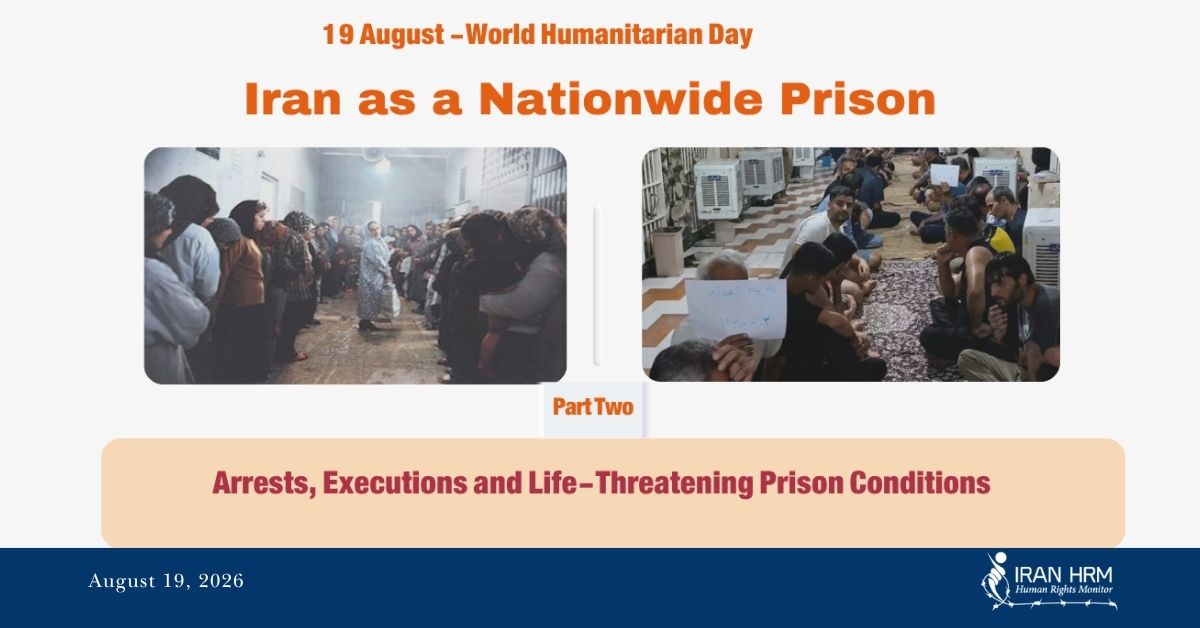
In Iran, the protection of civilians also extends to the doors of detention centres and prisons. The United Nations Human Rights Office reported that, since 19 March 2026, at least 56 people had been executed on national-security-related charges and more than 100 others were at risk of execution. The Office also estimated that more than 4,000 people had been arrested since 28 February. Verified information from Ward 5 of Greater Tehran Prison further indicates that approximately 400 prisoners are being held in a hall equipped with 240 beds. This report examines arrests, death sentences, prison conditions and international positions. (OHCHR, 29 April and 5 August 2026; information received, 12 August 2026)
Expansion of Arrests
On 23 January, the United Nations Fact-Finding Mission referred to reports of more than 24,000 arrests during the winter protests. On 29 April, the United Nations Human Rights Office subsequently estimated that more than 4,000 additional people had been arrested since 28 February on national-security-related charges. According to the Office, some detainees had been subjected to enforced disappearance, torture or ill-treatment, forced and sometimes televised confessions, and mock executions. Members of ethnic and religious minorities were at particular risk.
Verified information covering 1 to 7 August 2026 documented more than 40 cases of group arrests or continued detention without resolution in Kerman, Marivan, Khash, Ahvaz and Taftan. Specific reported cases included the arrest of 21 citizens in Kerman Province and six Kurdish citizens in the village of Ni, near Marivan; the continued detention of seven Sunni seminarians in Khash, eight members of the Shahbakhsh family in Taftan, and four citizens in Ahvaz. Between 8 and 14 August, at least 26 arrests or security-related summonses were also recorded, while 159 detainees remained in an unresolved situation in Yazd Prison. Because the second-period figure combines arrests and summonses, and the Yazd figure represents the population held at one prison, these data should not be added to one another or to United Nations estimates.
“In times of war, threats to human rights increase exponentially. Yet even where national security is at stake, human rights may be restricted only where strictly necessary, proportionate and in pursuit of a legitimate aim. Fundamental rights, including protection from arbitrary detention and the right to a fair trial, must be fully respected at all times.”
Volker Türk, United Nations High Commissioner for Human Rights, 29 April 2026, OHCHR
Death Sentences and Executions
A. The Case of 12 Protesters in Isfahan
On 5 August, the United Nations Human Rights Office stated that at least 56 people had been executed since 19 March on national-security-related charges, including 27 in cases connected to the protests that began earlier in the year. More than 100 others faced the risk of execution on similar charges. According to the Office, drug-related executions were also continuing at an ‘alarming’ rate. These figures are disaggregated by subject and should not be treated as the total number of all executions in the country.
A principal example is the case of 12 young men arrested in connection with the 8 January protests in Alikhani Square, Isfahan. United Nations experts reported that the death sentences were imposed following a three-hour mass trial held behind closed doors. The individual responsibility of each defendant was not established, and confessions broadcast on State television were reportedly obtained under pressure. The judiciary accused the men of involvement in the deaths of four officers and of destruction of property. These allegations are recorded here as the official position and not as independently established facts.
“Sentencing 12 people to death in a single session, in a closed court, and without establishing the individual responsibility of each defendant violates recognised standards of fair trial.”
United Nations independent experts, 27 July 2026, OHCHR
The judiciary confirmed the executions of Erfan Esfandiyari and Gol-Mohammad Mohammadi on 19 July, followed by the executions of Abolfazl Sepahi Badjani and Amirhossein Safari Hosseinabadi on 28 July. As of the final review date of this report, four defendants in the case had therefore been executed and the remaining eight continued to face death sentences. No decision quashing the outstanding sentences was located in the official sources reviewed. (Mizan, 19 and 28 July 2026; OHCHR, 27 July and 5 August 2026)
“I am alarmed by the increase in executions and death sentences imposed since March. The death penalty continues to be used to instil fear among the population and suppress dissent.”
Volker Türk, United Nations High Commissioner for Human Rights, 5 August 2026, OHCHR
B. At Least 27 Executions Recorded in the First Two Weeks of August
Verified information indicates that at least 17 people were executed in Iranian prisons between 1 and 7 August, and at least 10 more between 8 and 14 August, bringing the total to at least 27 executions over two weeks. This periodic count may overlap with the United Nations Human Rights Office’s thematic figures for executions on national-security-related charges and is not to be added to them.
Among those executed in the first week was Arvin Kheirkhahan, a 19-year-old protester who was put to death in Shahroud Prison on the official charge of moharebeh, or ‘enmity against God’. Farzad Sobhani was also executed in Urmia Prison. According to the case information, he was under 18 at the time of the alleged offence. In the second week, Marzieh Niri, a 24-year-old woman and a victim of child marriage, was executed in Qazvin Prison. During the same period, Mehdi, also known as Sikan, Roshani, who had been arrested during the January protests, was sentenced to death, and the Supreme Court upheld the death sentence against Rasoul Rezaei, another detainee from the same protests. These cases underscore the need for immediate publication of the judgments, identification of the court branches concerned, disclosure of access to legal counsel, and clarification of the basis on which individual responsibility was established.
Prisons in Life-Threatening Heat
A. Ward 5 of Greater Tehran Prison: 400 Prisoners for 240 Beds
According to verified information received on 12 August 2026, each hall in Ward 5 of Greater Tehran Prison contains 16 rooms with 15 beds each, providing a total of 240 beds, while the population of each hall is reported to be approximately 400. Around 160 people are held beyond bed capacity, and some sleep in corridors and in the prison’s communal religious hall, or hosseiniyeh. The ratio indicates approximate occupancy of 167 per cent when measured against the number of beds.
The water in this ward has been described as saline and unsuitable. Prisoners must purchase bottled water at their own expense for drinking and making tea. Sources have reported skin and fungal diseases, inadequate food, and bread associated with gastrointestinal problems. Prisoners sometimes wait three to four months for an in-person visit, while families face prolonged delays and inappropriate treatment on visiting days. These accounts concern the current conditions in Ward 5. No specific response from the Prisons Organisation to these matters was located in the public sources reviewed up to 16 August.
B. Ward 7 of Evin Prison: Sanitation, Scabies and Failure to Separate Prisoners
Verified information dated 17 July 2026 describes broken showers in Ward 7 of Evin Prison, shortages of cleaning and disinfecting materials, and an increase in skin diseases. People with scabies have reportedly been transferred to the ward without effective quarantine, while political prisoners are held alongside some people imprisoned for financial offences and foreign nationals. These reports require independent medical inspection and the publication of official data on infection, screening and treatment.
C. Unit 2 of Qezel Hesar: Hunger Strike Against Executions and Restrictions on Communication
According to verified information, a large-scale hunger strike in Unit 2 of Qezel Hesar Prison continued from 13 to 28 July 2026, after six prisoners sentenced to death were transferred to solitary confinement. Communication-jamming devices reportedly remained active after the strike ended. A number of prisoners complained of headaches and neurological discomfort. A causal relationship between these symptoms and the equipment cannot, however, be confirmed without an independent technical and medical assessment.
D. Findings of the Fact-Finding Mission on Qarchak Prison
The conference-room paper of the United Nations Fact-Finding Mission, published on 13 March 2026, described conditions in Qarchak Prison as involving overcrowding, unsanitary cells, dirt and insects, poor ventilation, extreme heat, and inadequate access to safe water and food. These findings are independent of the current information from Greater Tehran and Evin prisons, but indicate that problems involving water, ventilation, overcrowding and sanitation are not confined to one prison or one isolated report. (A/HRC/61/CRP.2, 13 March 2026)
“Detention conditions in Iran’s prisons are dire. Detainees suffer from severe overcrowding and acute shortages of food, water, hygiene supplies and medicine, and are denied medical care.”
Volker Türk, United Nations High Commissioner for Human Rights, 29 April 2026, OHCHR
E. Guard Violence and Denial of Medical Care in August
Between 1 and 7 August, guards at Evin Prison raided Ward 7 and severely beat Amirhossein Moradi, Ehsan Rostami and Afshin Rangriz. All three prisoners were transferred while injured to an unknown location. Given the lack of information about their place of detention and medical condition, the authorities must immediately inform their families and lawyers of the place to which they were transferred, their physical condition and the legal basis for the measure.
Between 8 and 14 August, Taktam Ramezani, aged 37, died after a ruptured gallbladder and a four-day delay in her transfer from Vakilabad Prison in Mashhad to hospital. The death of Nosrat Khaledi during the same period was also reported in connection with denial of essential medical services. Kamran, also known as Yehuda, Hekmati, a prisoner with cancer, was returned to Evin before completing necessary chemotherapy, while Javad Alikordi, a lawyer, was reported to have suffered serious physical harm after four months in solitary confinement. These cases require an independent investigation into any link between decisions or delays by prison officials and the injury or death of prisoners.
Families as Victims Outside Prison
In death penalty cases, lack of information about the place of detention, transfers to solitary confinement and the absence of transparent notice concerning the timing of executions place families under continuous anxiety. In the case of the 12 Isfahan protesters, four executions were carried out between 19 and 28 July despite warnings by United Nations experts about the mass and closed nature of the trial. The human consequences of such proceedings extend beyond the condemned person and affect the family’s rights to information, visits and a final farewell.
The Government’s Judicial and Political Response
A. Judicial Position on Arrests and Executions
“Our reviews show that 90 per cent of those arrested in the recent incidents have no criminal record.”
Ali Mozafari, Deputy for Judicial Affairs of the Judiciary, 10 February 2026; published by IRNA and domestic media
This official statement indicates that a large majority of those arrested had no criminal record, contrary to some security narratives. At the same time, however, the judiciary has emphasised the acceleration of proceedings.
“People expect us to expedite proceedings in the cases of the main elements of the disturbances, and this is a legitimate demand.”
Gholamhossein Mohseni Ejei, Head of the Judiciary, 16 February 2026; IRNA, 17 February 2026
At the Human Rights Council special session on 23 January, Ali Bahreini, the representative of the Islamic Republic of Iran in Geneva, stated that Iran recognised the right to peaceful protest, but alleged that the events of 8 to 10 January had developed into ‘organised violence’. He described the session and resolution as ‘merely a tool for exerting pressure on Iran’. These official claims, including the accusations made against the Isfahan defendants, cannot be accepted as established facts without publication of the full judgments and case files and the possibility of independent scrutiny.
B. Response to Overcrowding and Prison Conditions
On 28 January 2026, prison officials announced that 274 Qezel Hesar prisoners had been placed under electronic monitoring outside prison as a measure to reduce the prison population. This measure, however, does not specifically address current reports concerning Ward 5 of Greater Tehran Prison, Ward 7 of Evin Prison or Unit 2 of Qezel Hesar. As of 16 August 2026, the public sources reviewed contained no specific official explanation regarding hall capacity, drinking water, ventilation, the spread of disease, compulsory purchase of essential items, or waiting periods for visits at these three locations.
C. Response to the Joint International Statement
Abbas Araghchi, Minister for Foreign Affairs of the Islamic Republic of Iran, rejected international condemnation of the executions and, in response to the joint position of 32 countries and the European Union High Representative, accused critical States of applying double standards.
“Countries like France must stop lecturing the world about ‘human rights’ and international law.”
Abbas Araghchi, Minister for Foreign Affairs of the Islamic Republic of Iran, 13 August 2026; statement posted on X
International Positions
A. Positions of United Nations Bodies
“In the wake of the recent shocking events in Iran, the priority now must be to gather evidence and determine whether human rights violations and international crimes, including crimes against humanity, have been committed.”
Sara Hossain, Chair of the Independent International Fact-Finding Mission on Iran, 23 January 2026, United Nations Human Rights Council
On the same day, the Human Rights Council extended the mandate of the Fact-Finding Mission for two years and that of the Special Rapporteur for one year. On 29 April, the High Commissioner for Human Rights called for an end to executions, the establishment of a moratorium on the death penalty, guarantees of fair trial and the release of those arbitrarily detained. On 27 July, United Nations experts called for the death sentences against the 12 Isfahan protesters to be quashed and stressed: ‘Confessions obtained under duress should never be admitted as evidence, and broadcasting them before trial violates the presumption of innocence.’
B. Joint Position of 32 Countries and the European Union
On 12 August 2026, the European Union High Representative for Foreign Affairs and 32 countries, including Albania, Australia, Canada, France, Germany, New Zealand, Norway, Sweden and the United Kingdom, issued a joint statement condemning ‘in the strongest terms’ the execution of protesters and Iran’s continued use of the death penalty. The signatories called for an immediate halt to executions and the release of all those arbitrarily detained.
“The use of the death penalty to silence dissent, intimidate communities and punish individuals for exercising their human rights can never be justified. The people of Iran must be able to exercise their rights to freedom of expression and peaceful assembly without fear.”
Joint statement by 32 countries and the European Union High Representative, 12 August 2026
In a message issued at the same time, Jean-Noël Barrot, Minister for Europe and Foreign Affairs of France, wrote that seven months after widespread violations against people who had risen for justice and dignity, the authorities continued the bloodshed through increased executions. Unlike reports or statements by non-governmental organisations, this international position constitutes the official position of the signatory Governments and the European Union High Representative.
C. NGO Written Statement at the Sixty-First Session
On 9 March 2026, 11 non-governmental organisations in consultative status with the Economic and Social Council submitted joint written statement A/HRC/61/NGO/412 for consideration under agenda item 4 of the sixty-first session of the Human Rights Council. The document warned of the risk of execution facing political prisoners, accelerated and non-transparent proceedings, denial of access to legal counsel and the use of forced confessions. It addressed, among others, the situations of Zahra Tabari, Ehsan Faridi and Mohammad Javad Vafaei-Sani.
The statement called for an end to executions, support for the Fact-Finding Mission and the Special Rapporteur, preservation of evidence, prevention of the destruction of possible burial sites, and use of accountability mechanisms, including universal jurisdiction. Submission and circulation of the document within the Human Rights Council framework does not mean that the Council adopted its content or independently verified all its figures. This distinction is necessary for accurate attribution of positions.
Applicable Legal Standards
Articles 6, 7, 9, 10, 14, 19 and 21 of the International Covenant on Civil and Political Rights protect the right to life, the prohibition of torture, freedom from arbitrary detention, humane treatment of persons deprived of liberty, the right to a fair trial, and the freedoms of expression and peaceful assembly. In countries that have not yet abolished the death penalty, its use must be restricted to the ‘most serious crimes’. The Human Rights Committee has interpreted this expression as referring to crimes involving intentional killing that result in death. The imposition or execution of a death sentence following a closed mass trial, reliance on a forced confession, or denial of access to counsel of choice creates a risk of arbitrary deprivation of life.
The Nelson Mandela Rules also place direct responsibility for prisoners’ care on the State. Rules 13, 18, 22 and 24 require appropriate climatic conditions and ventilation, water and sanitation, drinking water whenever needed, and health-care services equivalent to those available in the community. Holding approximately 400 people for 240 beds, making access to drinking water dependent on ability to pay, and allowing communicable diseases to spread without effective quarantine would, if confirmed by independent inspection, be incompatible with these standards.
Conclusion and Proposed Immediate Measures
The evidence in this report reveals a traceable chain of events: mass arrests and families left without information; closed and accelerated proceedings; the risk and implementation of death sentences; and the transfer of new detainees into prisons already affected by shortages of beds, safe water, ventilation, sanitation and medical care. The positions of the United Nations, 32 countries and the European Union High Representative also emphasise an end to executions, the release of those arbitrarily detained, fair trials and accountability. On World Humanitarian Day, deprivation of liberty must not become deprivation of the rights to life, health and dignity.
- All executions should be halted immediately, death sentences imposed through proceedings lacking fair-trial guarantees should be quashed, and a formal moratorium on the death penalty should be established.
- The names, places of detention and legal status of all detainees should be disclosed, and their immediate access to counsel of choice, their families and independent medical care should be guaranteed.
- The Prisons Organisation should publish data on prison capacity, population, illness and deaths, and permit independent inspections of Greater Tehran, Evin, Qezel Hesar and Qarchak prisons.
- Safe water, ventilation, sleeping space, adequate food, hygiene products and medical care should be provided immediately, without making access dependent on the financial means of the prisoner or the prisoner’s family.
- Evidence relating to arrest, torture, enforced disappearance, death in custody and execution should be preserved, and independent United Nations mechanisms should be granted access to information and places of detention.
Selected Public Sources
The institution and date appear immediately after the relevant claim or quotation in the report. The list below is provided to facilitate retrieval of the original document or the nearest reliable public version. Internally verified information has been included without naming or publicly linking to the source in order to protect it.
- United Nations, official World Humanitarian Day page, accessed August 2026. Direct link
- OHCHR, ‘Iran: After unprecedented violence, priority must be on gathering evidence’, 23 January 2026. Direct link
- United Nations Human Rights Council, special session meeting summary on Iran, 23 January 2026. Direct link
- IRNA, remarks by Ali Mozafari on the criminal records of detainees, 10 February 2026. Direct link
- IRNA, remarks by the Head of the Judiciary in Isfahan, 17 February 2026. Direct link
- OHCHR, detailed report of the Fact-Finding Mission, A/HRC/61/CRP.2, 13 March 2026. Direct link
- OHCHR, ‘Iran: Türk deplores crackdown on dissent’, 29 April 2026. Direct link
- OHCHR, ‘UN experts urge Iran to quash death sentences of 12 protesters’, 27 July 2026. Direct link
- Mizan, confirmation of the executions of Erfan Esfandiyari and Gol-Mohammad Mohammadi, 19 July 2026. Direct link
- Mizan, confirmation of the executions of Abolfazl Sepahi Badjani and Amirhossein Safari Hosseinabadi, 28 July 2026. Direct link
- OHCHR, ‘Iran: Türk says executions used to instil fear, suppress dissent’, 5 August 2026. Direct link
- Government Offices of Sweden, joint statement on executions in Iran, 12 August 2026. Direct link
- Human Rights Council, joint NGO written statement, A/HRC/61/NGO/412, 9 March 2026. Direct link
- IRNA, electronic monitoring implemented for 274 prisoners at Qezel Hesar, 28 January 2026. Direct link
- United Nations Standard Minimum Rules for the Treatment of Prisoners, the Nelson Mandela Rules, 17 December 2015. Direct link
- OHCHR, International Covenant on Civil and Political Rights, 16 December 1966. Direct link