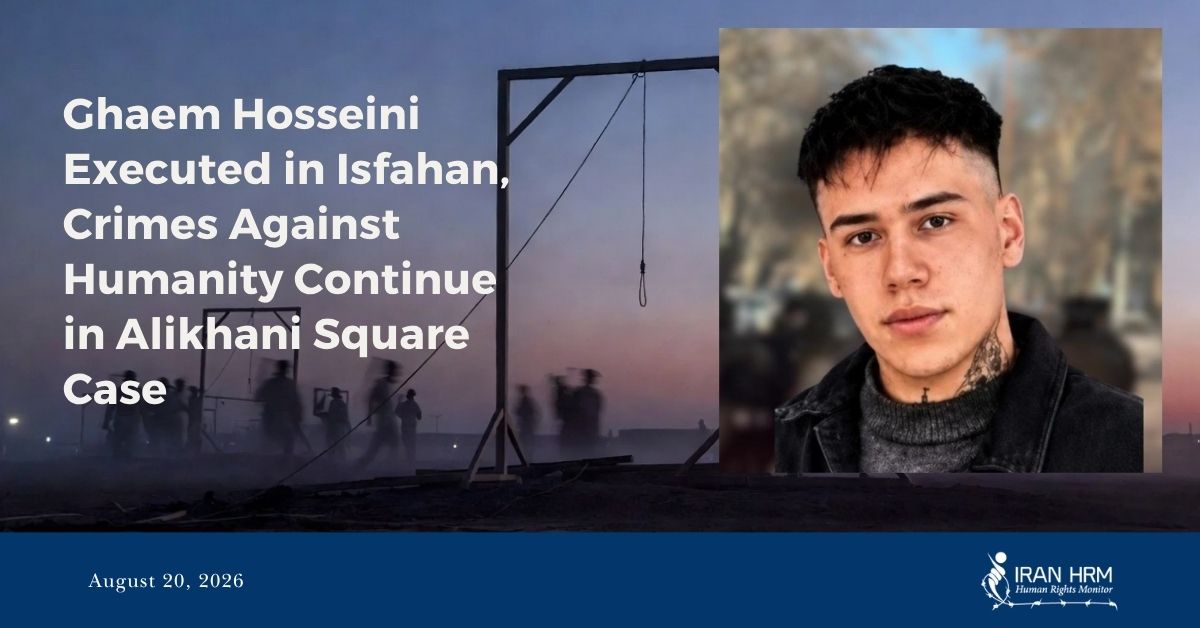
On the morning of Thursday, August 20, 2026, the government of the Islamic Republic of Iran hanged Ghaem Hosseini—the fifth detained protester in the “Alikhani Square” case—in Isfahan’s Dastgerd Prison. This execution took place in blatant defiance of international condemnations and repeated calls to halt political executions and the killing of protesters in Iran.

This execution was carried out despite a direct appeal on Tuesday, July 28, 2026, by Ms. Mai Sato, the UN Special Rapporteur on the situation of human rights in Iran following the public execution of two other defendants in the same case—Amirhossein Safari and Abolfazl Sepahi, who were hanged that morning in Isfahan’s Alikhani Square. Ms. Sato urged the Islamic Republic to halt all death sentences, explicitly describing public executions as an instance of “cruel, inhuman and degrading treatment.” Furthermore, on August 12, 2026, 32 countries—including France, the United Kingdom, and Canada—alongside the EU High Representative for Foreign Affairs, issued the strongest possible condemnation of the ongoing executions of protesters and the use of the death penalty in Iran.
Prior to this, four other detained protesters in this case—Erfan Esfandiari, Gol-Mohammad Mohammadi, Amirhossein Safari, and Abolfazl Sepahi—had been hanged.
 (Photo from right to left: Amirhossein Safari, Abolfazl Sepahi, Erfan Esfandiari, and Gol-Mohammad Mohammadi)
The Case of Detained Protester, Ghaem Hosseini
Ghaem Hosseini was among those arrested in connection with the nationwide protests of January 2026 in Isfahan. His name was on the list of 12 defendants sentenced to death in the Alikhani Square case.
On July 28, reports indicated that Ghaem Hosseini’s family, along with the families of Amirhossein Maleki and Ali Dashti (two other protesters sentenced to death in this case), were summoned to the prison for a final visit. Despite protests from the families and warnings from human rights organizations, Ghaem’s sentence was carried out at dawn on Thursday, August 20, in Dastgerd Prison.
 The prosecutor in the case was Mohammad Nakhjavan, and judicial proceedings were conducted by Mohammad Barati-Dorcheh and Mohammad-Reza Tavakoli. Like other detained protesters in this case, Ghaem Hosseini was deprived of the right to choose an independent lawyer during the preliminary stage and was tried with court-appointed lawyers handpicked by the Judiciary of the Islamic Republic. Even these lawyers were not granted full access to the complete case file. His trial, like those of other individuals sentenced to death in this case, took place in a single closed session. The non-publication of the details of the role attributed to Ghaem Hosseini in the events of Alikhani Square, the evidence supporting the charge, and the text of the issued verdict highlight numerous legal ambiguities in this case.
Only the Student News Network (SNN), in announcing this execution under the headline “Execution of the death sentence of the foreign national involved in the crime at Isfahan’s Alikhani Square was carried out,” (https://snn.ir/fa/news/1443943/ ) wrote that he, “Ghaem Hosseini, son of Arab-Ali, known as ‘Arian’ and a foreign national… had an active presence at the scene of the martyrdom of law enforcement officers and kicked the bodies of the martyrs.” An execution sentence passed simply for being present at the scene and kicking?!
Iranian Judicial Laws Violated in the Case of Ghaem Hosseini:
- Article 35 of the Constitution: Right to legal counsel;
- Article 37 of the Constitution: Presumption of innocence;
- Article 38 of the Constitution: Prohibition of torture and invalidity of forced confessions;
- Article 39 of the Constitution: Prohibition of the defamation and mistreatment of detainees;
- Article 165 of the Constitution: Principle of public trials;
- Article 190 of the Code of Criminal Procedure: Right to be accompanied by a lawyer during preliminary investigations;
- Articles 348 and 350 of the Code of Criminal Procedure: Mandatory presence of a lawyer in cases involving the death penalty.
International Laws Violated in the Case of Ghaem Hosseini Include:
- Article 3 of the Universal Declaration of Human Rights: Right to life;
- Article 5 of the Universal Declaration of Human Rights: Prohibition of torture and inhuman treatment;
- Articles 10 and 11 of the Universal Declaration of Human Rights: Right to a fair trial and presumption of innocence;
- Article 6 of the International Covenant on Civil and Political Rights: Protection of the right to life;
- Article 7 of the International Covenant on Civil and Political Rights: Prohibition of torture;
- Article 14 of the International Covenant on Civil and Political Rights: Right to a fair trial, legal representation, and effective defense.
Preventing the Continuation of Crimes Against Humanity; This is the Duty of the International Community
Silence is a license for the continuation of this killing machine. The execution machinery of the Islamic Republic will not be stopped by verbal condemnations alone. It is essential that the international community, the United Nations, and governments committed to human rights move beyond expressions of concern and take immediate, concrete action.
As citizens, activists, and human rights organizations, we also have a duty to be the voice of the voiceless; by continuous exposure, seeking justice in international forums, and placing pressure on our respective governments, we must raise the political cost of executions especially the execution of political prisoners and detained protesters for the Iranian government.
Every single day of delay in taking concrete action will cost the lives of more protesters. Act today; before another noose tightens around the neck of another protester.