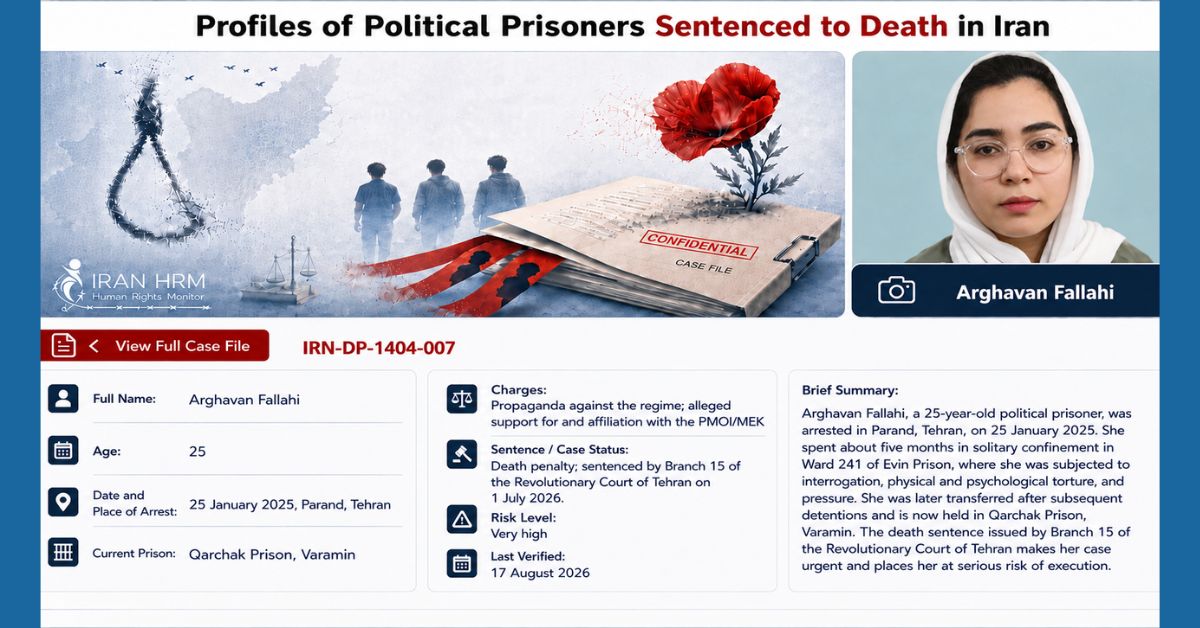
Cases of Political Prisoners Sentenced to Death in Iran
Case No. 7 | Case ID: IRN-DP-1404-007 | Last reviewed: 17 August 2026

| Arghavan Fallahi, a 25-year-old political prisoner, was arrested in Parand Township on 25 January 2025 and transferred to Ward 209 of Evin Prison. She was held for months in solitary confinement and, according to credible information, subjected to intensive interrogations and physical and psychological torture. Branch 15 of the Tehran Revolutionary Court, presided over by Judge Abolghasem Salavati, sentenced her to death, and the sentence was communicated through her lawyer on 1 July 2026. Reports of torture and restrictions on access to her family and lawyer raise serious concerns regarding her right to life and fair-trial guarantees. |
Key Case Information
| Category | Information |
| Full name | Arghavan Fallahi |
| Date of birth | Iranian calendar year 1379 (March 2000–March 2001); exact date unknown |
| Age | 25 |
| Occupation before arrest | Unknown |
| Family status | Father: Nasrollah Fallahi; brother: Ardavan Fallahi |
| Date and place of arrest | 25 January 2025; Parand Township, Tehran Province |
| Charges | “Propaganda against the state”; “support for an organisation opposed to the state”; alleged association with the People’s Mojahedin Organisation of Iran |
| Court | Branch 15, Tehran Revolutionary Court |
| Judge | Abolghasem Salavati |
| Lawyer | Name not specified; the death sentence was communicated through a lawyer |
| Sentence | Death; communicated on 1 July 2026 |
| Current place of detention | Qarchak Prison, Varamin |
Human and Personal Background
Arghavan Fallahi, born in Iranian calendar year 1379 (March 2000–March 2001), had been arrested previously. In November 2022, she was arrested with her father, Nasrollah Fallahi, her brother, Ardavan Fallahi, and their family friend, Parvin Mirasan. Branch 26 of the Tehran Revolutionary Court, presided over by Judge Iman Afshari, sentenced Nasrollah Fallahi and Parvin Mirasan to four years’ imprisonment each, Arghavan to two years, and Ardavan to one year. Arghavan was released on bail in March 2024.
Arrest, Interrogation and Sentencing
Arghavan Fallahi was arrested in Parand Township on 25 January 2025 and transferred to Ward 209 of Evin Prison. According to credible information, she was held for months in solitary confinement and subjected to intensive interrogations and physical and psychological torture. Contact with her family and effective access to legal counsel were also severely restricted during this period.
After the evacuation of Evin Prison, Arghavan was transferred to solitary confinement at Fashafouyeh Prison, also known as Greater Tehran Prison, and for a period her whereabouts were unknown to her family. She was later transferred to Qarchak Prison in Varamin. Bail of two billion tomans was set for her temporary release, but she was not released.
Branch 15 of the Tehran Revolutionary Court, presided over by Judge Abolghasem Salavati, sentenced Arghavan Fallahi to death on charges of “propaganda against the state” and “support for an organisation opposed to the state”. The death sentence was communicated to her through her lawyer on 1 July 2026. The full judgment, the evidence relied upon by the court and the precise status of any appeal or judicial review remain unknown.
Message from Nasrollah Fallahi from Prison
Nasrollah Fallahi, Arghavan’s father and himself a political prisoner, said from Ward 2 of Greater Tehran Prison: “Ministry agents arrested her without any evidence or documentation. During this period, they tortured my daughter in order to fabricate a case against her.” He added: “They did not even allow me a short telephone call with my daughter,” and warned about her health: “My Arghavan suffers from severe neurological migraines. Her medication must be available to her.” He ended by asking people to “be the voice of me and my Arghavan”.
Government Response and Conduct
Government conduct in this case has included rearrest, prolonged solitary confinement, intensive interrogation, restrictions on family contact and multiple transfers between detention facilities. Despite bail of two billion tomans being set, Arghavan was not released. No information has been published about an independent investigation into the reported torture or her medical condition.
International Reactions
More than 4,000 political and social figures from 62 countries across five continents have signed a statement calling for the death sentence against Arghavan Fallahi to be quashed and for executions of political prisoners in Iran to be halted.
The signatories include 172 political figures, among them members of national and European parliaments, former officials and ministers, and elected representatives. Academics, lawyers, judges, doctors and human rights advocates have also joined the appeal.
The signatories stressed that no one should be sentenced to death for holding or expressing an opposing political opinion and called on the United Nations, governments and international human rights organisations to act urgently to prevent the execution of Arghavan Fallahi.
Current Status and Risk of Execution
According to the latest available information, Arghavan Fallahi remains under sentence of death in Qarchak Prison, Varamin. The execution date and the precise status of any appeal or judicial review are unclear. Reports of torture, restrictions on contact with her family and lawyer, and her severe neurological migraines raise serious concerns about her health and life.
Human Rights and Fair Trial Analysis
Right to life: Article 6 of the International Covenant on Civil and Political Rights restricts the death penalty to the “most serious crimes”. None of the announced charges against Arghavan Fallahi involves intentional killing; the death sentence therefore raises serious concerns regarding its compatibility with Iran’s international obligations.
Right to a fair trial: Article 14 of the Covenant guarantees effective access to legal counsel and adequate facilities to prepare a defence. Prolonged solitary confinement, the interruption of family contact and restrictions on access to a lawyer raise serious concerns about compliance with these guarantees.
Prohibition of torture: Article 7 of the Covenant absolutely prohibits torture and cruel, inhuman or degrading treatment. Reports of physical and psychological torture and prolonged solitary confinement require an immediate and independent investigation.
Conclusion
Arghavan Fallahi was sentenced to death following rearrest, months of solitary confinement and reported torture. Her father’s message from prison and the appeal by more than 4,000 figures from 62 countries underscore the urgency of the case. The execution must be halted and fair-trial guarantees ensured.
Urgent Appeal
United Nations bodies, governments and international human rights organisations are urged to act immediately to prevent the execution of Arghavan Fallahi.
- Immediately halt any steps towards execution, quash the death sentence and transparently disclose the status of any appeal or judicial review.
- Guarantee immediate and confidential access to counsel of her choice, and publish the judgment, evidence and legal basis for the sentence.
- Conduct an independent investigation into the reported torture and solitary confinement; guarantee medical care and regular family contact; and ensure that any retrial takes place before an independent and impartial tribunal without recourse to the death penalty.