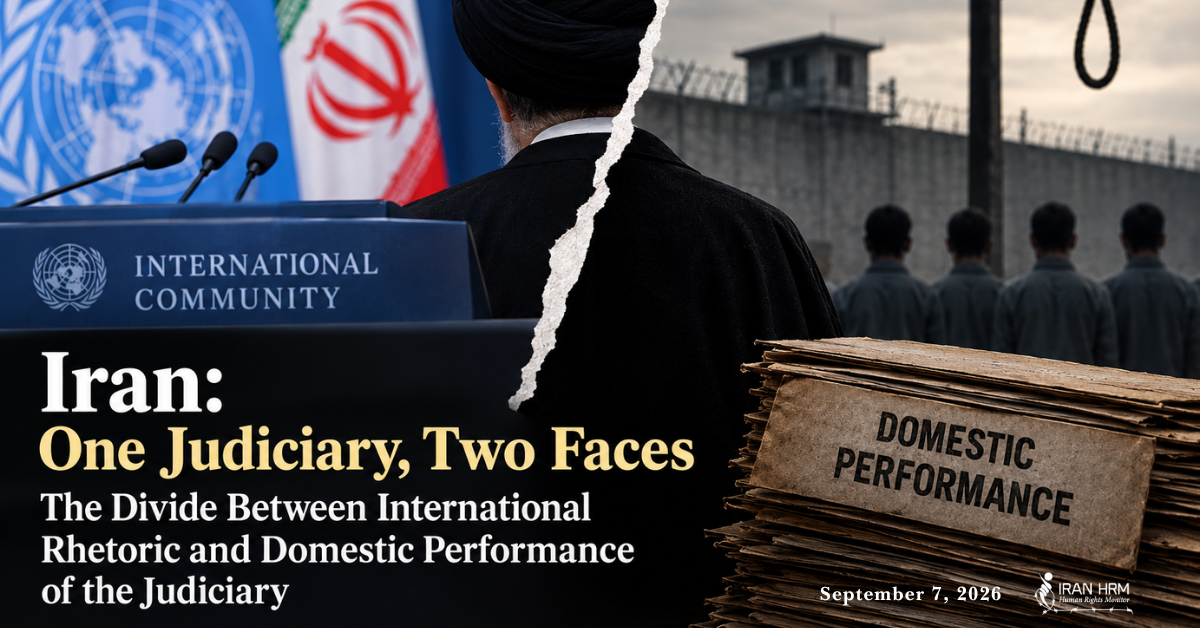
The Attendance of Gholamhossein Mohseni-Eje’i at the BRICS Legal Forum and the Divide Between International Rhetoric and Domestic Performance of the Judiciary of the Islamic Republic of Iran
In early September 2026, Gholamhossein Mohseni-Eje’i, Chief Justice of the Islamic Republic of Iran, attended the Meeting of Chief Justices of BRICS Member and Partner States in New Delhi. During the summit, he discussed the rule of law, public trust in the judiciary, the resolution of commercial disputes, and the role of the judicial system in facilitating international investment. However, just days prior (August 31, 2026 / 9 Shahrivar 1405), Mohseni-Eje’i had issued a stark warning in Tehran, stating that the judiciary would act “more decisively than ever before” in trying and punishing protesters, and that the government’s response to any new protests would be “more decisive than in all previous periods.”

These statements were made despite United Nations bodies and Special Rapporteurs repeatedly expressing concern over violations of due process and the misuse of security charges against citizens in Iran. The central question of this report is how the highest judicial authority in Iran can simultaneously advocate for legal certainty and judicial trust on the international stage while defending harsher crackdowns on critics and protesters domestically.
Behavioral Pattern: International Dialogue, Domestic Threats
Just days prior to participating in the BRICS judicial summit, Mohseni-Eje’i declared at a meeting of the Supreme Judicial Council on August 31, 2026:
“The Judiciary will act more decisively than ever before in trying and punishing elements who seek to compromise the security of the people and the country.” [mizanonline.ir]
He further warned:
“If they attempt to instigate unrest internally once again, our response will be more decisive than in all past periods.” [mizanonline.ir]
Shortly thereafter, he attended a forum centered on judicial trust, the rule of law, legal security, and international judicial cooperation. [en.irna.ir], [scconline.com]
This timing highlights a glaring discrepancy between the international discourse of Islamic Republic judicial officials and their domestic stances. Internationally, the Iranian judiciary presents itself as a defender of legal security, judicial trust, and statutory enforcement; domestically, its highest official threatens harsher crackdowns against citizens exercising their rights to peaceful assembly and free expression. Under the guise of “national security,” the Islamic Republic of Iran systematically conflates legitimate political and civic dissent with security threats to justify measures aimed at regime survival and the suppression of popular discontent.
Rhetorical Manipulation of Universal Human Rights Principles
Further illustrating this structural divide, Mohseni-Eje’i explicitly invoked the universal vocabulary of human rights during his address to the BRICS summit. According to official reporting by ISNA (Mohseni-Ejei: BRICS members should stand with the law – ISNA), he stated:
“The world, despite scientific and technological progress, is also witnessing increasing violations of national sovereignty, widespread breaches of human rights and humanitarian law, unlawful unilateral sanctions and growing pressure on independent nations by dominant powers. Judicial systems and legal institutions should not remain indifferent to violations of fundamental human rights, the killing of civilians, forced displacement, damage to infrastructure and impunity for those responsible for international crimes.”
The severe contradiction lies in the Chief Justice’s selective adoption of these principles. While calling upon international bodies not to remain “indifferent to violations of fundamental human rights,” the judiciary under his direct authority systematically denies those very rights to Iranian citizens. Domestically, basic rights to assembly, freedom of expression, and access to independent legal representation are categorized as national security threats, creating a profound gap between the international human rights discourse he utilizes and the punitive practices enforced under his jurisdiction.
From Judicial Trust for Investors to Decisive Crackdowns on Protesters
A central concept discussed at the BRICS judicial summit was the “predictability of judicial decisions”—a framework wherein rulings are rendered based on law, transparent procedures, and defined criteria, enabling entities to foresee the legal consequences of their actions. Such predictability is deemed essential for attracting investment and fostering trade. [scconline.com]
However, this principle extends beyond foreign investors. The very standards necessary for economic trust are equally vital for safeguarding fundamental human rights. Judicial independence, access to a fair trial, representation by counsel of choice, judicial impartiality, and the predictability of legal decisions must be guaranteed equally for all individuals—including protesters, journalists, civil activists, human rights defenders, and political prisoners.
From this perspective, the issue is not merely a variance in political terminology, but the application of a double standard: one standard when engaging international partners on trade, investment, and judicial cooperation, and another when confronting critics, protesters, and civil activists at home. A judicial system that denies independence, impartiality, and the right to defense for its own citizens cannot serve as a reliable platform for international arbitration or economic investment security.
Personal Responsibility of Gholamhossein Mohseni-Eje’i and Prior International Sanctions
This issue is not limited to institutional performance. Gholamhossein Mohseni-Eje’i has served as the Chief Justice of the Islamic Republic of Iran since July 2021, holding the highest judicial authority in the country. Furthermore, he has previously been placed on human rights sanction lists by the United States, the European Union, and the United Kingdom due to his role in severe human rights violations. These sanctions stem from his responsibility or involvement in crackdowns, arrests, mistreatment, forced confessions, and other human rights abuses. (https://fa.wikipedia.org/wiki/%D8%BA%D9%84%D8%A7%D9%85%D8%AD%D8%B3%DB%8C%D9%86_%D9%85%D8%AD%D8%B3%D9%86%DB%8C_%D8%A7%DA%98%D9%87%E2%80%8C%D8%A7%DB%8C)
Consequently, his participation in international forums emphasizing public trust, the rule of law, and legal cooperation should not obscure his accountability for the domestic operations of the judiciary under his leadership. On the contrary, such engagements present an opportunity to evaluate the actual compliance of Iranian judicial authorities with the principles they champion internationally.
Single Standard of Justice: Commerce vs. Citizen Rights
This matter transcends political or promotional inconsistency. Trust in a judicial system is indivisible. If judicial independence, trial transparency, and decision predictability are required to reassure investors and economic actors, those same principles must be upheld in political, security, and human rights cases.
The international community must not draw a distinction between “justice for commerce” and “justice for citizens.” The standards of the rule of law hold validity only when applied without discrimination to all individuals.
Significance for United Nations Mechanisms
The attendance of the Chief Justice of the Islamic Republic at the BRICS judicial summit should not be viewed merely as a diplomatic gesture. It provides an opportunity to evaluate the alignment between the international statements of Iranian judicial officials and their actual domestic practice.
Within this framework, the Special Rapporteur on the situation of human rights in Iran, the Special Rapporteur on the independence of judges and lawyers, and other relevant UN mechanisms are expected to:
- Evaluate the international commitments and statements of Islamic Republic judicial officials alongside the practical operations of the Iranian judiciary;
- Examine the impact of statements by senior judicial officials regarding crackdowns on protesters and security cases on the right to a fair trial;
- Request clarifications from Iranian authorities on how principles such as judicial independence, predictability of decisions, and the rule of law are implemented in political, security, and protest-related cases;
- Address the accountability of senior judicial officials regarding alleged violations of due process and other human rights concerns.
Conclusion
The BRICS judicial summit underscored that economic development, investment, and international cooperation depend on a reliable, independent, and predictable judicial system. Yet during the same period, while the Chief Justice of the Islamic Republic of Iran spoke internationally of judicial cooperation and trust in the justice system, he pledged domestically to act “more decisively than ever before” against citizens demanding their fundamental and civic rights—a crackdown executed under the guise of national security claims.
This divide between international posturing and domestic practice warrants rigorous examination by the international community and UN human rights mechanisms. The credibility of any assertion regarding the rule of law is ultimately judged not in international forums, but in the treatment of citizens and critics at home.
Requests to Special Rapporteurs and UN Human Rights Mechanisms
Given the central role of the Chief Justice of the Islamic Republic of Iran in directing and overseeing the judicial system, and considering the clear divide between international rhetoric at the BRICS summit and ongoing concerns regarding fair trials in Iran, Special Rapporteurs and relevant UN mechanisms are requested to:
- Directly Engage the Chief Justice of Iran:
The Special Rapporteur on the situation of human rights in Iran and the Special Rapporteur on the independence of judges and lawyers should, in official communications and upcoming reports, request that Gholamhossein Mohseni-Eje’i explain how concepts such as the “rule of law,” “judicial trust,” and “predictability of decisions” emphasized internationally are implemented domestically in cases involving protesters, civil activists, journalists, and human rights defenders.
- Investigate the Role of Senior Judicial Officials in Due Process Violations:
UN mechanisms should look beyond individual victims and cases to examine the role of decision-makers and senior judicial administrators, including how directives, judicial policies, and official statements impact court independence, the right to defense, and fair trial guarantees.
- Establish a Thematic File on “The Judiciary as a Tool of Repression”:
The Special Rapporteur on Iran should dedicate a distinct section in future reports to the judiciary’s role in quelling protests, including the use of security charges, heavy sentencing, restricted access to legal counsel, and the implementation of harsh penalties, while assessing the responsibility of high-level judicial figures.
- Examine the Gap Between International Commitments and Domestic Performance:
UN mechanisms should systematically benchmark the international positions of Islamic Republic judicial officials against domestic judicial practices and reflect these findings in public reports. This evaluation should determine whether standards highlighted in international judicial cooperation are afforded to Iranian citizens.
- Identify and Name Responsible Officials:
Where credible evidence indicates severe due process violations, execution sentences following contested trials, or other human rights abuses, Special Rapporteurs should explicitly name responsible officials in public reports to clarify the chain of decision-making responsibility.
- Request Access to Protest-Related Case Files:
UN Special Rapporteurs should request that the Islamic Republic permit independent review of case files related to nationwide protests, capital punishment cases, and sensitive political and security trials, providing international mechanisms access to court records, verdicts, and proceedings.
- Utilize UN Accountability Mechanisms:
Special Rapporteurs are requested to share findings regarding the role of senior judicial officials with other relevant UN mechanisms, including the Independent International Fact-Finding Mission on the Islamic Republic of Iran (FFMI) and other documentation mechanisms, to support the evaluation of individual responsibility for serious human rights violations.
Final Summary of Requests
The participation of the Chief Justice of the Islamic Republic of Iran in international forums emphasizing the rule of law, judicial trust, and legal predictability must not be treated as a routine diplomatic engagement. It should serve as an entry point to demand accountability regarding the domestic conduct of the Iranian judiciary and the role of its leadership in ongoing human rights violations.
Annexes & Documentation
Annex 1: Primary Domestic Sources (Statements by Chief Justice Gholamhossein Mohseni-Eje’i)
- Document 1.1: Statement on “Decisive Action Against Unrest”
- Source: Mizan News Agency (Official News Agency of the Judiciary of the Islamic Republic of Iran)
- Date of Publication: August 30, 2026 / 9 Shahrivar 1405
- Headline: “The Judiciary will act more decisively than ever before in trying and punishing elements who seek to compromise security”
- https://www.mizanonline.ir/fa/news/4915652/
- Key Citation: “The Judiciary will act more decisively than ever before in trying and punishing elements who seek to compromise the security of the people and the country… If they attempt to instigate unrest internally once again, our response will be more decisive than in all past periods.”
Annex 2: Official Statements at the BRICS Legal Forum
- Document 2.1: Speech at the Meeting of Chief Justices of BRICS Member and Partner States
- Host & Location: Supreme Court of India / New Delhi, India
- Date: September 2026
- https://en.isna.ir/news/1405061409169/
Annex 3: Relevant UN Resolutions, Reports, and Sanctions History
- Document 3.1: Reports of the UN Special Rapporteur on the Situation of Human Rights in the Islamic Republic of Iran
- Key Findings: Repeated concerns regarding the lack of judicial independence, broad use of security charges against peaceful dissenters, and violations of fair trial standards (Article 14 of the ICCPR).
- Document Symbols: A/HRC/55/62
- Document 3.2: UN Human Rights Council Resolutions on the Judiciary and Due Process in Iran
- Focus: Systematic concerns over forced confessions, restricted access to legal representation of choice, and the weaponization of the judicial system.
Document 3.3: International Sanctions Records for Human Rights Violations
-
- Subject: Gholamhossein Mohseni-Eje’i
- Designating Authorities: European Union, United States Department of the Treasury (OFAC), United Kingdom Foreign, Commonwealth & Development Office (FCDO).
- Grounds for Sanction: Personal involvement and executive responsibility in severe human rights violations, arbitrary detentions, and suppression of peaceful protests.
Gholam-Hossein MOHSENI-EJEI | Sanctions Finder
https://eur-lex.europa.eu/legal-content/EN/TXT/PDF/?uri=CELEX:32023R0721