Executive Summary

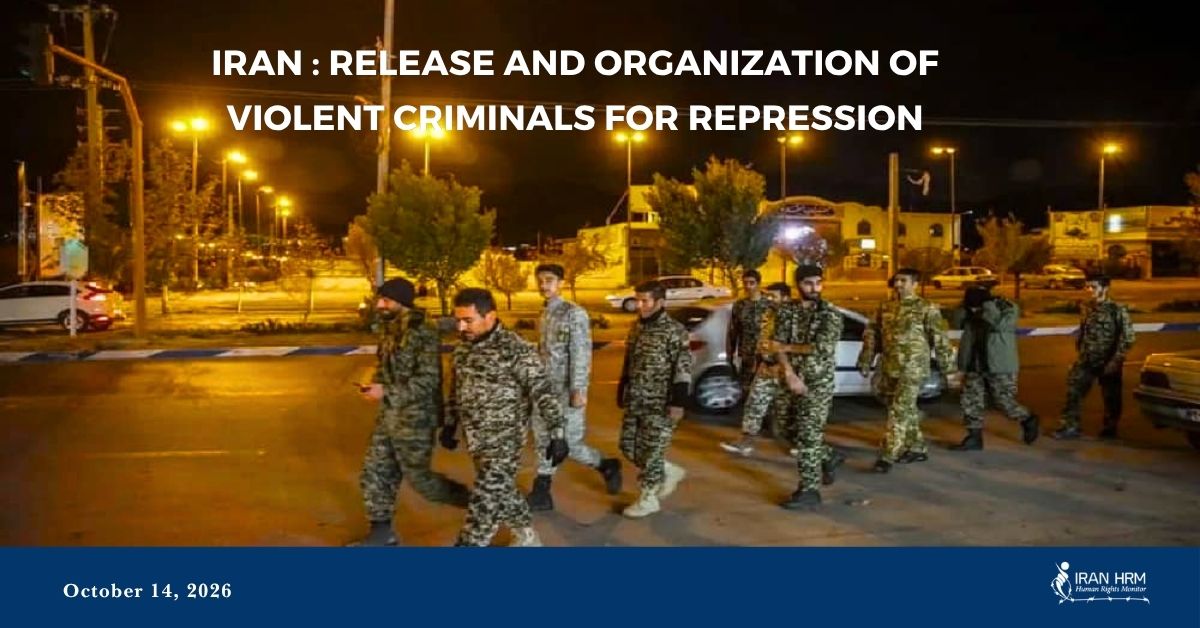
In September and October 2026, official media outlets of the Islamic Republic of Iran launched a massive propaganda campaign announcing the mobilization and military training of 1,000 “Jan-Fada” (Dedicated) National Resistance Battalions. While state propaganda portrays these units as “voluntary public campaigns composed of students, youth, and seminary scholars to defend against foreign threats,” field reports and documentation gathered by human rights organizations reveal a dangerous and hidden reality: “The systemic conditional release of violent criminal convicts from prisons, contingent upon their registration with the Basij and integration into ‘Jan-Fada’ battalions to suppress urban protests.”
This dual strategy allows the state to compensate for severe manpower shortages within its security apparatus while deploying individuals with criminal backgrounds as a violent enforcement arm for street-level repression.
The State’s Propaganda Façade: Official Media Claims
State-run news agencies (Tasnim, ISNA, IRNA, and Mehr), highlighting claims of 31 million participants, promote the structure of the Jan-Fada battalions around the following key axes:
- Organizational Scale and Expansion: Official announcements regarding military training for 1,000 battalions nationwide, alongside 100 public battalions organized in Alborz Province under the “SENMA” structure (Tasnim, Sept 16 & Sept 25, 2026).
- Militarization of Urban Squares: The establishment of bases and temporary “military training hubs” in major public transit squares, including Imam Hossein Square and Haft-e Tir Square in Tehran (Tasnim & ISNA, Oct 3, 2026).
- Training Curriculum: Three tiers of military training covering local security enforcement, general war readiness, observation/reconnaissance, operation of general-use military equipment, and emergency relief procedures (Tasnim, Sept 16, 2026).
- Public and Voluntary Front: Claims that 32% of registered participants are women and 60% are under the age of 46, aimed at presenting a benign, civic image of these forces (Tasnim, Sept 16, 2026).
Decoding the Repression Objectives Behind Official Rhetoric
A close examination of statements by military and propaganda officials demonstrates that the primary objective of these battalions—contrary to official claims—is domestic population control:
- Contradictions in Stated Goals: While Ali Kowsari (Deputy of Training for the Basij) claims existing capacities are sufficient for domestic unrest (Tasnim, Oct 3, 2026), Sasan Zare (spokesperson for Jan-Fada) explicitly states that the primary national operational objective is “local security enforcement, neighborhood networking, and surveillance/reconnaissance” (Tasnim, Sept 16, 2026).
- Displays of Intimidation in Public Spaces: Installing tactical training complexes and military gear in major city squares serves no plausible border defense function; rather, it is a calculated display of force designed to induce public fear and deter citizens from forming street protests.
Note to the Reader: The findings in this section are based on testimonies received from inmates, their families, informed sources within prisons, and field reports compiled by human rights organizations. Due to severe security risks, the identities of these sources remain strictly confidential.
The Hidden Reality: Injecting Violent Inmates into the Repression Apparatus
Contrasting the official narrative of “students and scholars,” reports from facilities across Iran (including Tehran Penitentiary and Fardis Prison in Karaj) reveal a coordinated judicial-security scheme:
Mechanisms of Inmate Recruitment and Conditional Release:
- Target Population in Prisons: Distribution of “Jan-Fada” registration and repentance forms to general crime inmates, violent offenders, and drug-related convicts in August and September 2026.
- Conditions for Release: Granting conditional release, reduced bail, or sentence commutations contingent upon registering with the Basij, reporting to local neighborhood bases, and committing to participate in night patrols and checkpoints.
- Coercion of Private Plaintiffs: Utilizing local “reconciliation agents” (Solh-Yaran), financial payouts, and security pressure against private plaintiffs in criminal cases to secure formal consent and pave the way for inmate releases in that accord.
- Operational Division of Labor in Suppression:
- Mobile Enforcement Units: Repeat offenders with active criminal networks outside prison are mandated to lead motorized convoys alongside regular IRGC personnel to directly crush street protests.
- Informant Networks: Inmates lacking physical capacity for street clashes are deployed as local informants (Mokhber) within neighborhood networks.
Historical Precedent: A Reusable Pattern of Repression
The co-optation of repeat offenders and violent criminal networks is an established, institutionalized pattern within the Islamic Republic’s security apparatus:
- The 2009 Post-Election Crackdown: IRGC Brigadier General Hossein Hamedani (former commander of the IRGC Mohammad Rasool-Allah Corps in Tehran) publicly admitted before his death that during the 2009 protests, approximately 5,000 violent repeat offenders were identified, monitored, and organized into three specialized battalions to crack down on protesters.(wikipedia of Hossein Hamedani)
- Structural Continuity: Statements by former security officials (including Ali Hashemi) confirm that deploying violent criminal elements dates back to the July 1999 student protests, allowing formal state institutions to evade legal accountability for severe street violence. (Gouya Newsletter)
Violations of International Human Rights Law
Equipping, organizing, and deploying individuals with violent criminal records within paramilitary and security structures to enforce social control or suppress demonstrations is incompatible with the state’s international human rights obligations and triggers state responsibility under international law.
- State Responsibility for Paramilitary and Non-State Actors: Under Articles 4, 5, and 8 of the Articles on Responsibility of States for Internationally Wrongful Acts (UN International Law Commission, 2001), actions of state organs as well as individuals or groups acting under the instruction, direction, organization, or effective control of state authorities are attributable to the State. Consequently, if members of “Jan-Fada” battalions, Basij personnel, or released inmates act under state direction in security operations, their conduct is attributable to the Iranian government under international law.
- Threats to the Right to Life and Personal Security: Deploying violent criminal offenders in urban patrols, checkpoints, and surveillance networks severely heightens the risk of extrajudicial violence and violates the state’s obligations to safeguard life and security under Article 3 of the Universal Declaration of Human Rights (UDHR) and Article 6 of the International Covenant on Civil and Political Rights (ICCPR).
- Subversion of Judicial Independence and Fair Trial: Conditioning judicial leniency, bail, or clemency on participation in paramilitary security structures undermines the independence of the judiciary and the impartiality of criminal justice. Furthermore, coercing private plaintiffs compromises fair trial guarantees and the rule of law.
- Violation of Obligations regarding the Prevention of Violence and Misuse of Force: International law mandates that the use of force remain strictly regulated, transparent, and confined to legally authorized, trained law enforcement. Delegating security duties to informal proxies or violent offenders inherently increases the risk of arbitrary violence, disproportionate use of force and vast violation of human rights.
Conclusion
The findings of this report demonstrate that the “Jan-Fada” campaign extends far beyond a voluntary public initiative or civic training program; it constitutes a core component of a broader state strategy to expand social control, local surveillance, and protest suppression capabilities. Evidence indicates that this structure relies not only on mobilizations linked to military and security institutions but also integrates released inmates and individuals with backgrounds in violent crime.
If claims regarding the conditional release, organization, and deployment of these individuals in security patrols, informant networks, or suppression operations are fully confirmed, it demonstrates a systematic reliance on non-state or proxy forces to inflict violence against citizens. Such practices gravely imperil the right to life, personal security, peaceful assembly, and the rule of law, while engaging the international legal responsibility of the Iranian government for actions carried out under its direction, training, or control.
The deployment of individuals with violent criminal histories in security missions, combined with the expansion of paramilitary structures across urban neighborhoods, signals an alarming militarization of public spaces and a heightened risk of widespread human rights violations in response to popular dissent.
Appendix: Official State Media & Reference Sources
- Tasnim News Agency (Sept 13, 2026): Announcement No. 1 of Jan-Fada Headquarters
- Tasnim News Agency (Sept 16, 2026): Press Conference of Sasan Zare on 1,000 Battalions
- Tasnim News Agency (Sept 16, 2026): Special Broadcast Coverage of Jan-Fada Campaign
- Tasnim News Agency (Sept 20, 2026): IRGC Fajr Corps Jan-Fada Maneuvers
- Tasnim News Agency (Sept 25, 2026): Organization of 100 Battalions in Alborz Province
- Tasnim News Agency (Oct 3, 2026): Opening of Training Center at Haft-e Tir Square
- ISNA News Agency (Oct 3, 2026): Military Training for 1,000 Battalions
- IRNA News Agency (Oct 3, 2026): Commencement of Jan-Fada Military Training
- Mehr News Agency (Sept 23, 2026): Photo Report on Imam Hossein Square Training Hub
- ISNA News Agency (Sept 13, 2026): Large Assembly of Jan-Fada Mobilized Forces
- Wikipedia (Hossein Hamedani Entry): Reference to Statements on Organizing Violent Inmates in 2009 Protests
- Gooya News (June 12, 2021): Report on Leaked Audio of Ali Hashemi on Historical Use of Violent Proxies