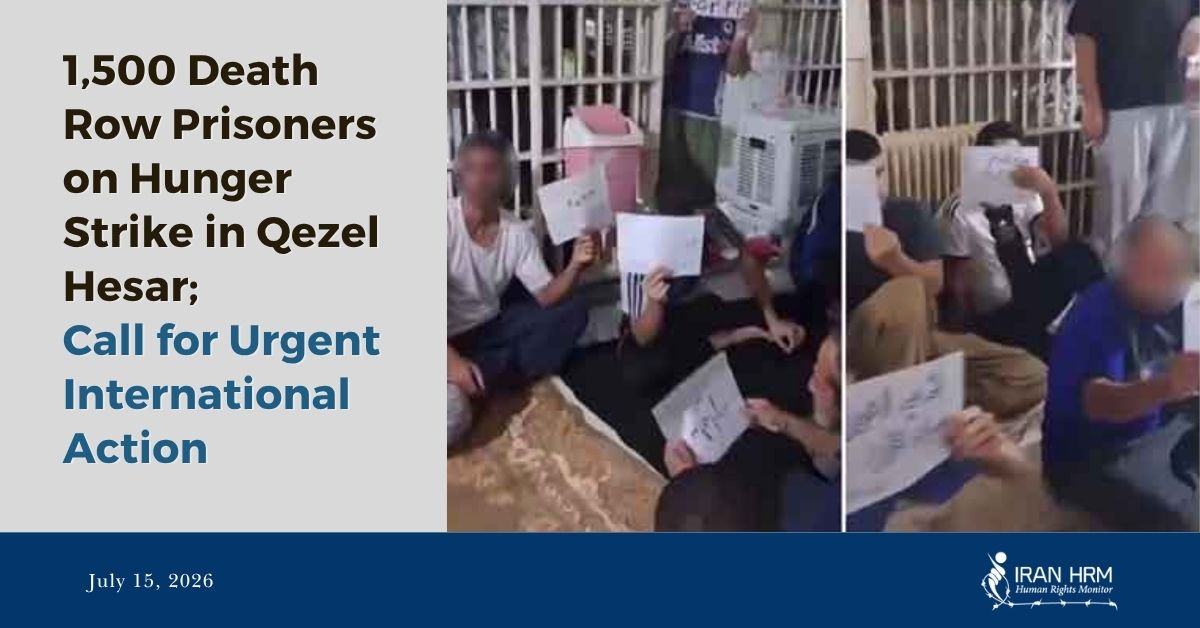
Qezel Hesar Prison, where the execution of prisoners is carried out systematically, currently holds 1,500 prisoners on death row. Faced with the rapidly accelerating rate of executions, these prisoners have found no other means to defend themselves than embarking on a protest hunger strike. Many of these prisoners, convicted of ordinary crimes, are themselves victims of poverty, corruption, flawed economic policies, and the Iranian government’s allocation of public wealth to military tools to fuel its regional wars. They have been sentenced to death for transporting, smuggling, or dealing a few grams or kilograms of drugs, while the actual major drug cartel in Iran is the Islamic Revolutionary Guard Corps (IRGC) itself.

The protesting prisoners have declared that their hunger strike is not only to save the lives of their fellow cellmates but is a collective opposition to the policy of expanding the death penalty, particularly in drug-related cases. According to them, this punishment, rather than confronting the main smuggling networks, takes the lives of the victims of poverty and systemic deprivation.
Transfer of Prisoners for Execution and the Commencement of the Hunger Strike
The protest hunger strike began at noon on Monday, July 13, following the transfer of five prisoners to solitary confinement for the implementation of their death sentences. These prisoners are:
- Seyed Iman Heidari, from Tehran
- Ayoub Asadi, from Harsin, Kermanshah Province
- Vahid Teimouri, from Kuhdasht, Lorestan Province
- Hamed Nazaryani, from Kuhdasht, Lorestan Province
- Amir Nazaryani, from Kuhdasht, Lorestan Province
These prisoners had previously been sentenced to death in cases related to drug charges. It is worth noting that earlier, in October 2025, prisoners successfully delayed the execution of several death sentences by staging a seven-day hunger strike. The striking prisoners have announced that they will continue their protest until the execution of death sentences is halted and their demands regarding the reform of drug-related laws are addressed.
Executions as a Tool to Advance Suppression in Society
The death penalty for such individuals, who have become involved in the drug trade due to poverty and critical economic conditions, has not only failed to reduce drug trafficking but has also failed to curb this phenomenon over the past years. While many low-level offenders face death sentences, organized trafficking networks continue their operations unimpeded.
Time and again, large shipments of drugs attributed to networks linked to the IRGC have been discovered and seized in various countries, including several European nations; yet not a single member of these networks has ever been reported arrested or executed. Consequently, Iran remains responsible for 79% of the world’s recorded drug-related executions.
(Capital Punishment for Drug Offenses (Death Penalty and Extrajudicial Killings) | Drug Policy Facts)
Considering the percentage of drug-related executions in Iran, which on average account for 40% to 60% of annual executions, one can comprehend the massive volume of executions for drug offenses. According to the Iran Human Rights Monitor, executions in Iran reached an unprecedented figure of 2,167 in 2025. If we calculate 50% of these executions to be for drug-related offenses, 1,083 people were executed for drug crimes in Iran.
This clearly demonstrates that these executions—and the unbelievable number of executions in Iran in general—do not serve as a punishment for crimes but rather function as a lever for suppression. The government, particularly during periods when it faces various crises, attempts to contain the potential for social protests by accelerating the implementation of death sentences, sacrificing individuals who are themselves victims of the government’s poverty-inducing policies. Furthermore, the judicial proceedings of these convicts are plagued by serious legal ambiguities, and in many cases, these prisoners are sentenced to death in a completely unfair process, deprived of standard and transparent legal due process.
What Must Be Done; The Responsibility of the International Community
The widespread hunger strike of death row prisoners in Ghezel Hesar Prison reflects their deep concern over the ongoing execution of death sentences and the conditions governing the adjudication of these cases. We reiterate that Iran Human Rights Monitor has repeatedly and continuously warned against the Islamic Republic’s instrumental use of the death penalty to intensify suppression and prevent the outbreak of protests.
From the perspective of international law, particularly the International Covenant on Civil and Political Rights (ICCPR)—to which Iran is a signatory—the death penalty must be strictly limited to the “most serious crimes,” and drug-related offenses, according to the official interpretations of the UN Human Rights Committee, do not fall within this category. Accordingly, we call upon the UN High Commissioner for Human Rights, the Special Rapporteur on the situation of human rights in Iran, and all international authorities to intervene in this crisis immediately and officially.
It is essential that these authorities utilize international legal and supervisory instruments to compel the authorities of the Islamic Republic to immediately halt the execution of death sentences, particularly in Qezel Hesar, review the issued verdicts, and reform the penal codes in accordance with international human rights standards. Silence in the face of the execution of 1,500 defenseless human beings, who have found hunger strike as their only recourse to demand justice, is a flagrant violation of international treaties and human dignity.