
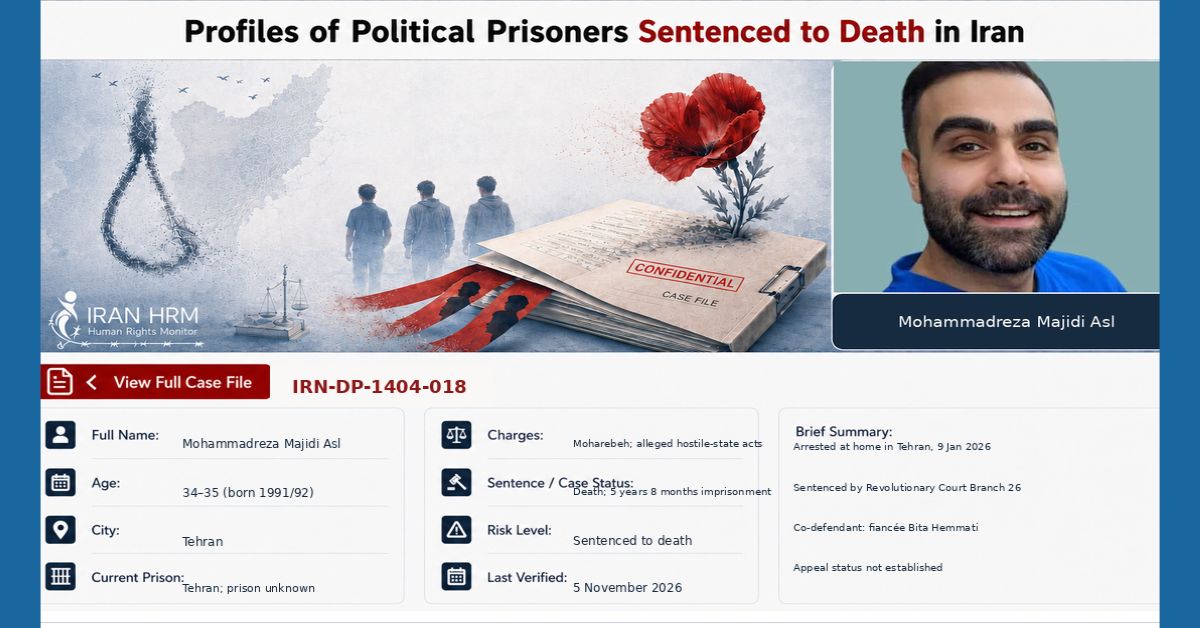
Cases of Political Prisoners Sentenced to Death in Iran
Case No. 18 | Case ID: IRN-DP-1404-018 | Last reviewed: 5 November 2026

| Mohammadreza Majidi Asl, a Tehran resident aged 34–35, was arrested in connection with the protests of January 2026. Following his arrest at home, Branch 26 of the Tehran Revolutionary Court sentenced him to death and five years and eight months of imprisonment. The capital sentence rests on allegations of moharebeh (enmity against God) and operational action for a hostile state. Information about any appeal, access to counsel and his precise place of detention remains insufficient, making urgent clarification of his judicial situation essential. |
Key Case Information
| Category | Information |
| Full name | Mohammadreza Majidi Asl |
| Date of birth | 1991–1992; exact date unknown |
| Age | 34–35 years |
| Occupation before arrest | Mobile phone repair technician |
| Family status | Engaged to Bita Hemmati |
| Date and place of arrest | 9 January 2026; home on Jomhouri Street, Tehran |
| Charges | Moharebeh (enmity against God); alleged operational action for a hostile state; assembly and collusion against national security; protest-related allegations |
| Court | Branch 26, Tehran Revolutionary Court |
| Judge | Iman Afshari |
| Lawyer | Unknown |
| Sentence | Death sentence; five years and eight months’ imprisonment; confiscation of property |
| Current place of detention | Tehran; prison not specified |
Human and Personal Background
Mohammadreza Majidi Asl, born in 1991–1992, worked as a mobile phone repair technician before his arrest. A resident of Tehran, he was engaged to Bita Hemmati, who was arrested in the same case and also sentenced to death. The proceedings extend beyond Mohammadreza to people close to him and his neighbours, who faced prosecution following simultaneous arrests. Bita Hemmati and neighbours Kourosh and Behrouz Zamaninejad are among the other people sentenced to death in this case.
Arrest, Trial and Sentencing
On 9 January 2026, security officers entered Mohammadreza Majidi Asl’s home on Jomhouri Street in Tehran by force and arrested him and his fiancée, Bita Hemmati. Amir Ali Hemmati, Bita’s brother, and two neighbours, Kourosh and Behrouz Zamaninejad, were arrested in the same operation.
The case was heard by Branch 26 of the Tehran Revolutionary Court, presided over by Judge Iman Afshari. Judicial authorities accused Mohammadreza and the other defendants of carrying out operations for a hostile state, participating in protest gatherings, chanting slogans, throwing objects, damaging public property and using explosives. They also faced an allegation of assembly and collusion against national security. These are allegations advanced by the authorities, not established findings of guilt.
According to the information provided, Mohammadreza received a death sentence and five years and eight months of discretionary imprisonment; confiscation of property was also reported as part of the punishment. The exact dates of sentencing and notification, details of the defence, access to legal counsel and the status of proceedings before higher courts remain unknown.
Government Response and Conduct
Judicial authorities issued death sentences against four defendants under Article 1 of the Law on Intensifying Punishment for Espionage and Cooperation with the Zionist Regime and Hostile States against National Security and Interests, adopted in October 2025. Through a broad definition of “operational action”, the law allows for the death penalty and total confiscation of assets for acts attributed to the benefit of hostile states. On 15 January 2026, state media broadcast footage of statements by Bita Hemmati in the presence of Gholamhossein Mohseni Ejei, head of the judiciary; human rights reporting has characterised the statements as a coerced confession. In the footage, she spoke about throwing concrete blocks towards security personnel. The broadcast raises serious concerns about possible pressure on defendants and its implications for fair-trial guarantees. However, independent information about Mohammadreza’s own interrogation conditions, or whether he personally experienced torture or was forced to confess, is unavailable.
Current Status and Risk of Execution
Mohammadreza Majidi Asl is still reported as a prisoner under sentence of death. According to the case information supplied, he is detained in Tehran, but the prison and any transfers have not been identified. Reliable details of any appeal, family visits, access to a lawyer or his physical and psychological condition are also unavailable. The death sentence, combined with the lack of transparency about the present stage of judicial proceedings, makes urgent clarification essential.
Human Rights and Fair Trial Analysis
Right to life: Article 6 of the International Covenant on Civil and Political Rights restricts the death penalty, where it has not been abolished, to the “most serious crimes”. The UN Human Rights Committee interprets this threshold as confined to crimes of extreme gravity involving intentional killing. The information provided about Mohammadreza Majidi Asl does not identify a charge of intentional killing. The imposition of capital punishment on the stated allegations therefore raises serious concerns about compatibility with Article 6.
Right to a fair trial: Under Article 14 of the Covenant, every defendant is entitled to an independent and impartial tribunal, effective access to a lawyer and adequate opportunity to prepare a defence. The absence of clear information about counsel, the evidence underlying the judgment and appeal proceedings underscores the need for an independent assessment of these safeguards.
Prohibition of compelled confession: The broadcasting of footage described as a coerced confession by a co-defendant reinforces the need to investigate interrogation conditions independently and to ensure that statements obtained under duress are not used as evidence.
Conclusion
Mohammadreza Majidi Asl, a mobile phone repair technician arrested in connection with the protests of January 2026, has been sentenced to death in proceedings involving his fiancée, relatives and neighbours. Uncertainty over appeals, access to legal counsel and his precise place of detention, together with the legal basis of the death sentence, requires urgent attention from international human rights bodies.
Urgent Appeal
United Nations bodies, governments and international human rights organisations are urged to act to protect the rights of Mohammadreza Majidi Asl and prevent his execution.
- Immediately halt any steps towards execution and quash the death sentence.
- Formally disclose his judicial status, any appeal and current place of detention.
- Guarantee immediate, confidential access to counsel of choice and adequate facilities for the defence.
- Publish the judgment, supporting evidence and legal basis for the sentence.
- Conduct an independent investigation into the arrest, interrogation and possible pressure on defendants.
- Ensure independent and fair judicial proceedings without recourse to the death penalty.
- Guarantee regular contact with his family.