Cases of Political Prisoners Sentenced to Death in Iran
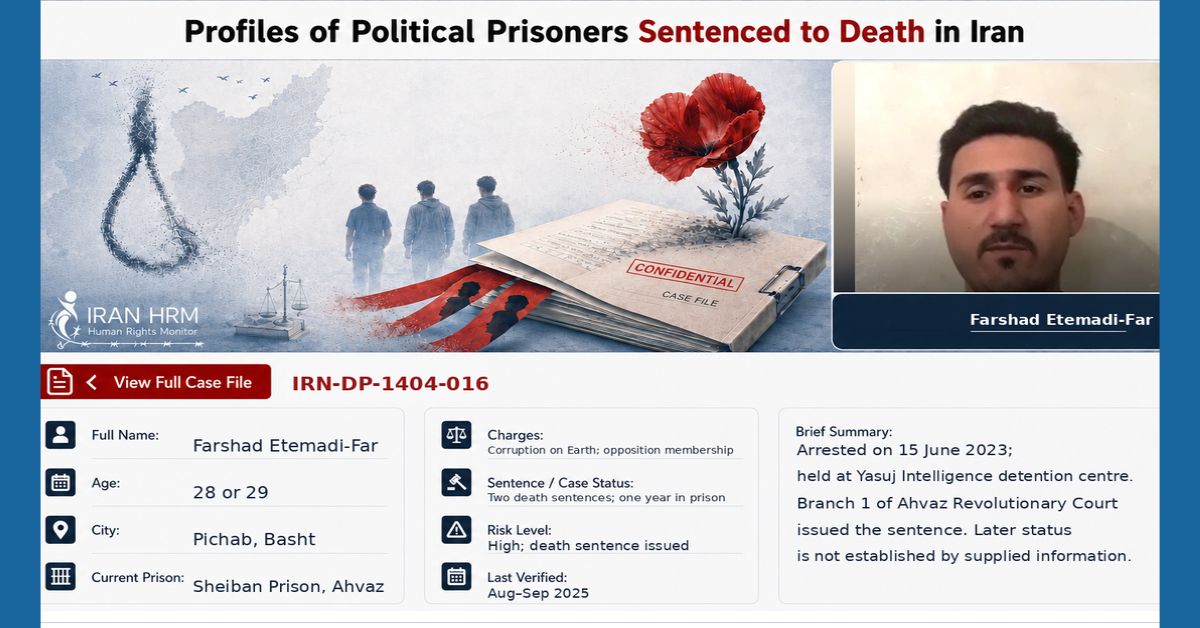
Case No. 16 | Case ID: IRN-DP-1404-016 | Last reviewed: 29 September 2026

| Farshad Etemadi-Far, from Pichab village in Basht County, has received two death sentences following his arrest on 15 June 2023 and prolonged detention. According to the information provided, Branch 1 of the Ahvaz Revolutionary Court, presided over by Judge Adibi-Mehr, issued and formally notified him of the judgment on 11 July 2025. Reports of torture, illness and denial of treatment heighten concerns for his life and health. Additional information reports that the death sentence has been upheld, but the date, authority responsible and precise status of judicial proceedings remain unclear. |
Key Case Information
| Category | Information |
| Full name | Farshad Etemadi-Far |
| Father’s name | Gholam |
| Date of birth | 1996 or 1997; exact day and month unknown |
| Age | 29 or 30 at the time of review; 28 or 29 between 23 August and 22 September 2025 |
| Place of birth and residence | Pichab village, Basht County, Kohgiluyeh and Boyer-Ahmad Province |
| Education and occupation | Secondary-school diploma; occupation before arrest unknown |
| Family status | Unknown |
| Date and place of arrest | 15 June 2023; exact place of arrest unknown; initially transferred to the Yasuj Intelligence Department detention centre |
| Alleged charges in the indictment | Moharebeh (enmity against God) on account of alleged membership of the People’s Mojahedin Organisation of Iran; propaganda against the system; assembly and collusion against national security |
| Charges cited in the reported judgment | Efsad-e fel-arz (corruption on Earth); membership of groups opposed to the system; propaganda against the system |
| Court | Branch 1 of the Ahvaz Revolutionary Court |
| Judge | Adibi-Mehr |
| Lawyer and access to the defence | Unknown |
| Sentence | Two death sentences; the initial information also mentions one year’s imprisonment |
| Last reported place of detention | Sheiban Prison, Ahvaz |
| Judicial status | Additional information reports that the sentence was upheld and formally notified; the date and authority responsible are unspecified |
Human and Personal Background
Farshad Etemadi-Far, son of Gholam, was born in 1996 or 1997 and holds a secondary-school diploma. Before his arrest, he lived in Pichab village. Information about his occupation, marital status or dependants is not available.
He had previously been arrested in 2018 or 2019; however, the charges, duration of detention and outcome of that case are unknown.
Arrest, Trial and Sentencing
Farshad Etemadi-Far was arrested by intelligence agents on 15 June 2023, together with Saman Hormat-Nejad and Davoud Hormat-Nejad, and transferred to the Yasuj Intelligence Department detention centre. Accounts of their interrogation also refer to their detention at an Islamic Revolutionary Guard Corps intelligence detention centre; the sequence and exact dates of transfers between these facilities remain unclear.
According to the accounts compiled, the three men were subjected to repeated interrogations, pressure from security officials, and physical and psychological torture. Details of the torture methods, any independent medical examination, and their access to legal counsel during this period are not available.
After some time, Farshad Etemadi-Far and his two companions were transferred to Sheiban Prison in Ahvaz. Following approximately fifteen months in detention, they were summoned to court between 22 August and 21 September 2024. The exact hearing date and details of their defence are unknown.
On 11 July 2025, Branch 1 of the Ahvaz Revolutionary Court, presided over by Judge Adibi-Mehr, sentenced Farshad Etemadi-Far to death on two counts, according to the information provided. Saman Hormat-Nejad received twelve years’ imprisonment and Davoud Hormat-Nejad received fifteen years. The full judgment and the legal basis for imposing two death sentences on Farshad are not available.
Physical Health and Denial of Treatment
A report dated 7 September 2024 described Farshad Etemadi-Far’s physical condition as critical and reported gastrointestinal illnesses affecting his stomach and intestines, as well as shortness of breath. The precise medical diagnosis and the cause of his breathlessness are unknown.
According to the same report, prison authorities prevented his transfer to a hospital outside the prison. His family had delivered the medication he needed to the prison, but officials refused to pass it on to him, while the prison infirmary did not have the necessary medicines either. His treatment and health status after that report remain unclear.
Government Response and Conduct
Between 23 July and 22 August 2023, a media outlet affiliated with security institutions alleged that these young men were linked to the People’s Mojahedin Organisation of Iran and were planning “disruptive operations” in Fars, Khuzestan, and Kohgiluyeh and Boyer-Ahmad provinces. These allegations represent a position attributed to security institutions and must not be treated as established facts. Evidence that could be assessed in relation to these allegations is not available in the case information.
No explanation from judicial or prison authorities is available concerning the reports of torture, restrictions on treatment, the basis for the two death sentences, or the process for challenging the judgment.
Current Status and Risk of Execution
Farshad Etemadi-Far’s last reported place of detention is Sheiban Prison in Ahvaz. Additional information reports that the death sentence was upheld and formally notified to him, but does not identify the authority or date of that decision; without further information, it therefore cannot be regarded as confirmed final approval by the Supreme Court.
The two death sentences, together with uncertainty about the status of any appeal and reports of denial of treatment, demonstrate the need for urgent follow-up. However, the available information does not report a scheduled execution date, transfer to solitary confinement in preparation for execution, or notification of an execution schedule. His situation since the latest case information requires updating.
Human Rights and Fair Trial Analysis
Right to life: Article 6 of the International Covenant on Civil and Political Rights limits the use of the death penalty to the most serious crimes. The available information does not report that Farshad Etemadi-Far committed intentional killing. Imposing a death sentence on the basis of political charges or alleged membership of an organisation, without establishing that this threshold has been met, raises serious concerns about a violation of the right to life.
Right to a fair trial: Prolonged detention before judicial proceedings, uncertainty about access to counsel, and the absence of the judgment and assessable evidence make it difficult to evaluate compliance with the safeguards in Article 14 of the Covenant. Full observance of these safeguards is essential in a case involving the death penalty.
Prohibition of torture and protection of health: Reports of torture and obstruction of access to medication and treatment require an independent investigation. If substantiated, such conduct would contravene the prohibition of torture and inhuman treatment and the obligation to treat persons deprived of their liberty humanely. Any statements obtained under torture must not form the basis of a conviction.
Conclusion
Farshad Etemadi-Far faces two death sentences and has a reported history of illness, torture and denial of treatment. The lack of clear information about the authority that upheld the sentence, facilities for his defence, and his medical condition underscores the need to halt any steps towards execution and ensure immediate access to judicial information and medical care.
Urgent Appeal
United Nations bodies, governments and international human rights organisations are urged to act to protect Farshad Etemadi-Far’s life and rights:
- Halt execution of the death sentences and seek the quashing of both sentences.
- Formally disclose his judicial status, the authority that upheld the sentence, and the available avenues of appeal or review.
- Guarantee confidential access to counsel of his choice and adequate facilities for his defence.
- Provide an independent medical examination, medication and transfer to hospital where necessary.
- Conduct an independent investigation into reports of torture and denial of treatment.
- Guarantee regular family contact and visits, and ensure that any retrial takes place before an independent and impartial tribunal without recourse to the death penalty.