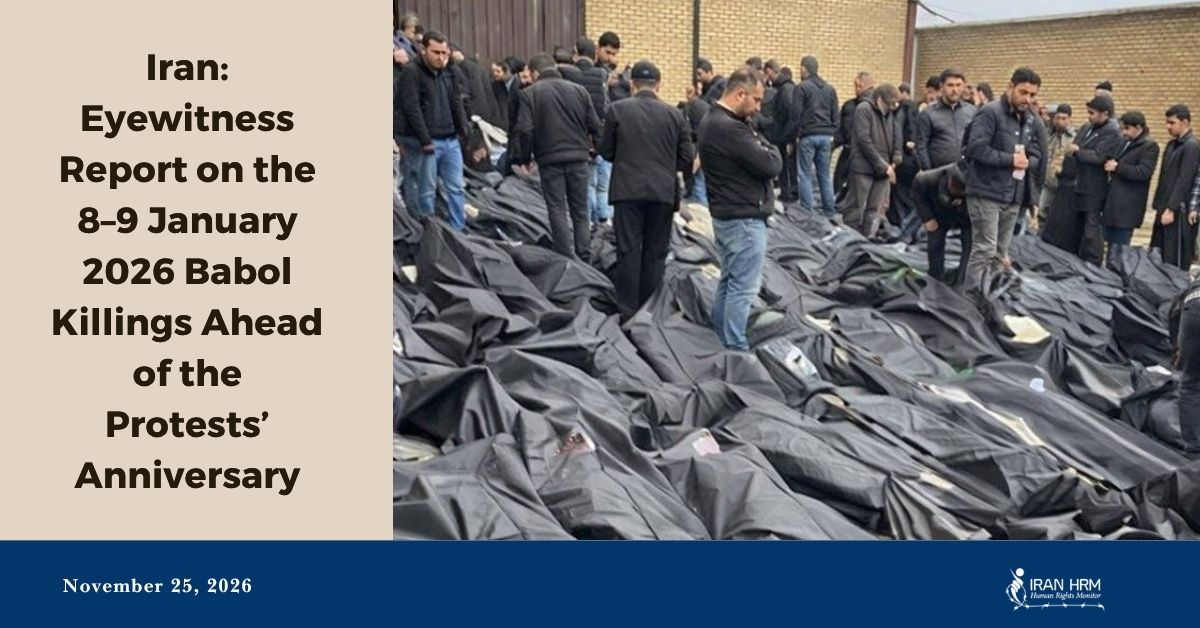
This report is based on a direct eyewitness account of events on Thursday and Friday, 8–9 January 2026, in the city of Babol during the nationwide protests. This report focuses strictly on field events, patterns of the use of force, the condition of the injured, and access to medical care within the framework of international human rights law. Approaching the anniversary of the nationwide Dey protests, recording and analyzing such evidence carries preventive and evidentiary importance for United Nations oversight mechanisms—particularly the Independent International Fact-Finding Mission on the Islamic Republic of Iran and the Special Rapporteur on the situation of human rights in the Islamic Republic of Iran.

Field Findings on Patterns of the Use of Force and Arming of Forces
- Widespread and Unrelenting Gunfire: According to the eyewitness account, during the nights of 8-9 January in central and densely populated areas of Babol, gunfire from firearms took place extensively and continuously; over prolonged periods—including roughly two and a half hours on Thursday, January 8, and also from approximately 8:20 p.m. to 10:00 p.m. in the city center—the sound of gunshots was heard roughly every three to five seconds, with thousands of rounds fired in total. It has also been reported that near Police Station No. 13 and the Babol police headquarters, roughly two thousand rounds were fired horizontally at ground level—rather than into the air—within about thirty minutes or less.
- Absence of Prior Warning and Direct Firing Instead of Arrest: Contrary to standard crowd-control procedures and unlike warning shots into the air or conventional warnings, gunfire was directed straight at protesters without prior warning. According to the witness, in certain locations (including from Bagh-e Ferdows Square toward Shariati Street), the implicit or explicit directive centered on “shooting instead of arresting” and “wounding or killing,” with no warning shots into the air or graduated crowd-dispersal measures observed.
- Orders to Target the Head Directly: The eyewitness reports that on Friday, in the vicinity of Shariati Street (in front of Shadi Park), an individual riding a motorcycle gathered his forces and, by gesturing with his hand to his forehead, issued an order to shoot directly at the head. The witness account also records an instance in which a motorcyclist carrying a pillion rider entered an alley near Amir Kabir Street (Mahdi Abad area) and shot two teenage schoolboys aged 18 to 19 directly in the head after cornering them, indicating a pattern of targeted killing outside lawful standards. He states: “In the crackdown on the nationwide protests, I saw with my own eyes that a motorcyclist, on Friday, in front of Shadi Park on Shariati Street, gathered his forces and, pointing a finger to his own forehead, ordered them to ‘shoot at the head.’” He continues: “In Babol they killed two people; two young boys aged 18 or 19, under 20, who were students… Those two boys ran into an alley near Amir Kabir Street, in the Mahdi Abad area of Babol. Immediately a motorcyclist with a pillion rider entered the alley. They cornered those two boys, so to speak. The boys were pleading and saying, ‘Don’t kill us.’ But one shot the first one in the head, then the second one in the head, and left.”
- Deployment of Armed Young and of relatively low age personnel: The eyewitness notes that a substantial proportion of those carrying firearms and firing were, by build and age, under 25. According to the witness, most of them were young persons, estimated to be aged approximately 15 to 25.who possessed firearms without professional anti-riot policing procedures or clear accountability mechanisms. This sharply increases the risk of arbitrary deprivation of life and disproportionate use of force.
- Expansion of Repression from Main Arteries to Alleys: While on Thursday clashes and casualties were concentrated on main streets and central arteries of the city (such as Shariati Street, Shiroukhorshid Square, Shahrebani Intersection, Bagh-e Ferdows, Owqaf, Hamzekola Square, and Modarres Street), on Friday confrontations and arrests extended into side alleys where diverse crowds—including women, older persons, retirees, shopkeepers, and youths—were present.
Barriers to Access to Treatment and Insecurity in Medical Facilities
- Fear of Identification and Arrest in Hospitals: According to this report, many individuals injured by bullets and pellets refrained from going to hospitals out of concern over the presence of security agents and informants in medical facilities and underwent home treatment instead.
- Concerning Conditions at Rouhani Hospital and Reference to Amol: The eyewitness describes hospitals in Babol—and particularly Rouhani Hospital—as concerning with respect to the safety of injured patients and points to the presence of informants and reporters (including among some members of medical staff). The report also refers to injured individuals being taken or pulled from hospitals and killed in Amol as a concurrent and cautionary experience, whereas in Babol the majority of those killed died at the scene in streets or alleys. He states: “I have information that in Amol, they pulled several of the injured out of hospitals and killed them. Unfortunately, in Babol, in most cases people were killed right at the scene, and those who were injured—whether by bullets or pellets—had to be treated at home. Babol’s hospitals do not have sufficient safety and are full of informants and reporters, some of whom unfortunately are among the medical staff. Rouhani Hospital in particular is in a more concerning situation in this regard.”
Legal Analysis Based on International Human Rights Instruments
| Documented Issue | Relevant Legal Instruments and Standards | Legal Analysis and Human Rights Implications |
| Direct, unrelenting gunfire and orders to target the head | Article 6 of the International Covenant on Civil and Political Rights (ICCPR); Principles 4, 5, 9 and 10 of the 1990 UN Basic Principles on the Use of Force and Firearms by Law Enforcement Officials; Articles 2 and 3 of the UN Code of Conduct for Law Enforcement Officials | The right to life is inherent and arbitrary deprivation of life is strictly prohibited. Intentional lethal use of firearms is permissible only when strictly unavoidable in order to protect life against an imminent threat of death or serious injury. Issuing orders to shoot at the head, unwarned widespread gunfire, and prioritizing shooting over arrest contravene the State’s obligation to protect life and the principles of necessity and proportionality. |
| Deployment of armed youths/teenagers lacking professional standards | Articles 2(1), 6 and 9 of the ICCPR; Principles 1–5, 18 and 19 of the UN Basic Principles on the Use of Force and Firearms; Convention on the Rights of the Child (CRC) where persons under 18 are involved | Placing lethal firearms in the hands of personnel lacking specialized law-enforcement training, effective oversight, and a clear chain of command substantially increases the likelihood of extrajudicial killings and grave violations of citizens’ rights, underscoring State responsibility for acts carried out under its direction or control. |
| Insecurity in hospitals and de facto obstruction of treatment for the wounded | Article 6 (right to life) and Article 7 (prohibition of torture and cruel, inhuman or degrading treatment or punishment) of the ICCPR; Article 12 of the International Covenant on Economic, Social and Cultural Rights (right to the highest attainable standard of physical and mental health) | Deterring wounded individuals from seeking hospital care, the presence of informants inside medical settings, or any obstruction of urgent medical care for injured protesters endangers the right to health and, in severe cases, the right to life, conflicting with the principle of medical neutrality and protection of the wounded. |
| Suppression of assemblies, arrests, and violation of the right to peaceful assembly | Articles 9, 19 and 21 of the ICCPR; Human Rights Committee General Comment No. 37 on the right of peaceful assembly | Widespread use of lethal force against assemblies in which the majority of participants are ordinary, unarmed citizens violates the right to peaceful assembly and freedom of expression, and where arrests are arbitrary, also violates Article 9 of the Covenant. |
Conclusion
The eyewitness testimony regarding the events of 18 and 19 Dey in Babol presents a troubling picture of the widespread use of firearms, unwarned direct shooting, head targeting, the presence of armed young and of relatively low age personnel, and insecurity in medical facilities during the crackdown on protests. Wounded individuals facing the risk of identification or insecurity in hospitals and turning to home treatment—alongside the pattern of continuous and lethal gunfire—shows that harm to citizens’ right to life and health can extend beyond the immediate street scene.
The approaching anniversary of the nationwide Dey protests, while substantial evidence and accounts of lethal violence and the absence of effective accountability in past cases remain, heightens the importance of accurate recording, independent verification, and preservation of documents and evidence concerning the chain of command and the manner in which force was used. Within this framework, special attention by United Nations human rights mechanisms—including the Independent International Fact-Finding Mission on the Islamic Republic of Iran and relevant Special Procedures—and cross-referencing these testimonies with other field reports can help clarify the dimensions of accountability of the authorities and security and law-enforcement institutions of the Islamic Republic of Iran, as well as protect the injured and witnesses.
Analyzing this report in light of States’ international obligations regarding the right to life, the prohibition of inhuman treatment, the right to health, and freedom of peaceful assembly highlights the necessity of focusing on prevention and timely risk assessment before cycles of lethal violence recur. Systematic recordings of these accounts and preservation of evidence regarding the conduct of armed forces and the situation of medical facilities constitute an essential step toward preventing the victims from being forgotten and strengthening future accountability mechanisms.