Overview
- Systemic Economic Deprivation: Salaries falling below the poverty line, forced overtime rates as low as IRR 200,000–300,000 per hour (~USD 0.30–0.50), and extreme wage gaps between nursing staff and physicians.
- Human Resources Deficit & Brain Drain: A deficit of 100,000 nurses and the annual emigration of 3,000 specialist nurses, alongside 60,000 unemployed nursing graduates facing precarious short-term contracts.
- Coerced Overtime: Mandatory overtime shifts amounting to structural pressure and severe physical and mental exhaustion.
- Security Crackdowns & Forced Regret Commitments: Judicial summonses, contract terminations, forced signing of “statements of regret” (e.g., Fayazbakhsh Hospital), and disqualification of union representatives.
Introduction
Nurses and healthcare workers constitute the primary pillars supporting the “right to health” and the “right to life.” However, evidence compiled in 2026 demonstrates that Iran’s nursing sector is grappling with a severe structural crisis characterized by sub-poverty wages, chronic payment delays, mandatory overtime, precarious temporary contracts, unprecedented emigration, and judicial retaliation against union advocates.

These conditions violate international standards of “decent work” and human dignity, while driving Iran’s public health apparatus toward systemic failure and directly jeopardizing patient care.
Nationwide Protests Against Systemic Wage Discrimination
In 2026, healthcare workers organized numerous protests across various Iranian cities:
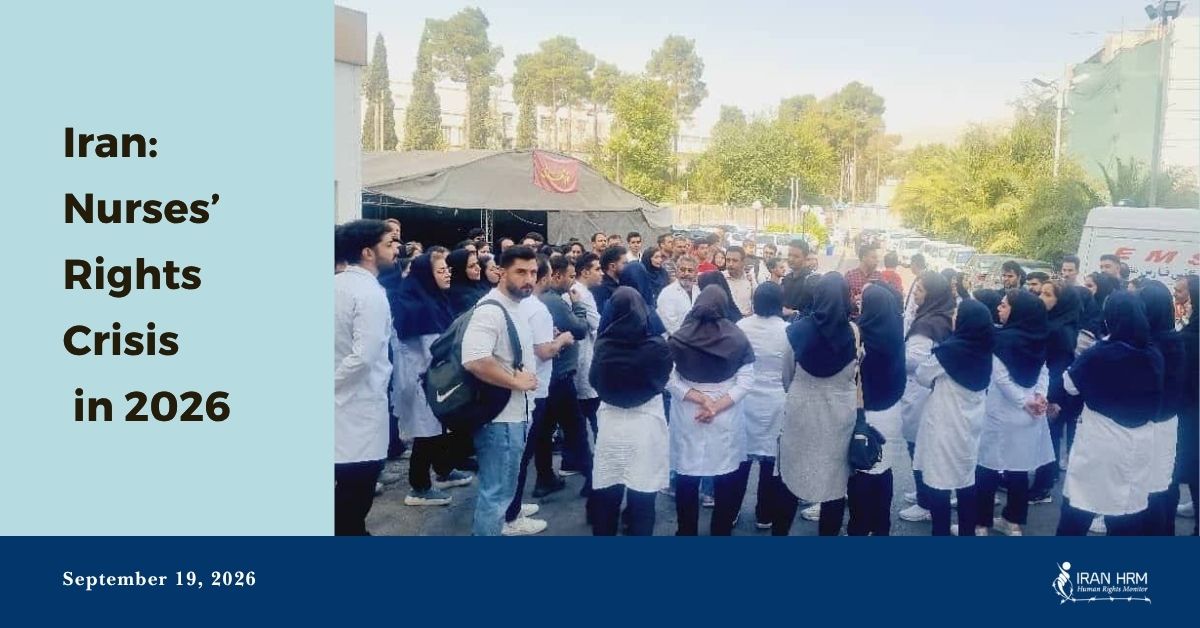
- Yazd: Protesting six-month delays in tariff payments and overtime compensation, nurses declared that despite heavy professional responsibilities, they remain below the poverty line.
- Tabriz: Healthcare personnel demanded equal pay, fair implementation of the “Special Allowance,” and the immediate clearance of delayed bonuses.
- Neyshabur: On 19 August 2026 (28 Mordad 1405), nurses held a second protest against forced overtime and nominal tariffs, stating: “We are exhausted by mandatory overtime… We have protested repeatedly, but no authority listens.”
- Kermanshah: On 8 September 2026 (17 Shahrivar 1405), healthcare workers protested over a year of unpaid overtime, describing their living conditions as critical.
Acute Wage Disparities and Systemic Discrimination
The widening gap between inflation and income has pushed nurses into severe financial distress. According to Ahmad Nejatian, President of the Iranian Nursing Organization, while other healthcare sectors saw salary adjustments of up to 60%, permanent nurses received only a 20–25% increase. He publicly acknowledged: “A nurse’s salary is lower than a worker’s minimum wage, which is unacceptable.”
Data from the House of Nurse organization exposes extreme structural inequality: the combined monthly performance bonus for 42 operating room and nursing staff members at one facility totaled IRR 252 million (~USD 3,600), whereas a single surgeon’s monthly bonus at the same facility exceeded IRR 700 million (~USD 10,000).
Coerced Overtime and Severe Occupational Burnout
A chronic shortage of personnel has converted overtime from an optional request into a mandatory order. Nurses report forced overtime pay rates between IRR 200,000 and 300,000 per hour (~USD 0.30 to 0.50), which are also subjected to long delays. Prolonged shifts and high nurse-to-patient ratios severely heighten occupational burnout, medical errors, and psychological distress.
Systemic Paradox: Shortage of 100,000 Nurses Alongside 60,000 Unemployed Graduates
A striking contradiction within Iran’s health system is the co-existence of severe understaffing and high graduate unemployment:
- Staffing Deficit: Estimates indicate a shortfall of nearly 100,000 nurses, with over 30 medical universities falling below minimum international nurse-to-bed ratios.
- Unemployment & Exploitative Contracts: Over 60,000 nurses remain unemployed or decline employment due to unstable 89-day temporary contracts.
- Brain Drain: Approximately 3000 specialized nurses emigrate annually, with over 2,150 leaving the public healthcare system over the past 3–4 years.
Key driving factors behind this trend include:
- Unacceptably low wages,
- Lack of job security,
- Severe workload pressures,
- Chronic occupational burnout, and
- Absence of a viable professional outlook.
It should be noted that these figures reflect only data published by official state media of the Islamic Republic. Due to structural opacity and the lack of official transparency regarding emigration metrics, these numbers represent a baseline minimum, and the actual rate of nurse emigration is likely significantly higher.
Judicial Retaliation, Security Pressure, and Coerced “Statements of Regret“
Iranian authorities have met labor demands with disciplinary and security measures. Mohammad Sharifi-Moghadam, Secretary-General of House of Nurse, reported systematic disqualifications in union elections, confiscation of personal belongings of union leaders, and pay cuts targeting outspoken advocates.
Suppression at Fayazbakhsh Hospital (Tehran):
Following labor protests regarding mandatory overtime and low compensation:
- Contract cancellations and punitive reassignments were imposed on protesting staff.
- Healthcare workers were summoned to disciplinary committees.
- Nurses were forced to sign written commitments expressing “regret” as a condition for continued employment.
- Five nurses were summoned to the Prosecutor’s Office under security-related charges of “spreading false information” and “disturbing public peace.”
- Following the January 2026 protests (Dey 1404), the Nursing Organization reported that at least 18 nurses were summoned by security bodies.
Legal Analysis and Breach of International Obligations
The documented practices violate Iran’s obligations under international human rights law and labor standards:
- International Covenant on Economic, Social and Cultural Rights (ICESCR): Violation of the right to just and favorable conditions of work (Article 7), fair wages, and the right to join trade unions (Article 8).
- International Labour Organization (ILO) Standards: Subjecting nurses to mandatory heavy shifts under threat of contract termination at nominal hourly rates conflicts with prohibitions against Forced Labor (ILO Convention No. 29) and infringes upon Freedom of Association (ILO Convention No. 87).
- Violation of the Right to Health (Article 12, ICESCR): Mass emigration and severe physical exhaustion directly compromise healthcare delivery, placing patient health and lives at grave risk.
Actionable Requests
- The Special Rapporteur on the right to health is requested to examine the situation of the nursing workforce in Iran as an integral component of the right to health, and to assess the impacts of severe staffing shortages, occupational burnout, and mass emigration of nurses.
- The Special Rapporteur on the situation of human rights in Iran is requested to reflect in their official reports, cases of retaliation against protesting nurses, judicial summonses, contract cancellations, and administrative pressure exerted on trade union activists.
- The Special Rapporteur on the rights to freedom of peaceful assembly and of association is requested to investigate the restrictions, pressures, and retaliatory measures imposed on peaceful professional protests and trade union actions by nurses.
- The World Health Organization (WHO) is requested to evaluate the impact of nurse shortages, widespread emigration of healthcare personnel, and severe workloads on the quality of health services and patient safety in Iran.
- The International Labour Organization (ILO) is requested to examine job security, temporary contracts, mandatory overtime, and working conditions of nurses in Iran in light of international labor standards, specifically those relevant to nursing personnel.
- The Office of the United Nations High Commissioner for Human Rights (OHCHR) is requested to record, document, and preserve information regarding actions taken against nurse union activists, judicial summonses, and administrative reprisals within UN documentation mechanisms concerning Iran.
- The UN Human Rights Council is requested to pay specific attention to the situation of healthcare workers in Iran as part of its monitoring of economic, social, and cultural rights in the country, should violations of nurses’ professional, livelihood, and union rights persist.
Sources:
https://www.toseeirani.ir/fa/tiny/news-90412
https://www.toseeirani.ir/fa/tiny/news-91382
https://www.toseeirani.ir/fa/tiny/news-92924
https://www.ilna.ir/fa/tiny/news-1836555
https://www.ilna.ir/fa/tiny/news-1793592
https://www.hamshahrionline.ir/news/1037390
https://www.ilna.ir/fa/tiny/news-1837865
https://www.hamshahrionline.ir/news/1037390/
https://www.toseeirani.ir/fa/tiny/news-87818
https://www.toseeirani.ir/fa/tiny/news-90999
https://www.hamshahrionline.ir/news/1037390/
https://www.toseeirani.ir/fa/tiny/news-91880
https://www.toseeirani.ir/fa/tiny/news-86988
https://www.hamshahrionline.ir/news/1014162/
https://www.salamatnews.com/news/401126/