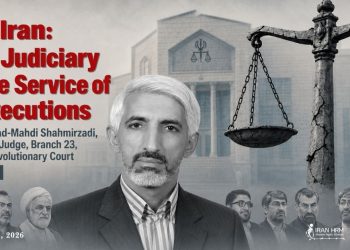

An Investigation into the Judicial Structure of Iran’s Theocratic Repression
For over four decades, the judicial system of Iran’s religious–authoritarian regime has functioned not as a guardian of justice, but as a ruthless instrument for repression, executions, torture, and the systematic elimination of critics, political dissidents, ethnic and religious minorities, as well as intellectuals and artists. From the Revolutionary Courts to the security branches within prisons, from Khalkhali and Gilani to Ejei, Raisi, and Salavati, “justice” in this system has never aimed to uphold the rule of law, but rather to sustain the dominance of the Supreme Leader and consolidate absolute religious power.

This investigative and documented report, presented in several chapters, examines the formation, legal structure, and political function of the judiciary within Iran’s apparatus of repression. It also includes separate sections introducing key figures among the repressive judges, including members of the “Death Commissions” responsible for the 1988 massacre, the 2022 uprising trials, and ongoing judicial crackdowns.
The aim of this series is to document grave violations of justice, expose the role of judges in crimes against humanity, and raise a fundamental question:
Has there ever been such a thing as independent, justice-oriented adjudication under Iran’s system of Velayat-e Faqih?
Section 1
Justice in the Service of Tyranny
Sharia-Based Judging or a Machine of Death?
Introduction
Since the early days of the clerical regime’s consolidation of power in Iran, judicial authority has not served as a guarantor of justice, but as an instrument of political and ideological control under the Supreme Leader’s doctrine. The judiciary, which should be a refuge for the oppressed, has instead become the executive arm of political purges, repression of dissent, and the monopolization of power by the criminal regime of the mullahs.
In this inhumane system, judges are not independent arbiters, but enforcers of the Supreme Leader’s directives and the security apparatus. These judges are neither committed to conscience, nor professional ethics, nor even the explicit provisions of domestic or international law. Their role—cloaked in religious legitimacy—has facilitated widespread political repression, extrajudicial executions, systemic torture, and character assassination through sham trials.
The Nature of Judging Under Velayat-e Faqih
In independent legal systems, judges are custodians of law and citizens’ rights. But under Iran’s theocratic regime, judging is grounded in “governmental Sharia” and the principle of Velayat-e Faqih (Guardianship of the Islamic Jurist). Article 110 of the Constitution grants the Supreme Leader unlimited powers, and Article 157 places the entire judiciary directly under his authority. In such a structure, judges operate under political orders—not principles of justice.
The process of appointing judges in the mullahs’ regime is not based on merit or legal expertise but on ideological loyalty, security clearance, and affiliation with religious seminaries. Many judges lack formal legal education or professional experience; instead, they come from backgrounds in the IRGC, the Basij militia, or religious training centers—and are directly elevated to judicial office.
Revolutionary Courts: Instruments of Systematic Elimination
Established in 1979 as temporary mechanisms to prosecute officials of the former regime, the Revolutionary Courts quickly evolved into machinery of mass executions. Sadegh Khalkhali, the first Sharia judge, issued thousands of death sentences without any due process. This pattern became institutionalized throughout the 1980s and continues to this day.
These courts do not recognize the presumption of innocence, do not allow independent legal counsel, hold no public hearings, and offer no real avenues for appeal. Verdicts are based on the judge’s “Sharia assessment” and the “interests of the regime,” rather than civil law or the principles of fair trial under international standards.
Judiciary: A Criminal Accomplice of the Supreme Leadership
Over the past four decades, the Iranian judiciary has actively contributed to preserving the regime’s political security. Instead of being a pillar of justice, it has become a pillar of theocratic despotism. From the mass executions of the 1980s and the 1988 prison massacre to death sentences issued against protesters in 2009, 2019, and 2022, the judiciary has consistently acted as the legal arm of repression.
Sentences of flogging, execution, stoning, limb amputation, long-term imprisonment, and social exclusion are not the result of isolated judicial extremism. They are systemic tools designed to eliminate dissent and enforce religious tyranny.
The Faces of Sharia Judges: From Khalkhali to Salavati
The regime’s Sharia judges—from Khalkhali to Raisi, from Moghiseh and Razini to Salavati—are all products of this ideological system. In future reports, we will examine their backgrounds, rulings, and individual roles in detail, showing how the judicial function has been weaponized under the guise of “Sharia” to justify and legitimize repression.
Conclusion
The crimes committed in the name of “justice” by these judicial executioners not only reveal the true face of the Islamic Republic’s judiciary but also constitute documented evidence of entrenched injustice cloaked in legal authority. As long as this structure remains intact—and as long as judges serve as agents of the regime rather than protectors of rights—genuine justice in Iran will remain out of reach.
This report is a first step toward documenting the judiciary’s role in four decades of crimes and calling for international justice and accountability.