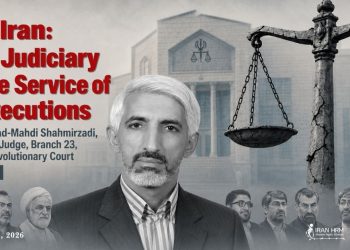

Introduction – The Death Decree and Organized Crime
In the summer of 1988, prisons across Iran witnessed one of the most horrific atrocities in modern history. Khomeini, through a secret fatwa, ordered the mass execution of thousands of political prisoners. Many of these prisoners had been arrested and tried years earlier; some had already completed their sentences or were on the verge of release.

These extrajudicial executions, carried out nationwide, aimed to completely eliminate political opponents and “purge” prisons of every dissenting voice. The majority of victims were members and supporters of the People’s Mojahedin Organization of Iran (PMOI/MEK), but other political opposition groups were also targeted.
The “Death Commissions” – Trials Lasting Only Minutes
To implement the decree, so-called “Death Commissions” were formed in Tehran and dozens of other cities. These commissions, composed of Sharia judges, prosecutors, and security agents, conducted brief sessions without defense lawyers or any due process, posing only one decisive question: “Are you still committed to your positions?”
A “yes” answer; or even silence meant an immediate death sentence.
In Tehran, figures such as Ebrahim Raisi and Judge Moghiseh were prominent members of these commissions. Although these individuals are no longer alive today, they remained in positions of power for years, and their impunity served as a model for the continuation of this cycle of crimes.
The Scale of the Crime – Execution and Enforced Disappearance of Thousands
According to documented evidence, between August and September 1988, at least 30,000 political prisoners were executed or forcibly disappeared across the country. Victims’ bodies were secretly buried in mass graves, the locations of many of which remain concealed to this day.
Families were not only denied any information about the fate of their loved ones but were also deprived of the right to mourn or hold memorials. Survivors recount that prisoners were blindfolded, lined up, and taken in small groups to the gallows. Some spent days or weeks in “death corridors” under unbearable psychological pressure before execution.
Legal Assessment – Statements by Professor Javaid Rehman
Professor Javaid Rehman, the former UN Special Rapporteur on the situation of human rights in Iran, has described this event as a clear case of crimes against humanity and even genocide, stating:
“These killings, along with systematic concealment, refusal to disclose burial sites and the fate of victims, and intimidation and harassment of families, constitute enforced disappearance and crimes against humanity. The available evidence also points to the occurrence of genocide.”
He has called for the establishment of an independent international investigative mechanism to address this crime and to end the “culture of impunity.”
Referring the Genocide Case to the United Nations
Coinciding with the 36th anniversary of the 1988 massacre, Professor Javaid Rehman, in his final report after six years as Special Rapporteur, referred this event to the United Nations as part of a genocide against members and supporters of the PMOI/MEK. He emphasized that “substantial evidence exists showing that mass killings, torture, and other inhumane acts against PMOI members were carried out with the intent of genocide.”
Citing Khomeini’s fatwa and the testimony of Ayatollah Montazeri, Rehman stressed that these executions were deliberate and aimed at the total annihilation of opponents. He urged the creation of an international mechanism for investigation and accountability, the collection and preservation of evidence for criminal prosecution, and the issuance of international arrest warrants for those responsible.
Destruction of Mass Graves – Amnesty International Report
In May 2018, Amnesty International, together with Justice for Iran, published a report presenting new evidence on the locations of mass graves of the 1988 massacre victims. Based on satellite imagery, photographs, analytical videos, and testimonies from 28 former prisoners and 23 families of victims, the report revealed that regime authorities were deliberately destroying these graves to erase the traces of this heinous crime.
The destruction included bulldozing, construction or road building over burial sites, pouring concrete, and even turning grave areas into garbage dumps. These actions, carried out with the involvement of judicial, security, and intelligence bodies, constitute a blatant cover-up of crimes and continuation of enforced disappearance.
Forced Silence and the Perpetuation of Crimes
Three decades later, the mullahs’ regime continues to deny or justify this crime. The destruction of mass graves, intimidation of families and survivors, and dissemination of false narratives are part of a policy of concealment that has not only prevented truth-finding but has also paved the way for repeating the same patterns of repression and extrajudicial executions in later years.
The Justice Movement – From Iranian Prisons to Streets Worldwide
From the earliest days after the 1988 massacre was exposed, families of victims and survivors, despite severe security threats and pressure, sought to make the truth known to the world. Over the decades, these efforts evolved into a global justice movement; one that, through survivors’ testimonies, international gatherings, publication of documents and images, and human rights campaigns, has presented the 1988 genocide as one of the most significant crimes of our time.
Today, this movement not only keeps the memory of the victims alive, but; relying on the support of international bodies and reports like Professor Javaid Rehman’s assessment; seeks to prosecute the perpetrators and end the “culture of impunity” that continues to enable the regime to apply the same criminal pattern against political prisoners and current protesters.
In this horrific genocide, victims came from all ages and walks of life: women and men, elderly and youth, from high school students and fresh university graduates to experienced doctors and engineers, from factory workers to distinguished professors. All faced the same choice: surrender and bow to tyranny or resist and face the noose.
They knowingly chose the latter; walking with steadfast steps toward death so that life, in the image of freedom, might remain for others. Their blood was entrusted not to the earth but to the soul of history, to keep the torch of liberty burning in the hands of future generations.
This bloody case did not end in 1988; it continued in the years that followed, and its shadow is still visible today in the renewed wave of executions, arrests, and pressure on families of political prisoners.
To be continued