As the wartime catastrophe at the borders takes on new dimensions, the Islamic Republic’s execution machine is accelerating its unprecedented purge of political prisoners behind the high walls of Qezel Hesar Prison. The execution of four political prisoners in just 48 hours demonstrates a “systematic elimination strategy” facilitated by the lack of deterrent action from the international community and international human rights bodies; a crime that exploits the wartime emergency to permanently silence protesters and deprive opponents of their right to life under a news blackout.

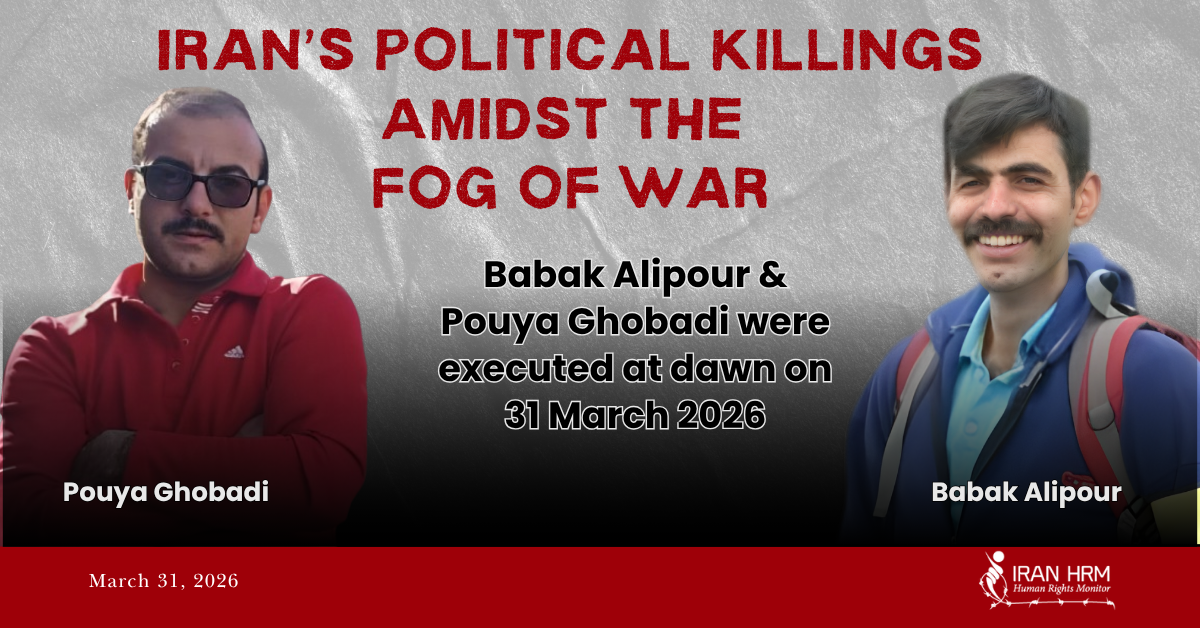
The government of the Islamic Republic has committed another brutal crime by executing two more political prisoners, Babak Alipour and Pouya Ghobadi.
Mizan, the news agency of the executioners’ judiciary, announced the news on Tuesday, March 31, 2026 (11 Farvardin 1405), stating that the charges against these two political prisoners were “participation in armed operations to strike at the security of the regime.” The execution of four political prisoners—Mohammad Taghavi, Ali Akbar Daneshvarkar, Pouya Ghobadi, and Babak Alipour—within two days amidst war and bombardment reflects the Islamic Republic’s deep fear and terror of its own people. These executions prove that the criminals, fearing the people’s wrath and uprising, have no tool left but suppression.
Information from Inside Qezel Hesar Prison
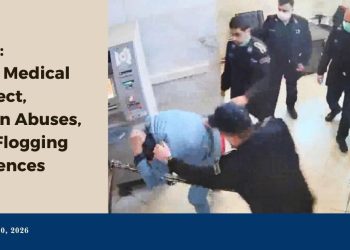
On the evening of Sunday, March 29, coinciding with the transfer of Mohammad Taghavi and Akbar Daneshvarkar for execution, the anti-riot unit of Qezel Hesar Prison raided the political prisoners’ hall in Ward 4. They physically assaulted the other prisoners and transferred them to solitary confinement cells.
Four political prisoners currently under death sentences—Babak Alipour, Vahid Bani-Amerian, Abolhassan Montazer, and Pouya Ghobadi—were among those brutally attacked. There is currently no information on the condition of the remaining two, and their lives are in greater danger than ever. Reports indicate the transfer of at least 19 political prisoners from Ward 4 to solitary confinement, including elderly and ill prisoners such as Ali Moezzi and Asadollah Hadi. Since Monday morning, all communication between the political prisoners in Ward 4 and their families have been severed.
Statements from the Defense Lawyers
- Concerning the execution of Akbar Daneshvarkar and Mohammad Taghavi, Mr. Nili and I are also the defense counsel for the three other defendants: Babak Alipour, Pouya Ghobadi, and Vahid Bani Amerian.
- As of the writing of this post, no verdict has been served to us. We are fundamentally unaware of the final results of the proceedings and do not know if these sentences were upheld for our clients.
- This is while, prior to the execution of a sentence, the content must be served to the defense lawyers or, at the very least, to the defendant. The minimum right of a convict is to benefit from the right to a retrial and a stay of execution.
۱/۳ در خصوص اجرای حکماعدام #اکبر_دانشور_کار و #محمد_تقوی_سنگ_دهی، اینجانب و آقای نیلی عهده دار وکالت سه متهمدیگر به نام های #بابک_علیپور ، #پویا_قبادی و #وحید_بنی_عامریان هستیم
— Babak Paknia (@DrPaknia) March 30, 2026
Biography of Pouya Ghobadi
Former political prisoner Pouya Ghobadi, born in 1992 in the city of Sonqor, is an electrical engineering graduate. Pouya Ghobadi was last arrested on December 22, 2023, and transferred to Ward 209 of Evin Prison, where he was subjected to torture and interrogation. He was subsequently transferred to the general ward of Evin Prison.
His trial, along with seven other political prisoners—Seyed Mohammad Taghavi, Mojtaba Taghavi, Babak Alipour, Vahid Bani-Amerian, Ali Akbar Daneshvarkar, and Abolhassan Montazer—took place in a joint case in Branch 26 of the Tehran Revolutionary Court, presided over by Judge Iman Afshari, on October 6, 2024.
On Saturday, November 30, 2024, along with five other political prisoners—Vahid Bani- Amerian, Babak Alipour, Seyed Abolhassan Montazer, Seyed Mohammad Taghavi, and Ali Akbar Daneshvarkar—he was sentenced to death and imprisonment. The charges against Pouya Ghobadi were announced as “acting against national security through membership and effective cooperation with the People’s Mojahedin Organization of Iran (PMOI),” “propaganda against the state,” “destruction of government property,” and “assembly and collusion with the intent to act against the national security of the country.”
Political prisoner Pouya Ghobadi was previously arrested by security forces in May 2018; after four months of interrogation and torture, he was transferred to the general ward of Evin Prison. In November 2019, he was transferred from Evin Prison to Greater Tehran Prison (Fashafuyeh). After serving a one-year period under the charge of “Moharebeh” (enmity against God), he was sentenced to ten years of imprisonment in December 2021.
Biography of Babak Alipour
Political prisoner Babak Alipour, born in 1991 in the city of Amol, holds a bachelor’s degree in Law and is single. He and his brother, Rozbeh Alipour, were arrested on November 4, 2018, at the Rasht fruit and vegetable market. Babak Alipour was sentenced to seven years in prison by Branch 1 of the Revolutionary Court of Rasht on charges of “membership in the People’s Mojahedin Organization of Iran (PMOI) and insulting the leadership.” This verdict was upheld in its entirety during the appellate stage. Ultimately, on July 3, 2019, Babak Alipour was arrested and sent to Lakan Prison in Rasht to serve his sentence. He was released after two and a half years of imprisonment.
He was arrested for a second time in December 2021 in Shahriar and, after serving two years of his sentence, was released from Ward 4 of Evin Prison in March 2023. During his previous terms of imprisonment, Babak Alipour suffered from intestinal infections and prostate disease, enduring long periods of severe pain without any medical attention.
He was arrested for the third time in January 2024 in Tehran and transferred to Ward 209 of Evin Prison, where he remained in a state of legal limbo for four months. In May 2024, along with Vahid Bani- Amerian, and after four months of being held in limbo in Ward 209, he was charged with “Baghi (armed rebellion), membership and cooperation with the PMOI, and assembly and collusion against national security through cooperation with the PMOI.” These charges have been formally served to him.
On May 21, 2024, Babak Alipour, along with four other political prisoners—Vahid Bani- Amerian, Abolhassan Montazer, Pouya Ghobadi, and Seyed Mohammad Taghavi—was transferred from Ward 209 of Evin Prison to the quarantine of Ward 4 of this prison.
Violation of International Human Rights Law and Call for Urgent Action
The execution of four political prisoners in the context of war constitutes an alarming escalation that places the lives of Vahid Bani-Amerian and Abolhassan Montazer at immediate risk. Both individuals are currently held in solitary confinement, raising serious concerns that their executions may be imminent.
These developments require an urgent and coordinated response from the international community. The UN Human Rights Council, the Fact-Finding Mission, and relevant mandate holders, including Ms. Mai Sato, must take immediate steps to address this situation. This includes publicly condemning these executions, demanding a halt to further death sentences, and pursuing accountability through available international mechanisms, including universal jurisdiction.
Failure to act decisively risks further irreversible harm and undermines the credibility of international human rights protections. The situation in Qezel Hesar Prison demands immediate scrutiny, sustained international attention, and concrete measures aimed at preventing further loss of life.