From Denial of the Right to Defense to Judicial Criminalization
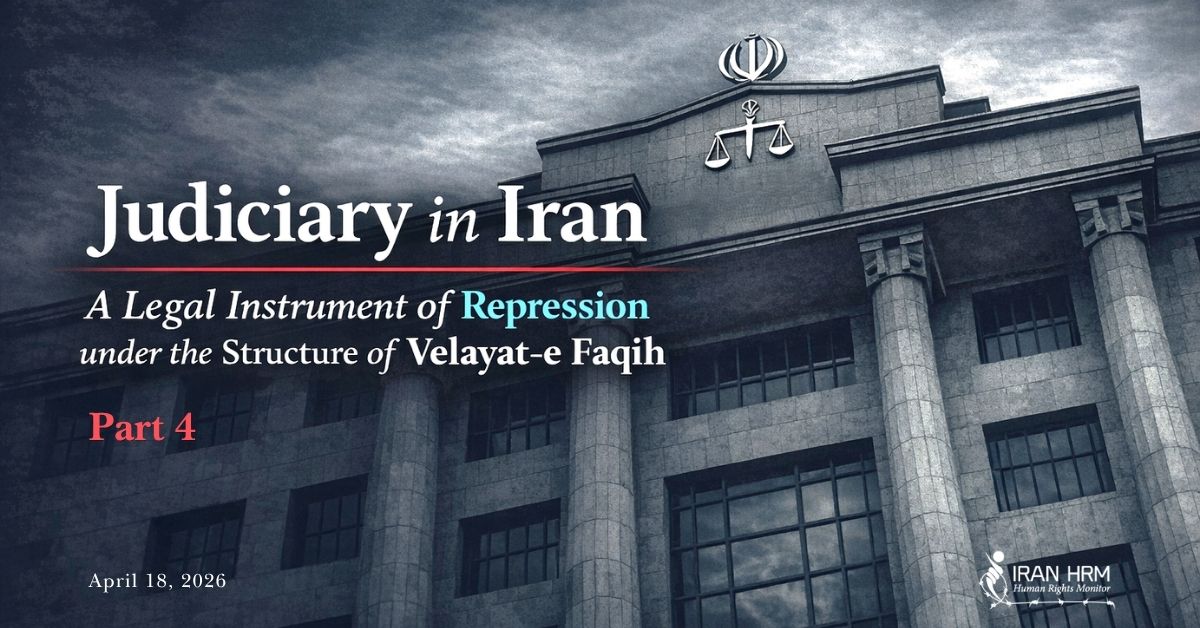
The previous three reports in this series examined, respectively, the legal and structural foundations of the judiciary of the ruling regime in Iran, the mechanism for the selection and removal of judges, and the role of Revolutionary Courts and security institutions in directing political and security-related cases. Those three parts showed that the judiciary in Iran is not an independent institution for the administration of justice, but rather part of the architecture of repression under Velayat-e Faqih. Report No. 4 follows this same path at a more concrete level; namely, how defendants in political and security cases are deprived of the right to defense from the very first stage of arrest, how they are charged with grave crimes through vague and elastic criminal titles, and how, from the outset, their cases are placed on a path toward judicial elimination.

Expedited Proceedings, Torture, and Executions Based on Forced Confessions
In March and April 2026, a new wave of executions targeted protesters and detainees in security-related cases; a wave in which proceedings moved at an abnormal speed, access to independent counsel was restricted, allegations of torture and forced confessions were ignored, and the interval between arrest, sentencing, and execution became unusually short. This acceleration was not merely the product of isolated conduct by a few branches of the judiciary; it was aligned with public emphasis by senior judicial authorities on expediting proceedings in security cases. The documented materials gathered for this report further indicate that on 15 June 2025, the head of the judiciary instructed judicial authorities to accelerate the handling of such cases; a move that international assessments regarded as a serious threat to fair trial guarantees and a factor increasing the likelihood of arbitrary executions.
Before the case of the seven defendants in Tehran, three young men arrested during the Dey 1404 protests in Qom were executed; Saleh Mohammadi, aged 19, a wrestler born on 11 mars 2007; Mehdi Ghasemi; and Saeed Davoudi. Saleh Mohammadi was tried before the Criminal Court of Qom and sentenced to death. Mehdi Ghasemi and Saeed Davoudi were likewise sentenced to death in Qom through an expedited process. The death sentences of all three, after being upheld by the Supreme Court, were carried out at dawn on 19 March 2026, in Qom. In Saleh Mohammadi’s case, he alleged that his confession had been obtained under torture, but the court rejected that claim. The full court ruling and indictment were never publicly released. This lack of transparency, together with the speed of the proceedings, makes this case one of the clearest examples of compressed judicial process in the recent wave.
After that, the case of seven young protesters linked to Basij Base 185 Shahid Mahmoud Kaveh on Namjoo Street in Tehran became one of the most prominent examples of the same pattern. These seven individuals were: Amirhossein Hatami, aged 18; Mohammadamin Biglari, aged 19, a computer science student from Karaj; Shahin Vahedparast; Ali Fahim; Abolfazl Salehi Siavashani; Shahab Zahdi; and Yaser Rajaeifar. All were arrested on 8 janvier and sentenced to death on 9 February 2026, by Branch 15 of the Tehran Revolutionary Court, presided over by Abolghasem Salavati. In this case as well, according to the materials gathered, the defendants were denied access to independent counsel, the trial proceeded with haste, and restrictions on access to the case file undermined the possibility of an effective defense.
Among these seven, Amirhossein Hatami was executed on 2 April 2026, in Qezel Hesar Prison. Then Mohammadamin Biglari and Shahin Vahedparast were executed in the same prison on 16 Farvardin 1405, corresponding to 5 April 2026, secretly and without a final visit with their families. Based on additional information regarding this case, Ali Fahim is also among those executed in the same پرونده. The remaining defendants; Abolfazl Salehi Siavashani, Shahab Zahdi, and Yaser Rajaeifar, were transferred to solitary confinement and faced an immediate risk of execution. This case shows how, within a short period, detainees from a street protest can be moved, through interrogation, deprivation of defense, and Revolutionary Court proceedings, into the category of death row prisoners.
The significance of these two cases lies not only in the number of executions, but in the pattern they reveal. In both instances, the arrests arose in the context of protests; proceedings advanced at an abnormal speed; defendants were denied effective access to independent counsel; allegations of torture and forced confessions were ignored; and the time between arrest, trial, confirmation of sentence, and execution was compressed to an extraordinary degree. In that sense, these executions were not the outcome of fair judicial proceedings, but the product of a mechanism designed from the outset to strip defendants of defense and move the case toward judicial elimination.
This degree of haste in judicial proceedings constitutes a grave violation of basic fair trial standards. In many legal systems, serious criminal charges require sufficient time, layered review, a real opportunity for defense, and, in more serious matters, multiple judges or additional safeguards to reduce the risk of judicial error. But within the judicial structure of the mullahs’ regime, because the overriding priority is the preservation of the ruling system, the judiciary is transformed into a lever of repression and departs entirely from the ordinary path of justice. This reality confirms what was explained in earlier parts of this series; namely, that in Iran under the rule of Velayat-e Faqih, the judiciary does not function in the legal and classical sense, but instead serves as a tool in the hands of the ruling authority to instill fear, control society, and prevent the spread of protests.
Denial of the Right to Defense; Restricted Counsel, Closed Case Files, and Ineffective Appeal
In political and security-related cases in Iran, denial of the right to defense does not begin in the courtroom; it begins from the very first stage of arrest. Note to Article 48 of the Code of Criminal Procedure, in cases involving internal or external security offenses and certain organized crimes, limits the choice of counsel during the preliminary investigation stage to a list of lawyers approved by the head of the judiciary. In 2018, with the issuance of the list of twenty approved lawyers in Tehran, this restriction was given a concrete form. As a result, at the most sensitive stage of the case; namely, interrogation, the taking of initial statements, and the formation of the accusatory framework, the defendant’s right to freely choose counsel is taken away.
In practice, this legal restriction results in the removal or neutralization of independent counsel. In the case of the seven young protesters linked to the Namjoo Basij base, reports indicate that the defendants were denied access to lawyers during the investigation phase, and court-appointed counsel were then imposed in their place. In the same case, independent lawyers were also denied access to the case file; a restriction that undermined effective defense and even the possibility of a meaningful appeal. As a result, counsel is neither present effectively from the start of the case nor later able to access the case materials freely.
The same pattern appeared in the case of Ehsan Hosseinpour Hesarlou, aged 18, and two other juvenile defendants; Matin Mohammadi and Erfan Amiri. In that case, the judge rejected at least three lawyers chosen by the family and imposed court-appointed counsel who failed to provide an effective defense. At the same time, it was alleged that Ehsan Hosseinpour was forced to confess after severe beatings and after a gun had been placed in his mouth. This simultaneity of depriving the defendant of counsel and producing a forced confession reveals the true nature of defense restrictions in security cases.
In the case of Mohammad Ghobadlou, his chosen lawyers; Mahdakht Damghanpour and Amir Raisian, were not accepted by Branch 15 of the Tehran Revolutionary Court. He was deprived of the right to counsel during the first month of detention and throughout the interrogation period. His lawyers, moreover, were summoned for final defense only one day after accepting representation and reviewing the case file. They were told that an order had been issued for urgent handling of the case. This turned defense from a real right into a hollow procedural formality. Mohammad Ghobadlou was later executed despite a request for retrial and despite serious flaws in the proceedings; a fact that makes this case one of the clearest examples of the ineffectiveness of defense in the face of the judiciary’s repressive will.
In the case of Mohammad Abbasi, aged 55, and his daughter Fatemeh Abbasi, aged 34, Branch 15 of the Tehran Revolutionary Court also refused to allow the family’s chosen lawyer into the case and, even after judgment had been issued, prevented the file from being provided to the chosen lawyer for the purpose of filing an appeal. In the same case, it was reported that the court-appointed lawyer lacked the independence necessary for effective defense. This means that even after judgment is issued, the limited remaining avenues of defense can still be blocked by the same judicial structure.
Older cases show that this practice is not confined to the most recent wave. Atena Farghadani was denied access to a lawyer during nearly two months of detention in Ward 2-A of the IRGC, and interrogators told her that she had no right to counsel until the investigation ended. In the case of Varisheh Moradi, according to communications by UN Special Rapporteurs, her lawyers were denied access to their client and the ability to present an effective defense at different stages of the proceedings. In the case of Eskandar Lotfi, his lawyer was likewise denied access to his client and to the case file in Ward 209. This continuity over time shows that restricting lawyers is not an exception, but a permanent component of the security-related judicial process in Iran.
Thus, the problem in these cases is not simply the “absence of a lawyer.” The problem is that the judicial structure of the ruling regime in Iran either removes independent counsel from the outset, delays their entry into the case, limits their access to the client and case materials, or even prevents any meaningful action after judgment. The result is a defendant who is deprived of the most important instrument of defense even before appearing in court. This stripping away of defense is the foundation of the next stage; namely, transforming protest activity or political attribution into grave security crimes.
Criminalization Through Elastic Charges; From Protest to War against God and rebellion
After the defendant is stripped of effective defense, the next stage begins; transforming protest activity, political conduct, or security-related accusations into the gravest criminal charges. Here, the law functions not as an instrument for protecting rights, but as the official language of repression. In the materials gathered for this report, five charges recur more than any others; war against God, corruption on Earth, rebellion, assembly and collusion against security, and propaganda against the state. What these titles share is interpretive elasticity, blurred boundaries, and a readiness for political use.
War against God is one of the principal tools in this arsenal. In the case of the seven young protesters linked to the Namjoo Basij base, all defendants faced charges such as war against God and corruption on Earth. In the case of Armin Nourmohammadi, damage described as the minor burning of an ATM ultimately resulted in a death sentence under the charge of war against God. In the case of Mohsen Shekari, the same title was used, and he was executed within a very short time after arrest. This use of war against God shows how easily the gap between the alleged conduct and the gravest criminal charge is closed inside Revolutionary Courts.
Corruption on Earth, because of its vague language and lack of clear standards, is likewise one of the regime’s most flexible tools of repression. The materials gathered for this report emphasize that phrases such as “on a broad scale,” “serious disruption,” and “to a wide extent” allow expansive and arbitrary interpretation. This very logic turns the charge into one of the most dangerous legal tools for driving political and security cases toward death sentences. Cases such as Mohammad Mehdi Karami and other defendants in the Karaj case, as well as Mohammad Ghobadlou, show how this charge is deployed in the context of protests and political cases.
Baghi has also been widely used in recent years against political prisoners, especially in cases connected to opposition parties and organizations. In the cases of Vahid Bani Amerian, Abolhassan Montazer, Babak Alipour, Pouya Qobadi, Akbar Daneshvarkar, and Mohammad Taghavi Sangdehi, the charge of baghi was used on the basis of alleged affiliation with the People’s Mojahedin Organization of Iran, leading to death sentences. These cases show that baghi, instead of remaining a narrowly defined legal concept, has become a tool for the organized criminalization of political dissent.
Assembly and collusion against security and propaganda against the state, while appearing less severe than capital charges, function in practice as the preliminary bridge to securitizing the case. In the case of Saman Sayyedi, the charge of assembly and collusion, together with other allegations, led to a death sentence. In the cases of Ashkan Maleki, Mehrdad Mohammadinia, and Arman Marefati, the same title appears in the indictment. In the case of Danial Niazi, propaganda against the state was also listed alongside other charges. This means that even charges that appear lighter on the surface can form part of the judicial ladder that carries a defendant into a grave security case.
The essence of this process is here; first, the defendant is deprived of counsel and effective defense. Then the conduct attributed to him, or the political or security-related allegations attached to him, are redefined within vague and elastic security charges. Finally, those same titles, in reliance on interrogation, forced confessions, and Revolutionary Court proceedings, are converted into death sentences or other severe punishments. For that reason, these charges must be understood not merely as legal terms, but as core components of the language of judicial repression in Iran. The law here loses its protective function and becomes the official instrument for turning the protester into a security criminal.
Conclusion
What this report reveals is the beginning of a systematic and structured path. That path begins with denial of the right to defense; namely, limiting counsel through Note to Article 48 of the Code of Criminal Procedure, preventing free access to the client, closing the file to independent lawyers, and emptying appeal of meaningful substance. It then moves to criminalization; where protest activity, security allegations, or unproven accusations are framed under charges such as moharebeh, efsad-e fel-arz, baghi, assembly and collusion, and propaganda against the state. At this stage, the defendant is already placed in an unequal and pre-weakened position even before reaching the courtroom.
The cases discussed in this report; from Saleh Mohammadi, Mehdi Ghasemi, and Saeed Davoudi in Qom to Amirhossein Hatami, Mohammadamin Biglari, Shahin Vahedparast, and Ali Fahim in the case of the seven young protesters in Tehran, show how the distance between arrest, interrogation, formulation of charges, and sentencing can become extraordinarily short. In the process, defendants are deprived of independent counsel, allegations of torture and forced confession are ignored, there is no transparent disclosure of the real content of the case files, and because chosen lawyers are excluded or restricted, a closed circuit forms between the makers of the case and the issuers of the judgment. Charges are rapidly escalated into the gravest security and criminal titles. These are not signs of a merely flawed judicial process; they are signs of a judicial mechanism designed for repression.
Report No. 5 will follow this same path at its next stage; where these cases enter the Revolutionary Courts, pass through the Supreme Court, and ultimately end in the execution of death sentences through expedited or concealed procedures. At that stage, it becomes clearer how the judicial system moves from the level of law and charge construction to the level of judgment and physical elimination.