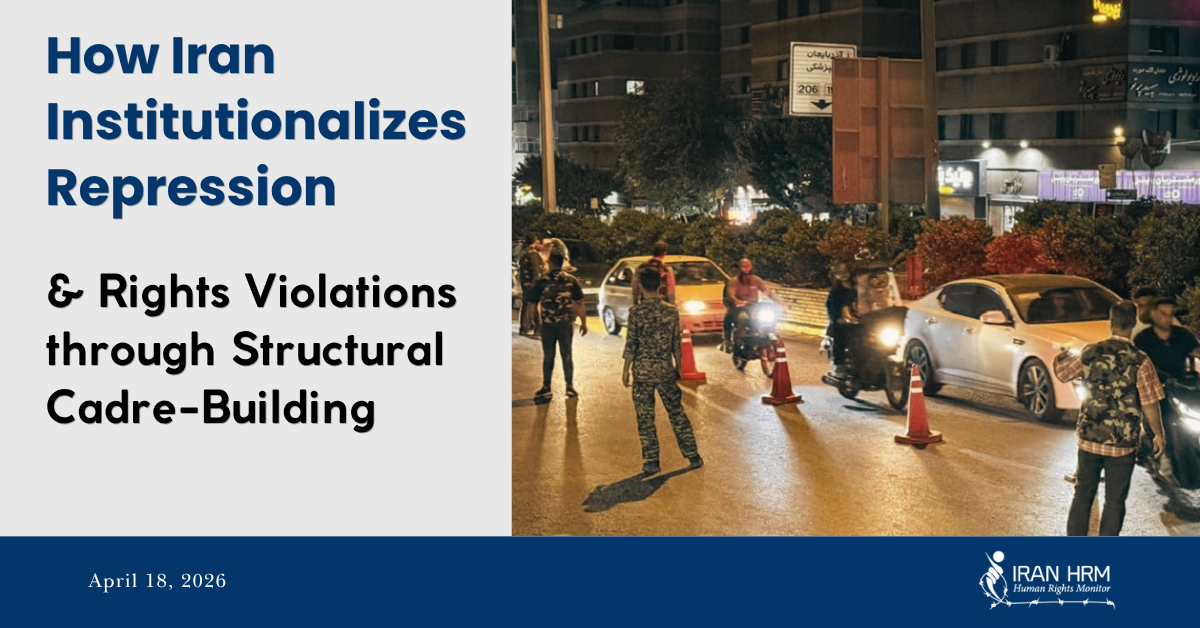
Human rights violations in the Islamic Republic are not accidental deviations from the law; rather, they are the output of an engineered and institutionalized system. By creating specific educational infrastructures, the regime has engaged in targeted cadre-building for its apparatus of repression. Within this framework, the Haqqani School in Qom has played a pivotal role as one of the most significant “cadre-building laboratories,” supplying personnel for the security-judicial architecture. A study of this school reveals the truth of how human rights violators are “trained” for their missions.

A Laboratory for Training Repression
Since the 1950s, the Haqqani School of Qom emerged as a modern educational center within the seminary, but following the 1979 Revolution, it became one of the most critical human resources for the Islamic Republic’s judicial and security institutions. This article demonstrates how the school’s educational and ideological structure, alongside its network of graduates, has shaped the regime’s security and judicial patterns. It also examines the link between this structure and widespread human rights violations.
-
The Haqqani School: From Seminary Reform to Political-Security Cadre Training
The school was founded to establish educational order and train students familiar with modern sciences. However, features such as:
- Coherent ideological training
- Emphasis on organizational discipline
- Readiness for political roles
- Rigorous ideological and ethical screening
transformed it into a hub for training political and security forces. After the 1979 Revolution, the school’s alumni network secured key roles in:
- Revolutionary Prosecutor’s Offices
- The Judiciary
- The Ministry of Intelligence
- Security and oversight bodies
-
Linking the Educational Structure to the Security-Judicial Pattern
Several characteristics of the school influenced the regime’s security-judicial model:
- 2.1 A Security View of Society: Training emphasized “threat identification”, “preserving the system,” and confronting “deviant currents.” This perspective was later reproduced within security institutions.
- 2.2 Focus on Ideological Loyalty: Selection based on ideological fealty created a pattern later replicated in security and judicial institutions.
- 2.3 Merging Traditional Jurisprudence with Security Functions: A specific interpretation of Sharia—prioritizing “system preservation”—was reinforced in the school and integrated into the judicial structure.
-
Human Rights Reports and the Role of Haqqani-Influenced Structures
Systemic rights violations in Iran—such as arbitrary arrests, unfair trials, coerced confessions, and severe restrictions on expression as well as violation of minorities rights (religious and ethnic) —are often linked to institutions rather than individuals. However, since a significant portion of managers in these structures were Haqqani graduates, the link between the school’s educational model and the behavior of security-judicial bodies is clear. This ideological training has led to the formation of structures responsible for systematic violations. Effectively, the school serves as the ideological base behind the regime’s repressive apparatus.
-
Human Rights Consequences of This Model
The following consequences are evident in Iran’s security-judicial structure:
- Lack of judicial independence
- Replacement of legal perspectives with security-driven ones
- Non-compliance with international fair trial standards
- Use of vague laws to restrict freedoms
- Persistent structural impunity for violators
-
What Can the International Community Do?
Within the framework of international law, the global community possesses legitimate tools:
- 5.1 Documentation: Supporting independent bodies to document violations and strengthening UN Special Rapporteurs.
- 5.2 Diplomatic Pressure: Utilizing the mechanisms of the Human Rights Council and the UN Security Council to hold the Islamic Republic accountable to its international treaty obligations.
- 5.3 Supporting Civil Society: Strengthening independent rights groups and protecting lawyers and activists.
- 5.4 Accountability Mechanisms: Using “Universal Jurisdiction” specifically regarding “Death Judges” and torturers and applying targeted sanctions.
-
Key Figures: From the Classroom to the Apparatus of Repression
The following list categorizes the most influential Haqqani alumni across various branches of power:
I- Judicial Branch (The primary sphere of influence)
Ebrahim Raisi
- Prosecutor of Karaj
- Prosecutor of Hamadan
- First Deputy Head of the Judiciary
- Prosecutor-General of Iran
- Head of the Judiciary
Gholam-Hossein Mohseni-Ejei
- Prosecutor-General of Iran
- Spokesman for the Judiciary
- First Deputy Head of the Judiciary
- Head of the Judiciary
Ali Razini
- Head of the Judicial Organization of the Armed Forces
- Head of the Special Clerical Court
- Deputy for Legal Affairs of the Judiciary
Hossein-Ali Nayeri
- Sharia Judge of the Revolutionary Courts
- Head of the Supreme Disciplinary Court for Judges
Gholam-Hossein Rahbarpour
- Sharia Judge of the Tehran Revolutionary Courts
Ebrahim Nekounam
- Judge of the Revolutionary Courts
- Lead Official for Security Cases in the 1980s (1360s)
Ali Qoddusi
- Attorney-General of the Islamic Revolution
- Co-founder of the Haqqani School
Mostafa Pourmohammadi
- Minister of Justice
Mohammad Mohammadi Reyshahri
- Sharia Judge of the Revolutionary Courts
- Head of the Military Courts
- Head of the Judicial Organization of the Armed Forces
- Prosecutor-General of Iran
- Minister of Justice (unofficial)
II- Security and Intelligence Branch
Mostafa Pourmohammadi
- Deputy Minister of Intelligence
- Minister of Interior
- Head of the General Inspection Organization
Ali Fallahian
- Minister of Intelligence
- Member of the Assembly of Experts
Ruhollah Hosseinian
- Security Official in the 1980s (1360s)
- Head of the Center for Islamic Revolution Document Center
- Member of Parliament (Majlis)
Mohammad Mohammadi Reyshahri
- Minister of Intelligence
Gholam-Hossein Mohseni-Ejei
- Minister of Intelligence
III. Political, Legislative, and Cultural Branches
Ebrahim Raisi
- President
- Member of the Assembly of Experts
Mostafa Pourmohammadi
- Minister of Interior
Mohammad Mohammadi Reyshahri
- Custodian of the Shah Abdol-Azim Shrine
Ruhollah Hosseinian
- Member of the Islamic Consultative Assembly (Majlis)
- Legislative Branch (Parliament/Majlis)
Ruhollah Hosseinian
- Representative of Tehran in the 8th Majlis
Ali Fallahian
- Member of the Assembly of Experts
Ebrahim Raisi
- Member of the Assembly of Experts
- Cultural and Religious Sphere
Mohammad Mohammadi Reyshahri
- Custodian of the Shah Abdol-Azim Shrine
- President of the Quran and Hadith University
Ruhollah Hosseinian
- Head of the Center for Islamic Revolution Document Center
Ali Qoddusi
- Co-founder of the Haqqani School
- Lesser-known Figures Linked to the Haqqani Network
These individuals are identified in research sources as judges, Sharia judges, or security managers of the 1980s (1360s):
- Gholam-Hossein Rahbarpour – Sharia Judge
- Ali Mobasheri – Judge of the Revolutionary Courts
- Mohammad Salimi – Judge and Security Official
- Mohammad-Reza Ali-Akbari – Judge of the Revolutionary Courts
- Hossein Karimi – Judge of the Revolutionary Courts
Analytical Summary
Since the 1970s, the Haqqani School has been the most significant center for training judicial and security managers for the Islamic Republic. The school’s influence is concentrated in three main areas:
- The Judiciary: Over 70% of senior judicial managers from the 1980s to the 2010s emerged from this school.
- Ministry of Intelligence and Security Apparatus: Several Ministers of Intelligence and dozens of security directors have been part of the Haqqani network.
- Politics and Governance: Including a President, several Ministers, and members of the Assembly of Experts.
- Network Map of the Haqqani School (Structural Analysis)
Central Node: Haqqani School (Qom) This node serves as the center of the network, from which four primary axes branch out:
-
Judicial Axis
The largest and most influential branch of the network
Main Nodes:
- Ebrahim Raisi
- Gholam-Hossein Mohseni-Ejei
- Ali Razini
- Hossein-Ali Nayeri
- Ali Qoddusi
- Mohammad Mohammadi Reyshahri
- Gholam-Hossein Rahbarpour
- Ebrahim Nekounam
Links:
- Haqqani School → Judiciary
- Judiciary → Revolutionary Courts
- Revolutionary Courts → Prosecutor-General’s Office, Special Clerical Court, Judicial Organization of the Armed Forces
Network Characteristics:
- This axis has the highest node density.
- Power transition in this axis typically follows the flow: “Judge” → “Prosecutor” → “Head of Organization” → “Head of Judiciary.”
-
Security and Intelligence Axis
The second most influential branch
Main Nodes:
- Mostafa Pourmohammadi
- Ali Fallahian
- Mohammad Mohammadi Reyshahri
- Gholam-Hossein Mohseni-Ejei
- Ruhollah Hosseinian
Links:
- Haqqani School → Ministry of Intelligence (MOIS)
- Ministry of Intelligence → Security Deputy, Counter-Intelligence Deputy, Security Courts
- Haqqani School → 1980s (1360s) Security Institutions
Network Characteristics:
- This axis has high overlap with the Judicial Axis.
- Many individuals have played roles in both axes simultaneously or sequentially.
-
Political and Executive Axis
The third branch in terms of scope
Main Nodes:
- Ebrahim Raisi
- Mostafa Pourmohammadi
- Mohammad Mohammadi Reyshahri
- Ruhollah Hosseinian
Links:
- Haqqani School → Government (Ministry of Interior, Ministry of Justice)
- Haqqani School → Parliament (Assembly of Experts, Islamic Consultative Assembly)
- Haqqani School → Religious-Executive Institutions (Custodianships/Bonyads)
Network Characteristics:
- This axis is primarily fed through judicial and security connections.
- Entry into politics usually occurs after consolidation within the other two axes.
-
Cultural and Archival Axis
A smaller but effective branch
Main Nodes:
- Ruhollah Hosseinian
- Mohammad Mohammadi Reyshahri
- Ali Qoddusi
Links:
- Haqqani School → Center for Islamic Revolution Document Center
- Haqqانی School → Quran and Hadith University
- Haqqani School → Seminaries (Hawza)
Network Structure
Network Type:
- “Star-Cluster” Network
- One Center (Haqqani School)
- Three Primary Clusters (Judicial, Security, Political)
- Secondary Clusters (Cultural, Religious)
Key Network Features:
- High Density in the judicial axis.
- Node Overlap between judicial and security sectors.
- Power Flow: School → Judiciary → Security → Politics.
- Network Stability sustained over four decades.
(Note to the reader: Some of the above-mentioned officials are deceased)
- Final Summary: The Industry of Crime and the Necessity of Structural Accountability
Analysis of the cadre-building process over recent decades proves that human rights violations in Iran are not accidental; they are the precise output of a “State Policy.” In this structure, educational and religious institutions serve as factories for producing “agents of repression” rather than experts.
- Replacing Expertise with Repressive Ideology:
Utilizing centers like the Haqqani School to supply judicial and security cadres reflects meticulous engineering. Absolute loyalty to the system and the suspension of universal human rights are prerequisites for office. This process has institutionalized human rights violations within the very fabric of the state’s pillars and the apparatus of power.
- Criminal Responsibility Beyond Individuals:
The existence of this cohesive network of like-minded managers constitutes “Superior Command Responsibility” and a systematic attack on civilians. The international community must realize that prosecuting individual officials is insufficient; the system constantly regenerates new violators through its cadre-building infrastructure.
- The Regime as a War Machine Against Citizens:
The international community must recognize the reality that the Islamic Republic is not a conventional state, but a structure built upon ‘organized and institutionalized crimes against humanity and human rights violations’.
Its reliance on networks like Haqqani demonstrates that this regime cannot govern without gross violations of human rights. These training centers are merely tools for the regime to ensure its survival by sustaining the agents of repression. Therefore, legal action must target the entirety of the Islamic Republic’s structure as a criminal entity designed for oppression.
Conclusion
To break the “Cycle of Impunity,” the international community must challenge the structural nature of this regime. By transforming education and the judiciary into “levers for crimes against humanity,” the Islamic Republic has forfeited its legitimacy as a member of the global community. Until this entire structure—built on the systematic training for repression—is held accountable under the doctrine of “Universal Jurisdiction,” the machinery of death and terror in Iran will not stop. This regime is not merely a rights violator; it is the institutionalized enemy of human dignity.