
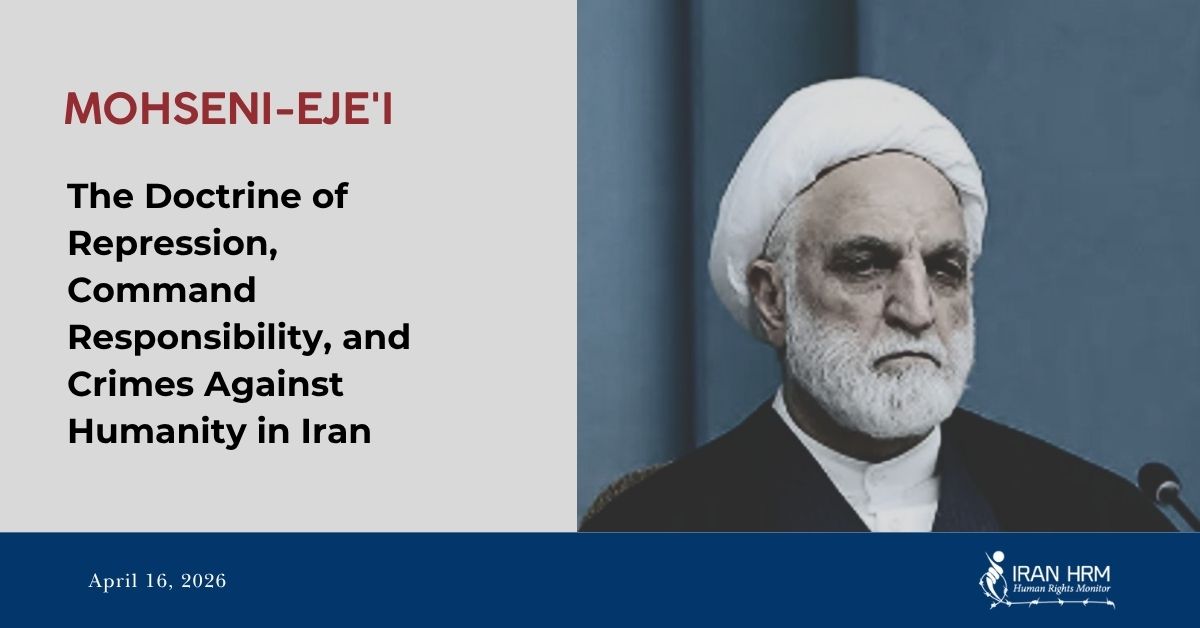
Gholam-Hossein Mohseni-Eje’i, as one of the key figures in the judicial and security apparatus of the Islamic Republic, possesses an extensive and multifaceted record; a record that, through continuous involvement in the suppression and execution of dissidents, has earned him the title “The Judge of Death.” From the perspective of international law, an examination of his career demonstrates the fulfillment of the criteria for “Command Responsibility” in systematic crimes.

Background and Development of a Security-Judicial Persona: Who is Gholam-Hossein Mohseni-Eje’i?
Gholam-Hossein Mohseni-Eje’i was born in 1956 in Ezhiyeh, Isfahan Province. He is a graduate of the Haqqani School, an institution from which many influential figures in the judicial and security structure of the Islamic Republic emerged.
His official activities began in early 1980 upon entering the Islamic Revolutionary Prosecutor’s Office, where he served as an interrogator and judicial official. In the early 1980s, he operated within the judicial structure alongside figures such as Asadollah Lajevardi (the then-Revolutionary Prosecutor of Tehran, known as the “Butcher of Evin” for his cruelty in the torture and mass execution of political prisoners), playing a significant role in the judicial processes of that era.

In subsequent years, Mohseni-Eje’i held numerous positions, including:
- Prosecutor of the Special Clerical Court
- Prosecutor-General of the Special Clerical Court
- Minister of Intelligence in the Ninth Government (under Mahmoud Ahmadinejad)
- Prosecutor-General of Iran
- First Deputy Chief of the Judiciary
- Chief Justice of Iran (since 2021)
He has also served as the head of the Monitoring Council of the IRIB and a member of the Expediency Discernment Council.
Eje’i’s Role in the Ministry of Intelligence and the Groundwork for the 1988 Massacre
With the formation of the Ministry of Intelligence, Mohseni-Eje’i became a key operative within the institution. In 1984 and 1985, he was responsible for recruitment at the Ministry and subsequently served as the Judiciary’s representative to the Ministry. Between 1985 and 1988 (the year of the massacre of 30,000 political prisoners), his role in security decision-making and planning began. During this period, he was the Judiciary’s representative in the Ministry of Intelligence. Although he did not directly sit on the “Death Committees” (those who issued the execution orders), his position played a vital role in advancing this massacre. This period constitutes a clear case of aiding and abetting the gross violation of Article 6 of the International Covenant on Civil and Political Rights (ICCPR) – the Right to Life. After this period, Eje’i remained active in security and judicial fields and taught at the Faculty of the Ministry of Intelligence.
Consolidating Eje’i’s Position in Eliminating Dissident Voices (The Al-Ghadir Plan)
During the 1990s, his presence in the Ministry of Intelligence continued, and his name became specifically linked to a project known as the “Al-Ghadir Plan.” According to reports, this plan involved the abduction and enforced disappearance of former political prisoners and dissidents—individuals who remained under surveillance and harassment even after their release. Under this framework, certain individuals were detained and transferred to unknown locations without any clear judicial process, which constitutes enforced disappearance and a violation of Article 9 of the ICCPR (Prohibition of Arbitrary Arrest). Gradually, the scope of these actions expanded beyond former political prisoners to include intellectuals, writers, and critics; a trend that later drew attention in cases such as the “Chain Murders.”
Eje’i and the Systematic Suppression of Freedom of Expression
As the Judiciary’s representative on the Press Monitoring Board, particularly between 1998 and 2000, Gholam-Hossein Mohseni-Eje’i played a significant role in restricting the country’s media landscape. During this period—one of the most sensitive times in Iranian press history—numerous publications were banned, and many journalists faced severe restrictions. These actions took place as independent and critical media were growing. Reports indicate that decisions regarding the closure of publications and the prosecution of media activists were conducted within a framework that evaluated media through a security lens. In an interview with Fars News Agency, Mohseni-Eje’i confirmed this approach, stating that in the view of certain officials, the activities of part of the press were in conflict with “system interests” and “national security.” This perspective paved the way for widespread crackdowns on media and journalists, leading to a drastic decline in press diversity and freedom—a flagrant violation of Article 19 of the ICCPR (Freedom of Expression).
Specific Role of Eje’i in the Suppression of Popular Protests
- The 2009 Protests: During the protests following the 2009 presidential election, Mohseni-Eje’i held two key positions: Minister of Intelligence and then Prosecutor-General. These roles gave him an influential part in the security and judicial processes related to the protests. Under his management, the Ministry of Intelligence was responsible for identifying, arresting, and interrogating protesters. During this period, reports of widespread detention and pressure to extract confessions were published. In July 2009, regarding the broadcasting of televised confessions of detainees, Eje’i stated that this matter depends on the Judiciary’s discretion and can be carried out based on the decisions of judicial authorities (a clear violation of the international prohibition against coerced confessions).
- Protests of December 2017–January 2018 and the Killing of Protesters in Prison: During the nationwide protests in December 2017/January 2018, reports emerged of the deaths of several political prisoners in detention centers—cases officially declared as “suicides.” On March 5, 2018, in a televised program, Mohseni-Eje’i defended the official narrative. He alluded to similar cases in the past, claiming that not all suicides result from prison conditions and that in some cases, individuals take such actions to prevent the disclosure of information. These justifications served as a cover for extrajudicial killings and constitute a violation of Article 7 of the ICCPR (Prohibition of Torture and Cruel Treatment).
- Antagonism Towards Women: In 2011, Gholam-Hossein Mohseni-Eje’i was named the recipient of the “International Club Award” (The Club) by the Women’s World Connection; an award presented to him in absentia on June 6 of that year in Madrid, Spain. The organization described him as the “most anti-woman judge in the world,” citing his role in restricting women’s rights, particularly in the area of divorce rights.
- In subsequent years, his name appeared in significant cases related to women, such as that of Rayhaneh Jabbari, who was executed in 2014 after being convicted of killing an intelligence official in self-defense against sexual assault.
- The case of Zahra Kazemi, the Iranian-Canadian journalist killed in custody in 2003, is another instance where Eje’i’s name was raised. During the proceedings, Saeed Mortazavi, the then-Tehran Prosecutor, was identified as the main suspect, and Eje’i’s role in his acquittal was prominent.
The Nationwide Protests of December 2025/January 2026 and the Most Brutal Anti-Human Positions
The most brutal and anti-human positions of Mohseni-Eje’i are observed regarding the protesters of the recent December/January uprising and the subsequent crackdown. He has repeatedly insisted on issuing death sentences for protesters and, following the recent war, on issuing death sentences under the pretext of espionage and ties to foreign media. We highlight several of his explicit statements which demonstrate criminal intent in committing crimes against civilians:
- “We will show no leniency to rioters”—”Rioters must be dealt with without any leniency.”
- “If we want to take action (commence executions), we must do it quickly… if it is two or three months later, it will have no effect” (a blatant violation of judicial independence and the right to a fair trial through the insistence on summary proceedings to achieve a deterrent effect).
- “Using the capacities of existing laws, especially the law known as the Aggravation of Punishment for Espionage, it is necessary that judicial verdicts and sentences for elements and agents of the invading enemy continue to be issued with greater speed; especially for those elements and cohorts of the enemy whose legal sentence is the confiscation of property and the deprivation of life.”
- “Our sentences, Mr. Khalili (First Deputy Chief of the Judiciary), must be issued more frequently. Both regarding the confiscation of property and regarding the issuance of death sentences—truly accelerate these.”
- And most recently on April 16, 2026: “The law known as the Aggravation of Punishment for Espionage clearly clarifies the duty regarding elements accompanying and cooperating with the hostile enemy, specifically the Zionist enemy, and this law is devoid of ambiguity in its various sections. Whether where the confiscation of property must be ordered or where the law mandates the deprivation of life and other punishments, no ambiguity exists.”
Total Communication Blackout and the New Wave of Mass Arrests: Virtual Pretexts in the Absence of Internet
While international internet in Iran has been completely cut off for 47 days, depriving people of access to the outside world to prevent exposure and appeals for help, the judicial-security apparatus under Mohseni-Eje’i is using this absolute silence as a pretext to expand the scope of repression.
A clear example of this blind suppression is evident in the news published by the state news agency IRNA on March 24, 2026; where the General Command of the Police, under the supervision and with the green light of Eje’i’s Judiciary, announced the “identification and arrest of 466 self-sold individuals dependent on the enemy who, through illegal activities in cyberspace, caused disruption to the country’s security.” According to these security-driven reports, which lack legal validity, these individuals are accused of “disturbing public opinion, creating fear and anxiety in society, mental insecurity, propaganda for the enemy, and organizing.” Attributing such heavy charges to activists and citizens in cyberspace, under the conditions of a total 47-day international internet blackout, reveals a horrific truth: fabricating baseless excuses devoid of evidentiary proof to justify mass arrests and the intimidation of society.
Escalation of Political Executions; The Necessity of Urgent International Intervention
Mohseni-Eje’i has ordered the “acceleration of the issuance and execution of death sentences” while, in the period between March and April 2026, the execution machine under his command has taken more than a dozen of lives to create an atmosphere of absolute terror. His recent bloody record includes the following:
- Political Executions of late March/April 2026: Execution of political prisoners, members of the PMOI including Mohammad Taghavi, Vahid Bani-Amerian, Babak Alipour, Pouya Ghobadi, Abolhassan Montazar, and Akbar Daneshvarkar on March 30, March 31, and April 4, 2026.
- Execution of Protesters from December 2025/January 2026 Uprising: Execution of four protesters hanged in a rushed process lacking any judicial standards:
- Amirhossein Hatami (April 2, 2026)
- Mohammad-Amin Biglari (April 5, 2026)
- Shahin Vahed-Parast (April 5, 2026)
- Ali Fahim (April 6, 2026)
- Public Executions: The brutal execution of three protesters named Saleh Mohammadi, Mahdi Ghassemi, and Saeed Davoudi in public in the city of Qom at dawn on Thursday, March 19, 2026; an act signifying a systematic return to medieval policies of intimidation and public humiliation of citizens.
- Issuance of Death Sentences (Imminent Risk of Execution): In addition to the above executions, Mohseni-Eje’i, by pressuring Revolutionary Court judges, has secured death sentences for four other detainees from the January uprising: Mohammad-Reza Majidi-Asl, Bita Ali-Hemmati (Mohamma-Reza’s wife), Behrouz Zamani-Nejad, and Kourosh Zamani-Nejad, whose execution is imminent at any moment.
These executions, carried out under the shadow of a 47-day international internet blackout and in total secrecy, are clear instances of extrajudicial killings and a flagrant violation of Article 6 of the ICCPR.
By presenting these documents to international legal bodies, including the UN High Commissioner for Human Rights, the Fact-Finding Mission, and prosecutors of courts with universal jurisdiction, we declare that Gholam-Hossein Mohseni-Eje’i, based on the doctrine of “Superior Command Responsibility,” stands at the apex of a systematic deadly attack against civilians in Iran. Therefore, criminal prosecution, the issuance of an international arrest warrant, and the opening of a case for Crimes Against Humanity against him are vital steps toward stopping this systematic slaughter.