The Historical Continuity of Judicial Repression; From the 1980s to Today’s Security Cases
Over the past days, five installments of the report series “The Judiciary in Iran; The Legal Lever of Repression Under the Supreme Leader” were published, addressing the following themes in sequence:

- The legal and political structure of the judiciary
- The selection, training, and removal of judges
- Revolutionary Courts and the role of security institutions
- From denial of the right to defense to judicial criminalization
- From Revolutionary Courts to the implementation of execution
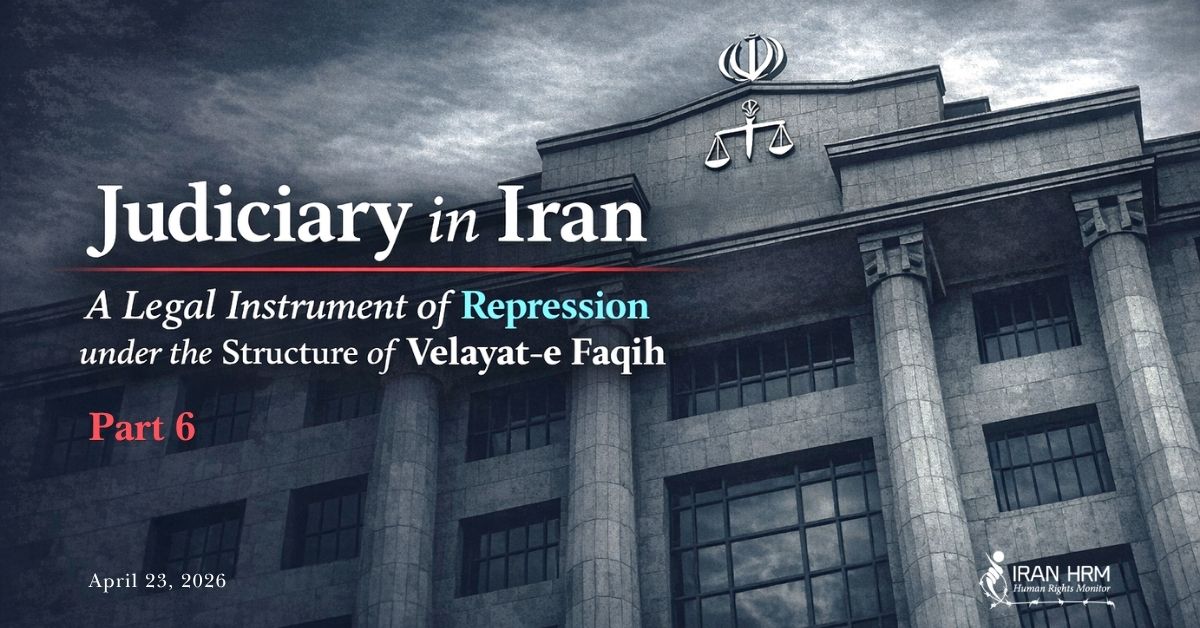
Now, in the sixth and final installment of this series, the focus turns to the historical continuity of this pattern; namely, that what is seen today in political and security-related cases in Iran is not a new deviation, nor the product of a few judges or a handful of cases, but rather the continuation of an entrenched mechanism in which the judiciary, within the framework of Velayat-e Faqih, functions as a legal lever of repression. The evidence gathered in this project; from restrictions on lawyers and solitary confinement to forced confessions, opaque trials, elastic criminal charges, and expedited executions, all point to this historical continuity.
What is examined in this installment is not merely a review of the past, but an effort to read the present in light of that past. If the previous five reports explored the different components of this mechanism step by step; from the structure of power to the selection of judges, from Revolutionary Courts to the denial of defense rights, and from criminalization to execution, the central issue becomes even clearer here: for decades, the judiciary in Iran has functioned not as an independent institution for the administration of justice, but as part of the political architecture for the elimination of opponents. What has changed across different periods is more the form in which this role appears than its substance.
Judicial repression; A continuous and structural pattern
One of the main findings of this series is that violations in political and security-related cases in Iran are neither scattered nor accidental. Arbitrary arrest, deprivation of legal counsel, isolation in security detention facilities, prolonged solitary confinement, threats against family members, extraction of confessions under pressure, restricted access to case files, brief and closed hearings, reliance on vague security charges, ineffective appeals, expedited or secret implementation of sentences, and even the exile of prisoners to remote prisons with harsh climates in order to intensify pressure on them and their families, have all been repeated across different periods and against diverse categories of defendants. Taking together, these elements form a stable pattern; one in which the judiciary, instead of creating distance between security power and the fate of the accused, becomes one of the channels through which the political will of the ruling system is translated into judicial elimination.
The significance of this repetition lies in the fact that it reveals the structural nature of repression. If these violations had occurred only in a few isolated cases, one might speak of disorder, abuse, or individual misconduct. But when the same pattern, with the same components, appears from older cases to those of 1401, 1404, and 1405, it is no longer possible to speak of exceptions. In such circumstances, the issue is not merely a particular judge, a particular interrogator, or a particular branch. It is an integrated structure in which the law, detention facilities, prosecution, courts, and implementation of sentences all operate along the same path.
From the 1980s to today; Changing form, constant logic
To understand the present situation, one must recognize that the logic of judicial repression in Iran has deep historical roots. The 1980s, and particularly the 1988 massacre, were not simply an isolated historical tragedy. They were an indication of how the structure of power confronts opposition. During that period, opponents were eliminated with minimal فاصله between political decision and physical destruction; without real trial, without the right to defense, and through structures that offered only the appearance of judicial process. What occurred in the following decades was not the end of that logic, but its legal and administrative reconfiguration. The same will to eliminate was increasingly framed through security cases, criminal charges, Revolutionary Courts, judicial rulings, and executive regulations.
In that transformation, the judicial appearance became more pronounced, but the outcome in many cases remained the same: silence, long imprisonment, or physical elimination of opponents. If in the past the process of elimination was faster and involved fewer formalities, the same logic is now reproduced through laws, court branches, indictments, judgments, appeals, and execution. This continuity can be seen in the repeated use of Revolutionary Courts, the recurrence of solitary confinement and forced confessions, the restriction of counsel, and the conversion of protest or political activity into capital offenses. This persistence shows that the ruling regime in Iran has never departed from the logic of elimination in dealing with its opponents; it has merely made the method more legalistic and bureaucratic.
Law; From an instrument of justice to the official language of repression
One of the most important findings of this series is that law, within this structure, has lost its ordinary function. In a healthy legal system, law should define the limits of power, protect the accused against governmental arbitrariness, and provide predictable and fair standards for adjudication. Yet in Iran’s political and security-related cases, law has repeatedly been transformed into an instrument for expanding the repressive power of the state. Charges such as “enminy against God” (moharebeh), “Corruption on Earth” (efsad-e fel-arz), rebellion (baghi), assembly and collusion against national security, and propaganda against the state are so vague, elastic, and open to broad interpretation that they enable the judiciary to redefine protest activity, political associations, or civil activism as among the gravest criminal offenses.
This distortion of the function of law is clearly visible in actual cases. In some instances, limited damage to an ATM, setting fire to a Basij base, alleged cooperation with or membership in an opposition group, or even media activity and public statement-writing, have all been framed as enmity against God, corruption on Earth, rebellion, assembly and collusion, or propaganda against the state. In this way, the law no longer marks a clear boundary between protest and crime; rather, that boundary is shifted according to the political needs of the ruling system. In such a structure, legal terminology becomes the official language of repression. The indictment no longer serves to describe a crime precisely; it becomes a tool for politicizing a case. And the judicial ruling is no longer the product of impartial assessment of evidence, but the outcome of legal framing built upon the same security narrative that began at the moment of arrest.
The continuity of the tools; Solitary confinement, confession, Revolutionary Court, execution
Across all these years, the main tools of this pattern have not changed in substance. First, the accused is cut off from the outside world; through sudden arrest, severed contact with family, denial of counsel, and detention in solitary confinement. Then, under unequal and coercive conditions, the accused is subjected to physical and psychological pressure until acceptance of the charge or confession is obtained. After that, the tainted material is transformed into judicial rulings through Revolutionary Courts or courts aligned with the security structure. Finally, through ineffective appeal and expedited or secret execution, the case ends in judicial elimination. This sequence has recurred from earlier decades to the present in numerous cases.
Descriptions of security wards make this mechanism even clearer. Atena Farghadani reported that cameras had even been installed inside toilets. Ali Kantouri described being beaten and then held in complete solitary confinement for 25 days to prepare him to accept the charges. These are not merely details about prison conditions; they describe the mechanism by which detainees are broken.
At the next stage, forced confessions become central. One of the materials gathered for this project lists methods of extracting confessions, including beatings, flogging, electric shocks, mock executions, induced suffocation, and threats against family members. In the case of Navid Afkari, he himself complained that he had been subjected to severe torture to make false confessions; a witness also documented his beating. Yet the judiciary relied on those confessions as the basis of judgment. In other cases, as well; from Soheil Arabi to Vahid and Habib Afkari, the same pattern appears. What makes the matter structural is not merely the occurrence of torture, but the judicial acceptance of torture-tainted confessions. In this sense, torture in detention and judgment in court are not separate stages; they are parts of a single mechanism.
Recent cases; The reproduction of the same logic
The cases of recent years, especially those connected to protests, clearly show how this logic is reproduced in the present. Mohsen Shekari moved from arrest to execution in an extraordinarily short time. Majidreza Rahnavard was executed only 13 days after the start of his trial. Mohammad Ghobadlou faced rejection of his chosen lawyers, expedited proceedings, and denial of effective defense. Saleh Mohammadi, Mehdi Ghasemi, and Saeed Davoudi were executed in Qom after a very short period following arrest and through rushed proceedings. In the case of the seven young protesters linked to Basij Base 185 Shahid Mahmoud Kaveh on Namjoo Street in Tehran, several defendants were executed in Farvardin 1405, while from the outset the case involved denial of counsel, restricted access to the file, reliance on forced confessions, and accelerated proceedings. These are different cases across different times and places, but their underlying logic is the same: security arrest, weakening of defense, charge construction, compressed proceedings, and elimination.
The importance of these cases lies in the fact that they show the historical pattern of judicial repression is not confined to the past; it remains active and ongoing. What was applied in earlier decades through other methods is now continued through security cases, Revolutionary Court branches, judicial rulings, and executive regulations governing sentences. During one period, the Supreme Court upheld many death sentences within a short time. During another, official warnings were issued that orders to accelerate proceedings in security cases would increase the risk of arbitrary and summary executions. Moreover, recent statements by Gholamhossein Mohseni Ejei on the need for “extraordinary” proceedings in security cases once again showed that, within the judicial structure of the ruling regime in Iran, accelerating proceedings and implementation of judgments is part of the logic of repression, not an exception. A detailed examination of Ejei’s role and that of other judicial officials appears in the separate report on the architects and executors of judicial repression.
The judiciary; Part of the architecture of power, not a monitor of it
If one moves beyond individual cases, the conclusion of this six-part series becomes clear: the judiciary in Iran does not stand outside the structure of repression, occasionally failing to confront it. It is itself one of the principal components of that structure. From the appointment of the head of the judiciary, to the concentration of authority, to the ideological selection of judges, to its ties with security officers, to Revolutionary Courts and the power of the head of the judiciary to intervene in final judgments, all show that the judiciary in Iran functions from within the structure of Velayat-e Faqih, not at an independent distance from it. From the moment of arrest to the implementation of sentence, the judiciary operates alongside security institutions as one of the mechanisms for organizing, legitimizing, and completing repression.
Even the examination of key judges and prosecutors must be understood in that framework. The issue is not merely about individuals, though their role and the role of specific branches is important. The issue is that such individuals and branches operate within a larger architecture that enables them to transform the security narrative into judicial rulings, and judicial rulings into death sentences or long-term silencing. For that reason, as agreed earlier, detailed discussion of particular individuals and branches is better pursued in the separate report on the so-called “death judges” and the architects and executors of judicial repression. Yet no structural summary of this series can be complete without expressly identifying the judiciary’s institutional role within the architecture of power. Here, the judiciary is not a monitor of repression. It is one of its pillars.
Structural conflict with international obligations
When this pattern is measured against Iran’s international obligations, its nature becomes even clearer. Articles 9 and 14 of the International Covenant on Civil and Political Rights guarantee liberty and security of people, prohibit arbitrary detention, and guarantee the right to a fair trial and access to counsel of one’s own choosing. The Human Rights Committee’s General Comments also make clear that in cases involving the death penalty, effective access to counsel at all stages of the proceedings is essential, and punishment following a manifestly unfair trial is arbitrary. They further emphasize the exclusion of evidence obtained through torture. Yet the pattern documented in this series; from solitary confinement and denial of counsel to forced confessions, sham proceedings, ineffective appeals, and secret or expedited executions, conflicts with these obligations at almost every point. That is why international assessments speak of sham trials, arbitrary executions, and systematically unfair processes.
This conflict is not marginal or secondary. It is structural. The issue is not simply that one particular judgment was unjust or that one specific judge committed misconduct. The issue is that in a large number of cases, the entire process, from arrest to judgment to execution, has been in conflict with the most basic principles of fair trial, the prohibition of torture, and the right to life. When the accused is denied independent counsel, denied access to the case file, forced into confession through torture, tried by a court lacking independence and transparency, and executed without a final visit or prior notice, one can no longer speak of criminal justice. What exists instead is a process in which judicial appearance is used to legitimize a political decision.
Final conclusion; Law as the language of elimination
If these six reports are read together, the final conclusion is clear. The judiciary in Iran, within the framework of Velayat-e Faqih, is not an institution for the administration of justice. It is one of the principal pillars of the continuation of repression. This role begins at the structural level; in the selection and control of judges, in dependence upon the apex of power, and in close connection with security institutions. It then appears in political and security cases through restriction of counsel, solitary confinement, forced confessions, elastic criminal charges, and opaque trials. Finally, in Revolutionary Courts, the Supreme Court, and the implementation of sentences, it leads to complete silencing, long imprisonment, or the physical elimination of opponents. In that sense, the law is no longer a shield for the accused. It is the official language of elimination. Adjudication is no longer a path toward truth. It is a path toward legitimizing a decision already formed within the security sphere. And execution, in this context, is not the endpoint of criminal justice, but the final link in a chain of repression.
This conclusion is the result of the logic of the entire series; from Report No. 1 to Report No. 6. What emerges from these six installments is a coherent picture of the place of the judiciary within the structure of power in Iran: not as an impartial forum of adjudication, but as a legal lever of repression within the framework of Velayat-e Faqih. Understanding this role is essential to any serious assessment of human rights, executions, unfair trials, and political repression in Iran.