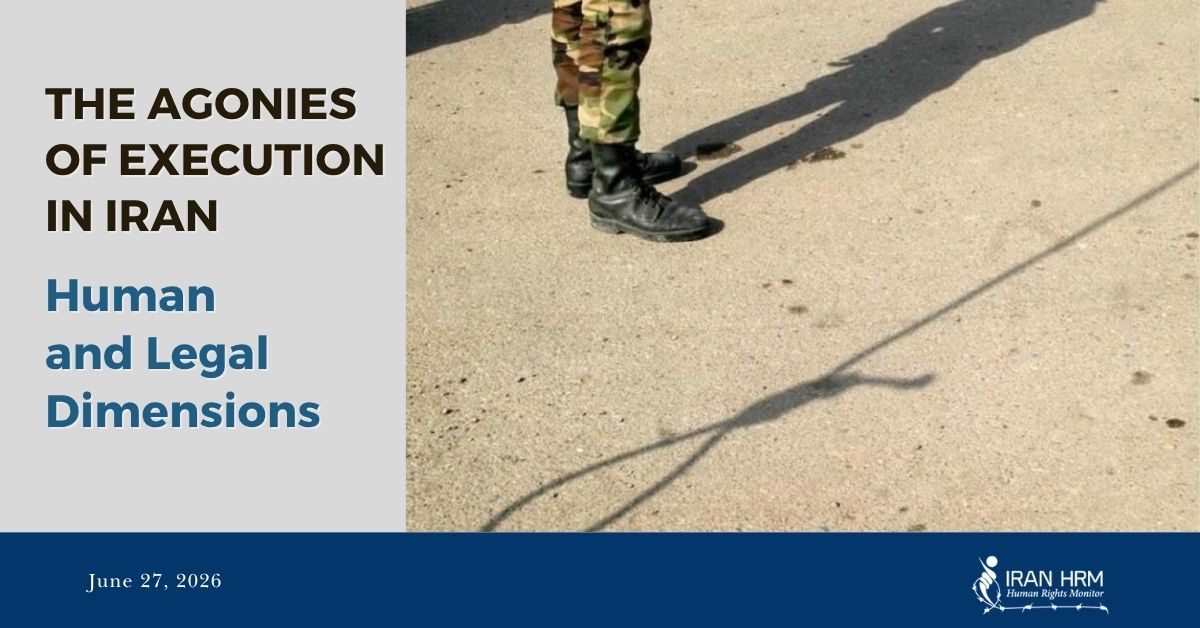
The execution machinery within the judicial system of the Islamic Republic of Iran is not merely a tool for punishment; rather, it functions as a complex mechanism designed to reproduce terror, inflict psychological torture upon survivors, and contain the society’s potential for protest. The agonies of execution in Iran extend far beyond the gallows, unfolding inside solitary confinement cells filled with dread, within the hearts of families deprived of a final farewell, and across unmarked graves whose very physical handover terrifies the ruling establishment. By screening documented facts of egregious violations of due process, secret executions, and silent medical killings, this report uncovers a human catastrophe that challenges the global human conscience.

1. Secret Executions; no right to see your loved ones for the last time
In continuation of the alarming trend of implementing capital sentences without institutional transparency, the inhumane practice of “secret executions” has become a routine tool across the country’s prisons. Under international law, failing to notify the family prior to execution, depriving the prisoner of a final visitation, and concealing the burial site constitute the core components of the crime of secret execution—a lawless pattern executed line by line in the following cases:
- Ali-Asghar Aminipour: 48 years old, married, and a father of three children, originally from Sistan and residing in Gorgan. He was arrested on June 4, 2022, in a drug-related case and was executed during the dawn hours of June 14, 2026, in Birjand Prison, without prior notice to his family and without the opportunity for a final visit. Authorities informed the family of his death only after the sentence had been carried out.
- Belal Saadat Jahani (Gorgij) and Mohammad Amin Narouei: Mohammad Amin, 57 years old, and Belal, 35 years old, both fathers of 3 children from Sistan and Golestan provinces. Their death sentences were carried out in the central prison of Birjand at dawn on Sunday, June 14, 2026, and Monday, June 15, 2026, respectively, without prior notification to their families and in absolute deprivation of their right to a final meeting.
- Ali-Bakhsh Raeisi: A 27-year-old Baluch youth, married, and the father of one child. His execution was also carried out secretly at dawn on June 14, 2026, in Roudan Prison in Hormozgan Province, without any prior notification to his family.
2. The Dread of Death in the Cell; Suicide or State-Sponsored Killing?
The psychological torture stemming from the agonizing anticipation of execution and living under the constant shadow of the gallows has evolved into another lethal component within the structure of Iranian prisons. On Monday, June 22, 2026, a prisoner held in Ghezel Hesar Prison named “Mostafa Nezami” committed suicide and lost his life following severe mental and psychological pressure.
Mostafa, who had been arrested on charges of murder and sentenced to death, had been on the verge of execution since 2023. The excruciating pressure, horrific detention conditions, and lack of access to specialized mental health services in prison drove this human being to a breaking point where, before the executioner had arrived, he ended his own life—a crime for which the Judiciary and the Prisons Organization bear direct responsibility.
3. The Death of Jabbar Mostafa in Evin; Silent Killing Through Medical Deprivation
The deliberate deprivation of access to adequate medical care serves as a hidden, auxiliary arm of death sentences to physically eliminate prisoners. “Jabbar Mostafa”, an Iraqi-born political prisoner who was held in Salon 2 of Ward 7 at Evin Prison, stands as a stark example of these silent killings.
Sentenced to 1.5 years in prison on the baseless charge of “propaganda against the state,” he lost his life after exhibiting acute symptoms of a heart attack due to unanswered pleas for medical assistance and the absolute failure of prison authorities to provide immediate intervention. This tragedy demonstrates once again how the judicial apparatus utilizes the deliberate delay in transferring ailing prisoners and the withholding of medical treatment as instruments of torture and death.
4. Hostage-Taking of Corpses and Unmarked Graves; The Eternal Torture of Survivors
The cruel policy of withholding the bodies of executed individuals from their families and concealing their burial sites constitutes a blatant form of continuous psychological torture inflicted upon survivors. Since the beginning of 1405 (March 2026), the bodies of a large number of political prisoners, including Vahid Bani-Amerian, Mohammad Taghavi, Babak Alipour, Pouya Ghobadi, Abolhassan Montazer, Akbar Daneshvarkar, Nima Masoomshahi, and Hamed Validi, as well as detainees from the January 2026 nationwide protests such as Amir-Hossein Hatami, Mohammad-Amin Bigleri, Shahin Vahedparast, and Ali Fahim, have been buried secretly after execution without being returned to their families.
This trajectory continues the 1404 (2025) policy implemented against political prisoners such as Mehdi Hassani, Behrouz Ehsani, Ali Mojadam, Habib Deris, Salem Mousavi, and others. The agonizing and poignant Instagram post by Vahid Bani-Amerian’s father reveals the depth of this torture:
“How long will you fix two expectant eyes on the threshold of the house? You will no longer see the shadow of your child at the door. They have still not handed over the body of Vahid and the other executed individuals, nor have they disclosed the location of their graves.”
5. Systematic Obstruction of Due Process; The Engineering of Death Sentences
The facts of recent cases demonstrate how legal safeguards for defendants have been utterly obliterated:
- The Case of Armin Noormohammadi: An architecture student born in 1998, he was sentenced to death on the charge of “Moharebeh” (enmity against God) by Judge Salavati in Branch 15 of the Revolutionary Court for causing minor damage to a Sepah Bank ATM during the 2022 protests. This sentence was issued despite the fact that the designated financial damage of 184 million Tomans had been fully paid and the private plaintiff had formalized a waiver of complaint. His defense attorney (Ali Sharifzadeh Ardkani) stated that he registered the appeal within the statutory legal timeframe; however, Judge Salavati refuses to forward the case to the Supreme Court and falsely claims that no appeal has been filed.
- The Case of Peyman Ganjehi: A 33-year-old youth and one of the detainees of the January 2026 nationwide protests. He was sentenced to death by Judge Iman Afshari in Branch 26 of the Revolutionary Court on the charge of “Moharebeh” (with the alleged act of burning public property cited as the basis).
- The Cases of Zahedan Protesters: Death sentences have been issued for Misagh Rahmatzadeh (Kharkouhi), an 18-year-old Baluch youth who was subjected to severe physical and psychological torture to extract forced confessions, and Yasin Kabdani, 22 years old, who was a minor (17 years old) at the time of his arrest and was sentenced to death solely based on forced confessions extracted under torture.
- Saadan Hassani: Another horrific example is the execution of his death sentence in Hamedan Prison after enduring 26 years of agonizing anticipation under the constant shadow of a death decree.
6. The Alarm Bells of Imminent Executions and International Warnings
Following the relative subsiding of regional conflicts and geopolitical tensions, the ruling establishment has drastically intensified its domestic wave of suppression. The covert transfers of prisoners have sounded the alarm regarding the imminent execution of sentences:
- Transfer to Death Quarantine:
- On June 13, 2026, Ali Fattah (Kamali) and Mohammad (Babak) Naghizadeh, both protesters from the January 2026 demonstrations, were immediately transferred from the Greater Tehran Prison to Ghezel Hesar Prison in Karaj following the confirmation of their death sentences (on charges of Moharebeh and Sab-al-Nabi based on confessions extracted under torture).
- Concurrently, Alireza Peighambari, a 26-year-old political prisoner who was previously sentenced to death by Branch 23 of the Tehran Revolutionary Court on the charge of “Moharebeh” and whose case is currently pending before the Supreme Court, was also transferred from Greater Tehran Prison to Ghezel Hesar Prison (the execution facility). Previously, an informed source stated that Alireza Peighambari had not even participated in the protests and happened to find himself amidst the crowd by pure coincidence after leaving his workplace.
Furthermore, Ali Pishevarzadeh, a 28-year-old medal-winning athlete in water polo from Rasht, faces an imminent risk of execution on the charge of Moharebeh.
- Volker Türk’s Warning: Highlighting the execution of at least 40 individuals on security-related charges since the beginning of 2026 (18 of whom were protesters), the UN High Commissioner for Human Rights described the situation in Iran as critical, stating: “I deeply sympathize with the people of Iran, who are caught between war and brutal repression.”
- European Union and Amnesty International Joint Statement: The European Union strongly condemned the widespread violations of human rights and the utilization of executions to silence dissent following the January 2026 protests. Amnesty International and its Secretary General, Agnès Callamard, further warned that geopolitical agreements and ceasefires between the United States and Iran must not serve as a “shield for continued impunity” or a cover for escalating domestic repression.
Conclusion and Executive-Legal Solutions (An Urgent Call to Action)
The agonies of execution must be brought to an end. The international community must not mistake the cessation of military conflicts in the region for the conclusion of its own responsibility; beneath the heavy shroud of current repression, the gallows in Iran are consuming the lives of youth at an unprecedented pace. Peace without justice serves only to grant impunity to human rights abusers. To halt this catastrophic trajectory, the following concrete actions are imperative:
- International Criminalization of “Secret Executions” and the Hostage-Taking of Corpses: The United Nations Human Rights Council must document and investigate the failure to notify families, the deprivation of final visitations, and the withholding of executed individuals’ bodies as “clear instances of systematic torture” and crimes against humanity. Concurrently, the international community must exert rigorous diplomatic pressure on the Islamic Republic to cease these flagrant human rights violations.
- Sanctioning of Death-Decreeing Judges and Perpetrators of Protest Suppression: It is critical that Judge Abolghasem Salavati (Branch 15) and Judge Iman Afshari (Branch 26), who issue death sentences by systematically blocking legal appeals and relying on forced confessions extracted under torture, be placed under severe international sanctions and face criminal prosecution by international tribunals.
- Conditioning All Diplomatic Agreements upon the Cessation of Executions: As emphasized by Amnesty International, Western governments and international institutions must directly condition any political or economic agreement with Tehran upon the immediate halting of the execution machinery, the unconditional release of protesters, and absolute respect for the right to life.
- Establishment of an International Fact-Finding Committee for Silent Medical Killings and Forced Suicides: The World Health Organization (WHO) and the UN Special Rapporteur on Human Rights must investigate cases such as the silent killing of Jabbar Mostafa in Evin and executions-induced suicides like that of Mostafa Nezami in Ghezel Hesar through an independent international committee, holding prison authorities practically accountable.
The right to life and human dignity knows no geographical borders. Silence in the face of the agonies of execution in Iran, and silence regarding the transformation of the country’s judicial courts into slaughterhouses for the deprivation of life, amounts to complicity in these crimes. The execution machinery must be stopped. An end must be put to the agonies of execution in Iran.