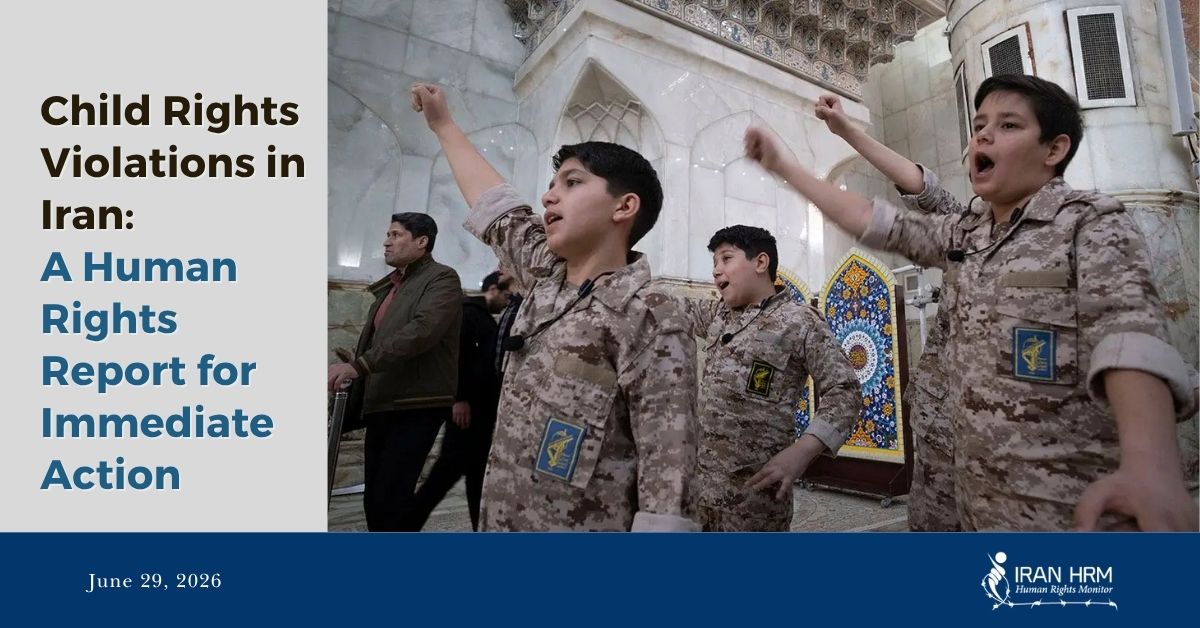
In recent years, child rights violations in Iran have escalated into deeply alarming dimensions. These violations span from intense psychological pressures triggered by economic, social, and security crises, to ideological indoctrination in child-rearing, and a severe shortage of specialized mental health services. Official data published in domestic media reveals that within the national anxiety screening program, out of 899,793 children aged 5 to 6, a staggering 186,772 children were identified as suspected of having anxiety disorders, and 141,293 were referred to counseling centers. Furthermore, out of a total of 2,903 active counseling and psychological service centers across the country, only 91 centers specialize in children and adolescents—representing a mere 3% of all available facilities (Hamshahri Online – June 27, 2026).

The International Legal Framework
The Convention on the Rights of the Child (CRC) mandates state parties to prioritize the “best interests of the child” in all actions concerning children. It obligates governments to guarantee the child’s right to survival and development; protect them from all forms of violence, injury, exploitation, discrimination, and psychological distress; and recognize their rights to freedom of thought, conscience, religion, expression, and participation in accordance with their age and maturity. Consequently, any educational, cultural, or security policy that weaponizes a child as a tool for political, ideological, or military indoctrination directly contradicts the spirit and provisions of this Convention.
The CRC was adopted on November 20, 1989, and entered into force on September 2, 1990. Iran ratified the convention in 1994 but applied a sweeping general reservation declaring that it would not apply any provisions incompatible with “domestic laws and Islamic standards,” effectively undermining and limiting the scope of its full implementation.
The UN Committee on the Rights of the Child expressed grave concerns regarding Iran’s implementation of the Convention in its 2016 Concluding Observations. In these observations, concerning the third and fourth periodic reports of the Islamic Republic of Iran (Document No. CRC/C/IRN/CO/3-4)—adopted in January 2016 and published in April 2016—the Committee voiced deep concern over the incomplete implementation of previous recommendations. It specifically highlighted Iran’s general reservation, systemic discrimination, juvenile justice administration, the low age of criminal responsibility, early marriage, corporal punishment, and inadequate child protection frameworks.
Furthermore, the fifth and sixth periodic reports of the Islamic Republic of Iran (Document No. CRC/C/IRN/5-6), received on October 31, 2023, and officially published on November 18, 2025, explicitly reiterate in the introduction that the provisions of the Convention are binding on Iran only to the extent that they conform to Sharia criteria and domestic legislation. This stance is of fundamental importance when analyzing child rights violations in Iran, as this general reservation systematically obstructs effective state accountability before its international obligations.
Children’s Mental Health: A Hidden Crisis and the Shortage of Specialized Care
The published statistics identifying 186,772 children as suspected of suffering from anxiety out of those screened is a critical indicator of a silent child mental health crisis. This figure is not merely a clinical metric; it is a profound human rights warning regarding the failure of protective, educational, and social structures to secure a safe environment for child development. With only 91 specialized child and adolescent centers operating nationwide, equal and effective access to specialized psychological care is practically non-existent for the vast majority of children.
Scientific evidence strongly reinforces these concerns. The systematic review article titled “Prevalence of Anxiety Disorders among Children and Adolescents in Iran: A Systematic Review,” published in 2015 in the Iranian Journal of Psychiatry, analyzed existing scientific literature up to June 2014 and concluded that anxiety disorders are reported at a significantly high rate among Iranian children and adolescents. Additionally, the study “Child and Adolescent Mental Health Care in Iran: Current Status and Future Directions,” published in 2016 in the Archives of Iranian Medicine, reports that various studies estimate approximately 16.7% to 36.4% of children and adolescents in Iran suffer from one or more mental health disorders, while specialized resources to address these critical needs remain severely limited.
Ideological Indoctrination and the Violation of the Child’s Right to Free Personality Development
One of the core pillars of child rights violations in Iran is the transformation of child-rearing into a state-sponsored ideological project. This issue is not merely a generalized observation of the country’s educational or cultural atmosphere; rather, it is explicitly codified within the official discourse of the highest echelons of state leadership. In compiled doctrines regarding “Child-Rearing in the Thought of Ayatollah Khamenei,” ideal child development is framed not as an autonomous process of personality growth, but as a mechanism designed to forge a “religious-revolutionary identity,” “absolute obedience to the ruling jurist (Velayat-e Faqih),” a “spirit of resistance,” and “enemy-cognition.” The ultimate objective is the engineering of a “Velayi Child” (a child loyal to the supreme leader) and a “pious, revolutionary youth.” Within this framework, a child is subjected from their earliest years to a model that systematically links religion, politics, absolute loyalty to the state, and an enemy-centric revolutionary identity.
Under this mandated educational directive, the family, the school, the media, and the broader social environment are required to operate in unison to cement this state-defined identity:
- The Family: Functions as the primary institution for transmitting unquestioning obedience to authority.
- The School: Operates as a tool for teaching state-sanctioned revolutionary history, romanticizing revolutionary forces and martyrs, and institutionalizing ideological compliance.
- The Media: Utilized as a controlled battlefield to counter what the state defines as a “cultural invasion.”
- The Social Environment: Serves as an arena for mandatory religious-revolutionary participation through state-linked mosques, religious congregations (Heiyats), and the Basij paramilitary forces.
Instead of recognizing the child as an independent, right-bearing individual capable of freely choosing their own identity, this model forces the child onto a predetermined path designed solely to reproduce political and ideological loyalty to the ruling regime.
From a human rights perspective, the fundamental flaw of this approach is that it prioritizes the regime’s ideological interests over the “best interests of the child.” The Convention on the Rights of the Child (CRC) explicitly emphasizes the holistic development of the child’s personality, talents, and mental and physical abilities; respect for freedom of thought and conscience; and the preparation of the child for a responsible life in a free society, imbued with a spirit of peace, dignity, tolerance, liberty, equality, and solidarity.
Conversely, an upbringing that traps a child from infancy within rigid binaries of “truth vs. falsehood,” “insider (insider/Khodi) vs. enemy,” or “loyal vs. disloyal” structurally undermines the child’s right to independent thought, free identity formation, multi-dimensional personality development, freedom of conscience, and safe participation in civic life. Consequently, these top-down educational directives must be analyzed not merely as a cultural viewpoint, but as a core structural mechanism driving child rights violations in Iran.
Comparative Analysis: “Velayi” Indoctrination vs. Modern Child-Rearing Models
| Category | “Velayi” Indoctrination Model | Modern Child-Rearing Model |
| A) Objective of Upbringing | • Engineering a pious-revolutionary individual
• Absolute loyalty to the ruling jurist (Velayat-e Faqih)
• Collective-ideological identity |
• Personal growth, independence, and autonomy
• Critical thinking and freedom of choice
• Individual, multi-layered identity |
| B) Method of Upbringing | • Strict media censorship and control
• Emulation of state-sanctioned revolutionary heroes
• Heavy emphasis on obedience and compliance |
• Media literacy and critical consumption
• Emulation of cultural, scientific, and global diversity
• Emphasis on dialogue and active participation |
| C) Parent-Child Relationship | • Parents act as ideological directors
• Highly patriarchal structure (pronounced role of the father)
• Religious-political indoctrination |
• Parents act as developmental facilitators
• Equal, collaborative parenting roles
• Psycho-social and emotional development |
| D) Worldview | • The world as a zero-sum cultural battlefield
• Enemy-centric and isolationist perspective
• Closed, rigid identity |
• The world as a continuous learning opportunity
• Interaction-oriented and cooperative perspective
• Open, evolving identity |
Structural Mechanisms of “Velayi” Engineering: How a Child’s Identity is Systematically Molded
1.Phase 1: Foundational Ideology: Early Childhood.
The world is framed exclusively through a rigid binary of truth versus falsehood. The concept of Velayat-e Faqih (the rule of the jurist) is introduced as the direct continuation of divine authority, establishing the baseline for a religious-revolutionary identity.
2.Phase 2: Domestic Enforcement (The Family): Primary Socialization.
The household is structured as a micro-revolutionary environment. The father acts as the absolute source of state-aligned authority, while the mother manages emotional compliance. Media exposure and peer circles are tightly monitored and filtered.
3.Phase 3: Educational Indoctrination (The School): Formal Education.
The curriculum heavily prioritizes state-curated revolutionary history and the romanticization of martyrs. This stage focuses on building a “spirit of resistance” and training the child in “enemy-cognition” to reject external or independent ideas.
4.Phase 4: Social Integration: Community Level.
The child is integrated into collective state activities. Mandatory or heavily incentivized participation in state-sponsored religious congregations, the Basij youth divisions, and ideological mosque programs reinforces a collective, state-approved identity over individual expression.
5.Phase 5: Final Consolidation: Adolescence to Young Adulthood.
During adolescence, internal obedience is deeply solidified. An individual’s academic, career, and social trajectories are steered to align strictly with revolutionary values, successfully converting the child into a “pious, revolutionary youth” who serves the state’s apparatus.
Conclusion of Analysis: This structural mapping demonstrates that the issue extends far beyond a mere divergence in parenting styles; it represents a fundamental conflict between two irreconcilable worldviews. While modern child-rearing views the child as a right-bearing individual with an independent personality entitled to free inquiry, the “Velayi” model restricts the child from the outset within a predetermined blueprint aimed at political and ideological subjugation.
When enforced systematically by state leadership through the combined leverage of family, school, state media, and social institutions, this apparatus directly violates the child’s fundamental rights to freedom of thought, conscience, independent identity, and holistic development. Therefore, this model must be categorized in human rights documentation as an organized, structural tool of child rights violations in Iran.
An Unsafe Environment, Continuous Crises, and Psychological Impacts on Children
Domestic reports documenting a surge in clinical manifestations among children—such as heightened fear of loud noises, nyctophobia (fear of darkness), nocturnal enuresis (bedwetting), separation anxiety, aggression, and severe sleep disorders (Hamshahri Online – June 27, 2026)—demonstrate that children in Iran are systematically subjected to chronic psychological distress. Officials from the State Welfare Organization of Iran (Behzisti) have explicitly pointed to the cumulative role of economic deprivation, domestic instability, continuous exposure to crisis news, pervasive insecurity, and the direct or indirect trauma of geopolitical conflict in exacerbating childhood anxiety. This environment constitutes a direct threat to the child’s fundamental right to health, psychological security, holistic development, and a peaceful, nurturing environment.
In its December 2024 Factsheet on the situation of Children in Iran, file, UNICEF reported that children constituted approximately one-quarter of Iran’s population in 2023. This demographic reality underscores that any structural crisis within the realms of public education, mental healthcare, poverty, violence, or national security directly impacts a massive segment of the country’s population, elevating these concerns far beyond mere internal or administrative matters.
Core Dimensions of Child Rights Violations in Iran
- Violation of the Right to Mental Health: The identification of hundreds of thousands of anxious children, contrasted against a severe lack of specialized institutions, exposes the gross inadequacy of state mechanisms for prevention, diagnosis, and clinical intervention.
- Violation of the Right to Free Personality Development: The top-down imposition of rigid political and ideological blueprints restricts the child’s fundamental right to independently form an identity and exercise free thought.
- Violation of the Right to Education Grounded in Human Dignity: Educational systems must serve the development of individual capabilities, critical thinking, tolerance, and global peace, rather than operating as vectors for political alignment or enemy-centric polarization.
- Violation of the Right to Protection Against Violence and Harm: Subjecting children to continuous state-manufactured crises, militarized public spaces, conflict rhetoric, political violence, and the threat of arbitrary detention directly jeopardizes both their physical and psychological safety.
- Violation of the Principle of the Best Interests of the Child: Any state policy that prioritizes the preservation of a political regime or an official state ideology over the developmental, psychological, and educational needs of a child stands in direct, flagrant violation of this foundational pillar of international law.
Urgent Implications for International Child Rights Bodies
Child rights violations in Iran must be scrutinized through a multidimensional lens that covers mental health, education, freedom of thought, security, civic participation, the prohibition of violence, and social protection. Narrowly focusing on a single metric—such as the number of counseling facilities or anxiety screening data—is insufficient. The core investigative focus must remain on the extent to which state, educational, and cultural frameworks recognize the child as an independent, right-bearing entity, versus the degree to which they exploit them as instruments for state ideological production.
On March 4, 2026, the UN Committee on the Rights of the Child, specifically addressing the catastrophic impact of conflicts on children, emphatically reiterated that children must never be treated as “collateral damage.” The Committee reinforced that state parties are legally obligated to guarantee the right to life, survival, and development of children under conditions of crisis and conflict. This binding principle is equally applicable to all forms of harm, including psychological, security-related, educational, and ideological injuries.
Actionable and Urgent Recommendations
To immediately halt and prevent the systemic violation of child rights in Iran, the following international interventions are urgently required:
- Formal Inquiries by the UN Committee on the Rights of the Child: The Committee must demand official, comprehensive explanations from the Iranian government regarding childhood anxiety statistics, the actual operational capacity of its youth mental health infrastructure, and the ideological content of state curricula.
- Independent Assessments by UN Agencies: UNICEF and related specialized international bodies must conduct independent, unhindered evaluations of the state of child mental health and welfare inside Iran.
- Mandate Expansion for UN Special Rapporteurs: UN Special Rapporteurs on human rights must explicitly emphasize state-sponsored ideological indoctrination, chronic psychological pressure, violence against minors, and the restriction of freedom of thought in their periodic briefings.
- Evidence Documentation by Human Rights Organizations: Civil society and human rights groups must compile thoroughly documented case files featuring concrete statistics, familial testimonies, school textbooks, and verified clinical data to present to international tribunals.
- Binding Structural Reforms for the State: The Iranian government must be compelled to immediately expand its specialized child mental health networks, replace enemy-centric indoctrination with educational curricula rooted in human dignity, critical thinking, and peace, and comprehensively review all child-related policies under the strict guidance of the “best interests of the child”