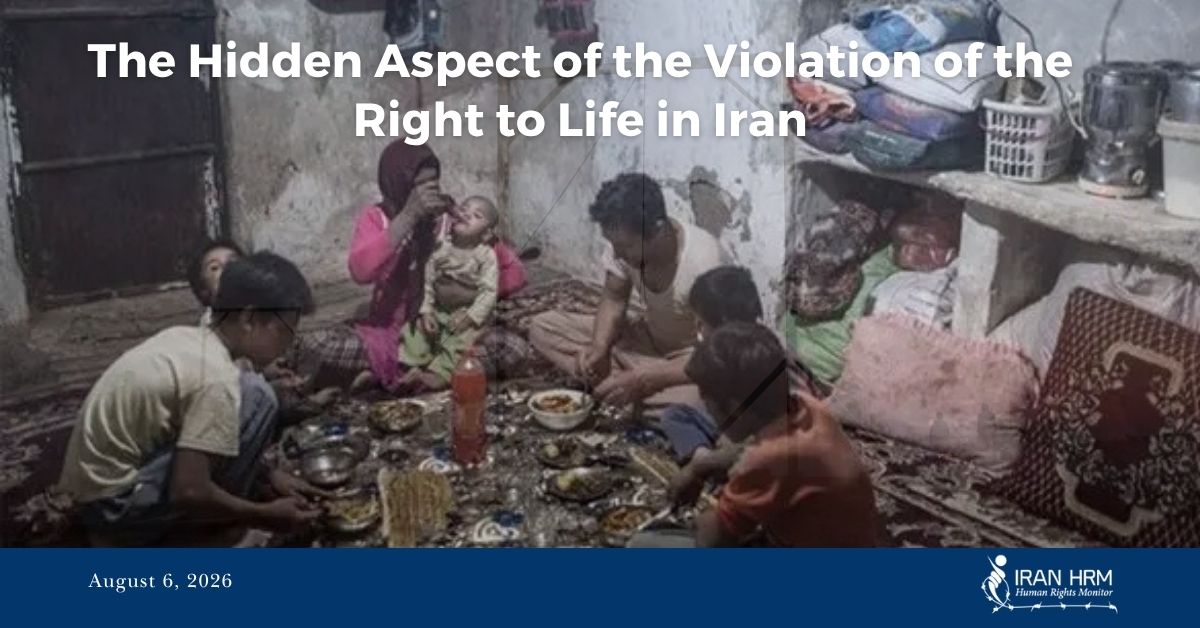
When discussing the violation of the right to life in Iran, the first things that come to mind are executions, deaths under torture, and state-sponsored killings inside and outside prisons. However, a silent tragedy receiving far less international attention is the gradual deprivation of the right to life for the general public in Iran. With each passing day under the rule of the Islamic Republic, this fundamental human right is surreptitiously stripped away from an increasing number of people—not through an instantaneous death, but through a slow, agonizing process accompanied by the indescribable pain of watching oneself and one’s loved ones slip toward death.

Daily, vast segments of Iran’s population are driven to a journey towards slow death, due to the Islamic Republic’s catastrophic economic policies, billion-dollar embezzlements, continuous warmongering, and the diversion of national wealth into bombs, missiles, drones, and the apparatus of suppression which is drowning them under the absolute poverty line. This gradual death brings a suffering far more painful than a single moment of execution, yet the world turns a blind eye to this grim reality of the Islamic Republic.
A Look at the Statistics on the Hidden Violation of the Right to Life in Iran
According to data from the World Bank Document, the population below the poverty line in Iran over the last three years stands at:
- 2024: 33.2%
- 2025: 35.4%
- 2026: 38.8%
Meanwhile, some analysts estimate this figure to be nearly half of Iran’s population.
Reports such as the one by The Media Line (War-Stricken Economy Fuels Prospect of Renewed Protests as Citizens Say They Have Reached a ‘Breaking Point’) in March 2026 have reported the proportion of the population living below the absolute poverty line to be over 40%, with the overall poverty line reaching up to 60%.
According to reports from various agencies, the absolute poverty line in 2026 is estimated at over 55 million Tomans per month (approximately $293 USD at the current free-market exchange rate). Meanwhile, the above-mentioned report highlights that the average income of many households is less than 25 million Tomans per month (approximately $133 USD).
| Indicator | Value |
| Population below the poverty line | 30% to 40% (Based on official and international sources) |
| Population below the absolute poverty line | 40% to 45% (Research and media estimates) |
| Poverty line (4-person household, National) | Over 55 million Tomans per month |
| Absolute poverty line (3-person household, Tehran) | ~50 million Tomans in Tehran (Lower national average) |
State-Controlled Media Admissions of the Hidden Violation of Public Right to Life
- Pensioners Can No Longer Even Afford Bread and Cheese
The political, social, and economic outlet Tose’e Irani has addressed the dire living conditions of the public in various articles. In an article titled “Pensioners Have Even Lost the Ability to Buy Bread and Cheese” published on August 5, we read:
“The latest data from the Statistical Center of Iran points to intensifying inflationary pressure on household livelihoods. In the month of Tir (June-July 2026), point-to-point food inflation (YoY) surged beyond 120%, meaning households must pay more than double to purchase the exact same food basket compared to last year. This comes as the Supreme Labor Council estimated the cost of a working-class household livelihood basket at around 45 million Tomans, while a worker’s income—including benefits—amounts to only about 25 million Tomans; a gap that widens every day with the rising prices of basic goods, particularly bread.”
- Iran Rapidly Heading Toward a “Working Poor” Crisis
In another article by the same outlet titled The Collapse of Employment Quality and the Intensification of the Working Poor Phenomenon dated August 3, it is stated:
“Behind the numbers and figures of the Spring 1405 (2026) labor market, there is more than just an increasing unemployment rate; signs of a deep structural shift in Iran’s employment landscape are visible. Decreased industrial employment, the growth of unstable service jobs, rising underemployment, and declining economic participation all point to a market increasingly affected by political and economic uncertainties.
According to experts, if this trend continues, the consequence will not only be a shrinking labor market, but household livelihoods, social welfare, pension funds, and even human capital will face severe challenges…”
The article then references an interview with Fatemeh Azizkhani, a labor market expert, speaking to Eqtesad News:
“The consequence of this continuing trend is the intensification of poverty and the formation of a poverty trap. Those currently on the margin of the poverty line will gradually be pulled under if these conditions persist. Consequently, we will face a phenomenon known as the ‘working poor’.”
- The Great Paradox
In an article titled Why Are Iranians Becoming Poorer Every Day?, we read:
“Recent data from the Central Bank of Iran and the World Bank reveal an alarming reality: the real income of every Iranian decreased by approximately 47% between 2011 and 2024. In this report, we examine why, despite recorded economic growth in recent years, purchasing power continues to collapse and the middle class shrinks by the day… According to Eqtesad24, based on these figures, the Real Gross Domestic Income (GDI) per capita, which stood at around 141 million Tomans in 2011, fell to approximately 75 million Tomans in 2024. In plain language and without statistical fluff, real per capita income has been cut nearly in half over the past 13 years. This bitter reality occurs while executive officials constantly boast of positive economic growth, yet the gap between official statistics and people’s dinner tables grows wider every day.”
- A Shocking Admission of the Gradual Deprivation of Public Right to Life
From the same article:
“The 47% drop in per capita income is not merely a figure in economic reports; it manifests in fundamental shifts in consumer behavior. An analysis of household spending in recent years reveals that declining purchasing power has caused a ‘dominance of basic survival priorities’ over all other aspects of life. In this process, families first eliminated recreational, cultural, and non-essential educational expenses, and were subsequently forced to contract their food baskets. The drop in per capita consumption of protein, dairy, and essential goods across various income deciles is a grave warning sign for long-term public health and food security.
On the other hand, spiraling costs for medicine and healthcare have forced many households to postpone periodic check-ups and preventive medical measures—an involuntary behavior that effectively amounts to mortgaging future health to pay for current daily expenses. When the bulk of a family’s income goes solely toward housing rent and bare subsistence, the quality-of-life approaches zero, trapping society in a severe poverty trap from which recovery will require extraordinary economic leaps.”
- The Conclusion: Minimum Wage Covers Only One Meal a Day; Workers Face a Painful Choice Between Food and Shelter
Tose’e Irani itself draws the starkest conclusion from these facts:
“According to ILNA, many labor activists believe that the minimum livelihood basket for a working-class household in 1405 (2026)—approved at approximately 43 million Tomans—now barely covers the food basket for a family of three. It fails to cover essential costs such as housing rent, clothing, healthcare, and education. This occurs even though this 43 million Toman figure is double the minimum wage including all side benefits!…
The head of the Khorasan Razavi Provincial Labor Council noted: ‘The approved livelihood basket of 43 million Tomans is a figure with which a three-person working-class household cannot survive today. A quick calculation shows that a family on minimum wage can barely afford breakfast alone. Consuming only bread, cheese, and tea costs up to 30 million Tomans a month for such a family. Today, even if a worker receives the minimum livelihood amount, they must choose between shelter (paying rent) on one hand and providing a minimal food basket on the other—a agonizing choice even in small cities!'”
Beyond Absolute Poverty: Society Is Now Below the “Absolute Survival Line”
The labor official sums up the destruction of the public right to life in Iran with this striking declaration:
“Today, for workers living on these wages, it is no longer a question of the absolute poverty line, but the absolute survival line.”
What is the International Community’s Duty Regarding the Hidden Violation of the Right to Life in Iran?
The international community’s silence and inaction in the face of daily executions, torture, and crackdown in Iran carry consequences far more devastating than the loss of individual protesters’ lives. The real outcome of this international oversight is not merely the violation of these individuals’ right to life; by failing to act against a regime that actively prevents its people from exercising their fundamental right to self-determination and establishing a government of their choice, the international community becomes complicit in the gradual, agonizing, and collective deprivation of the right to life for the vast majority of the Iranian population.
When a political regime blocks any peaceful transition of power and prevents the formation of a legitimate governance structure, catastrophic poverty, the collapse of food security, the breakdown of healthcare, and environmental destruction turn into lethal instruments that force millions of human beings below the “absolute survival line.” This is a “slow-motion death” whose suffering is no less than an instantaneous loss of life. Therefore, the global community cannot ignore that continued complacency toward the Islamic Republic equates to complicity in denying a nation its right to exist.
To fulfill its moral and legal obligations toward the Iranian people, the international community must immediately pursue the following concrete actions:
- Making All Relations Strictly Conditional: All diplomatic, economic, and political relations with the Iranian regime must be immediately and explicitly conditioned upon a complete, verifiable halt to executions, an end to torture, and the immediate cessation of the bloody crackdown on protesters. Restraining the regime’s apparatus of repression will open the necessary space for the Iranian people to take their destiny into their own hands and exercise their right to self-determination.
- Recognizing the Iranian People’s Right to Self-Determination: The global community must acknowledge that safeguarding the right to life in Iran requires supporting the people’s will for fundamental political change and confronting the regime’s machinery of suppression.
- Moving from Inaction to Legal Accountability (Complicity through Inaction): The United Nations and democratic nations must end diplomatic complacency, terminating routine political and economic transactions with Iran that has driven an entire society into a trap of attrition and slow death.
- Exercising Universal Jurisdiction: All officials, commanders, and perpetrators involved in suppression, executions, systemic corruption, and the diversion of national wealth into missiles, drones, and domestic repression must face international sanctions and legal prosecution under universal jurisdiction.
- Redefining the Legal Framework on Iran: International human rights bodies must expand their definition of the “violation of the right to life” beyond execution statistics to officially recognize the deliberate imposition of absolute poverty and systemic deprivation of basic survival as structural violations of the right to life.