Iran witnessed another alarming escalation in executions, death sentences against political prisoners, pressure on detainees, and deteriorating prison conditions during July 2026.

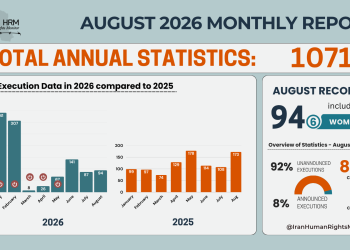
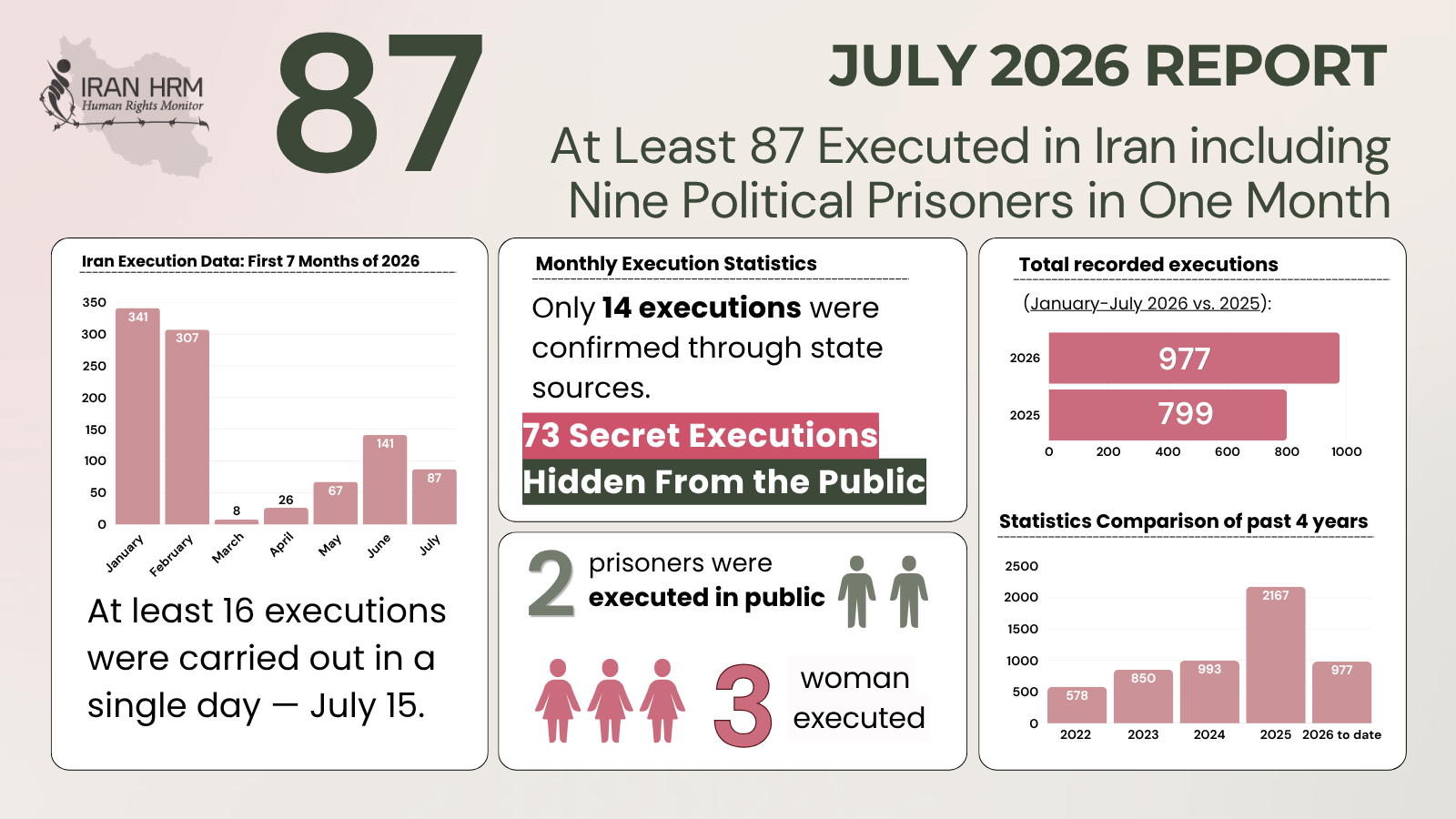
According to information compiled by Iran Human Rights Monitor, at least 87 prisoners were executed during July, including three women, two juvenile offenders who had been under 18 at the time of their alleged offenses, nine political prisoners, and two prisoners executed in public.
Of the 87 executions documented during the month, 73 were not officially announced by Iranian authorities, including the executions of two women. Fourteen executions were reported through official or state-affiliated sources. The officially reported cases included one woman, nine political prisoners, and two public executions.
The month was also marked by new death sentences against political prisoners, executions of protesters arrested during recent nationwide uprisings, and a prolonged hunger strike by approximately 1,500 death-row prisoners at Qezel Hesar Prison.
At Least 87 Executions in July
Iranian authorities carried out at least 87 executions during July 2026, continuing the extensive use of the death penalty.
Among those executed were prisoners convicted of ordinary offenses as well as political prisoners and individuals arrested in connection with anti-government protests.
On July 12, five prisoners were executed in Shirvan and Shiraz. They included Mohammad Imani, 27, and Asadollah Alijani, 33, in Shirvan, as well as Hossein Rahim-Khanli, 32, Morad Iranmanesh, and 52-year-old Setayesh Mohammadpour in Shiraz.
Two more prisoners, Mehdi Latifi, 27, and Abdolreza Heydari, were executed in Tabriz on July 13.
On July 14, Mohyeddin Abdollahi and Hossein Palani were executed on charges of “armed rebellion against the Islamic Republic,” or baghy. The judiciary alleged that the two had belonged to cells affiliated with ISIS.
The executions continued throughout the month. On July 15 alone, at least 16 prisoners were reportedly hanged in prisons across the country, including in Shushtar, Aligudarz, Sari, Shiraz, Khorramabad, Isfahan, and Qezel Hesar Prison.
Execution of Juvenile Offender Meysam Irandegani
On July 21, authorities executed Meysam Irandegani, a Baluch prisoner, in Iranshahr.
Irandegani had reportedly been only 14 years old at the time of his arrest and alleged offense. He was executed at the age of 18 following approximately four years of imprisonment.
The execution of individuals for crimes committed while under the age of 18 violates Iran’s obligations under international human rights law, including the Convention on the Rights of the Child and the International Covenant on Civil and Political Rights.
The July statistics compiled by Iran HRM indicate that two people executed during the month had been juvenile offenders.
Political Prisoners Executed
At least nine political prisoners were among those executed during July.
On July 16, authorities executed Aref Khoshkar, 28, in Qezel Hesar Prison. Khoshkar had been arrested during the 2022 nationwide protests in Tehran and was reportedly subjected to severe torture while in detention. He was sentenced to death in connection with the killing of a member of the Basij forces during the protests.
On the same day, Mohammad Amini Dahaqani, who had been arrested during the January 2026 uprising, was executed in Isfahan. He had been convicted of charges including moharebeh—“enmity against God”—and “corruption on Earth.”
On July 19, authorities executed Erfan Esfandiari, 18, and Gol-Mohammad Mohammadi, 24, an Afghan national, in Isfahan. Both had been arrested in connection with the January 2026 uprising.
They were among 12 defendants sentenced to death in the so-called “Alikhani Square” case. Authorities accused the defendants of moharebeh, “corruption on Earth,” and involvement in the deaths of four members of the State Security Force during protests in Isfahan.
The defendants were reportedly denied the right to choose independent lawyers.
Execution of Mehdi Khanaki
On July 22, authorities executed Mehdi Khanaki, a 26-year-old law graduate and member of the People’s Mojahedin Organization of Iran (PMOI/MEK).
Khanaki had been wanted by security forces following the January 2026 uprising and was arrested in Karaj on February 10.
He was subsequently sentenced to death by the Revolutionary Court in Karaj on charges of membership in the MEK and active participation in the January uprising.
Reports indicated that he was subjected to severe physical and psychological torture during detention.
Two Protesters Publicly Executed in Isfahan
On July 28, Iranian authorities carried out the public executions of Abolfazl Sepahi Badjani, 24, and Amirhossein Safari Hosseinabadi, 27, in Alikhani Square in Isfahan.
Both men had been arrested following the January 2026 uprising and were defendants in the Alikhani Square case.
They were convicted of charges including moharebeh and “corruption on Earth,” as well as involvement in the deaths of security officers, possession of weapons and Molotov cocktails, setting fire to a police station, and blocking streets.
Security forces reportedly deployed personnel in surrounding streets and on nearby rooftops before the executions.
People who had gathered at the scene protested the executions. Security forces subsequently attempted to disperse the crowd and reportedly fired tear gas.
Following these executions, eight other defendants in the same case remained under death sentences:
Alireza Sepahi, 24; Ghaem Hosseini, 20; Shervin Bagherian, 18; Amirhossein Ebrahimi Analucheh, 19; Amirhossein Maleki, 19; Ali Dashti, 19; Abolfazl Ebrahimi, 18; and Alireza Raeisi, 21.
Their cases raised serious concerns over due process, particularly reports that defendants were denied access to lawyers of their choice and that even court-appointed lawyers were prevented from fully accessing case files.
Arghavan Fallahi Sentenced to Death
On July 1, Branch 15 of Tehran’s Revolutionary Court sentenced Arghavan Fallahi, a 25-year-old political prisoner and MEK supporter, to death. The court was presided over by Judge Abolqasem Salavati.
Fallahi had been arrested on January 25, 2025, in Parand and transferred to Ward 241 of Evin Prison. She reportedly spent approximately five months in solitary confinement while undergoing interrogation and physical and psychological mistreatment.
Following the evacuation of Evin Prison, she was transferred to solitary confinement in Fashafuyeh Prison before later being returned to the women’s section of Evin.
Fallahi had previously been arrested in Shiraz in November 2022 along with her father, Nasrollah Fallahi, a former political prisoner who is currently serving a five-year prison sentence.
Her death sentence prompted renewed calls for urgent international intervention.
Amir Hassan Akbari-Monfared Sentenced to Death
Political prisoner Amir Hassan Akbari-Monfared, a 22-year-old accounting student from Karaj, was also sentenced to death by Branch 15 of Tehran’s Revolutionary Court.
He was convicted of baghy, or rebellion, through alleged contact with the MEK.
Akbari-Monfared was arrested on January 19, 2025, during a raid on his home by intelligence agents.
He was reportedly subjected to severe interrogation and torture in Ward 209 of Evin Prison in an attempt to obtain forced confessions.
Following the evacuation of Evin Prison, he was transferred to Fashafuyeh Prison and subsequently returned to Evin.
Four members of his extended family were executed during the 1980s.
Isa Chari Sentenced to Death
On July 25, reports emerged that Isa Chari, a 37-year-old Baluch laborer and father of two children, had been sentenced to death. Branch 23 of Tehran’s Revolutionary Court convicted him of PMOI membership and alleged “anti-security measures.” Chari had been arrested in Varamin on December 7, 2025.
For approximately seven months following his arrest, his family reportedly received little or no information about his condition or whereabouts.
He was later transferred to solitary confinement in Ward 35 of Qezel Hesar Prison.
His case raised concerns regarding prolonged incommunicado detention, lack of transparency in judicial proceedings, and access to legal representation.
Other Political Prisoners Face Death Threats and Heavy Sentences
Five political prisoners detained in Hall 37 of Qezel Hesar Prison were reported to be facing increasing judicial and security pressure during July.
Abolfazl Rahbar, 23, and Omid Rahbar, 24, who were arrested in January 2026, were reportedly informed verbally that they had received prison terms of 20 and 26 years respectively on charges relating to MEK membership.
Three other prisoners, Vahid Azizi, 42; Mostafa Imani, 39; and Farshid Dolatyari, 41—were reportedly threatened with execution or remained in prolonged legal uncertainty.
The prisoners were reported to be held under severe restrictions and deprived of basic amenities.
1,500 Death-Row Prisoners Launch Mass Hunger Strike
One of the most significant prison protests during July occurred at Qezel Hesar Prison in Karaj, where approximately 1,500 prisoners in Unit 2 launched a hunger strike and sit-in on July 13.
Most of the participating prisoners were reportedly under death sentences. The protest began after six death-row prisoners were transferred to solitary confinement in preparation for execution.
Prisoners displayed signs reading “No to Execution” and demanded an end to executions and the revocation of death sentences.
Authorities reportedly installed signal-jamming equipment inside the prison in an effort to restrict communication between prisoners and the outside world. Guards also threatened raids and confiscation of mobile phones.
More than 500 relatives of prisoners gathered outside Qezel Hesar Prison to demand that the authorities revoke death sentences. Security forces reportedly attempted to disperse the gathering, while family members continued their protest.
Prison officials also began transferring prisoners between units. Approximately 140 prisoners who were not under death sentences were transferred from Unit 2 to another section of the prison, raising concerns among families that authorities were seeking to isolate the hunger strikers and impose additional restrictions.
Raid on Women’s Ward of Evin Prison
On July 12, prison authorities raided the women’s section of Evin Prison amid increasing pressure on female political prisoners.
Approximately 50 prisoners convicted of financial and non-political offenses were transferred into an area where women detained during the January uprising were being held. The move violated the principle of separation of prisoners according to the nature of their alleged offenses and was met with protests from detainees.
During the confrontation, guards reportedly clashed with prisoners and transferred two protesting women to solitary confinement.
Reports also indicated that authorities were considering moving female political prisoners from Evin to Qarchak Prison in Varamin, where conditions have repeatedly raised serious human rights concerns.
Around 60 recently detained women were reportedly already being held in the quarantine section of Qarchak Prison under overcrowded conditions, with inadequate medical facilities and extreme summer heat.
Prisoners Beaten During Raid on Evin Prison
On July 26, guards raided Hall 5 of Ward 7 in Evin Prison. Prisoners were reportedly beaten and personal possessions, including clothing and other items, were confiscated. Reports from the prison described severely inadequate sanitary and living conditions.
Prisoners reportedly lacked sufficient access to bathing facilities, while infestations of mice, bedbugs, and other pests had contributed to the spread of skin conditions, including scabies.
Political prisoners were also reportedly being held alongside prisoners convicted of violent or ordinary criminal offenses rather than being separated according to the nature of their cases.
Call to Action
Iran HRM urges the international community, the United Nations, the UN Human Rights Council, the Office of the High Commissioner for Human Rights, the UN Special Rapporteur on the situation of human rights in Iran, and other relevant human rights mechanisms to closely monitor these cases and take effective measures to protect prisoners facing execution.
Particular attention is urgently required for political prisoners currently under death sentences and for the remaining defendants in the Alikhani Square case who remain at risk of execution.
Iranian authorities must immediately halt executions, respect their international human rights obligations, guarantee due process and access to independent legal counsel, end torture and ill-treatment in detention, and ensure that all prisoners have access to adequate medical care and humane conditions.