An Analytical Report for Human Rights Organizations on the Structural Deprivation of Livelihood, Food Security, and Social Agency
Citing official data and statistics, this analytical report investigates the structural deprivation of the Iranian populace regarding basic livelihoods and food security. It demonstrates how resource allocation policies and the stark disparity between wages and the poverty line lead to the gradual erosion of the “right to life,” human dignity, and the possibility of civic participation.

Introduction and Legal Framework
This report is prepared for submission to international human rights bodies. Its focus is not on political positions, but rather on the human, livelihood, and legal consequences of policies that progressively deprive the majority of Iranian society of the minimum conditions for a dignified life.
International human rights assessments and standards of social justice indicate that while the extensive allocation and distribution of basic commodities for state, religious, and ceremonial events are highly organized and provided at subsidized rates, these same items face unprecedented price surges, practical scarcity, and severe unaffordability in the daily lives of households.
From the perspective of international human rights law, the core issue is not merely economic inefficiency or inflation, but the gradual deprivation of society of the means of subsistence, food security, health, human dignity, and ultimately the “right to life.”
- UN Human Rights Committee General Comment No. 36 (under Article 6 of the International Covenant on Civil and Political Rights – ICCPR): The right to life is not limited merely to protection against the direct deprivation of life (such as executions or killings); it includes a positive obligation on states to address structural conditions that lead to premature death, health deterioration, hunger, and food insecurity.
- International Covenant on Economic, Social and Cultural Rights (ICESCR): Under Article 11 of this Covenant, no people may be deprived of its own means of subsistence, and states are bound by Minimum Core Obligations to ensure non-discriminatory access to essential food for all individuals.
Data presented in this report shows that a vast segment of society, overwhelmed by the crisis of securing basic staples (bread, rice, dairy, cooking oil, chicken, and eggs), loses the capacity, opportunity, and security required to pursue fundamental rights, engage in civic activism, and participate in its socio-political destiny. Such a state—especially when resulting from prioritizing official rituals over the vital needs of society—constitutes a pattern of structural and discriminatory deprivation of human rights.
Source Note: The statistical data, pricing, and quotations in this document were collected from domestic media outlets (including Rokna News Agency and economic/labor news websites) covering the period from February/March 2026 to July/August 2026, serving as the basis for the following legal analysis.
Documented Findings: Prioritizing Official Resources vs. The Shrinking Household Table
The following documented data illustrates the deep divide between the allocation of public resources for official occasions and the inability of households to meet minimum nutritional needs:
(Note: Dollar calculations are based on an official/subsidized rate of ~153,536 Tomans and a free market rate of ~187,500 Tomans per USD as of today’s rate)
- Mobilization of Public Resources for State Events
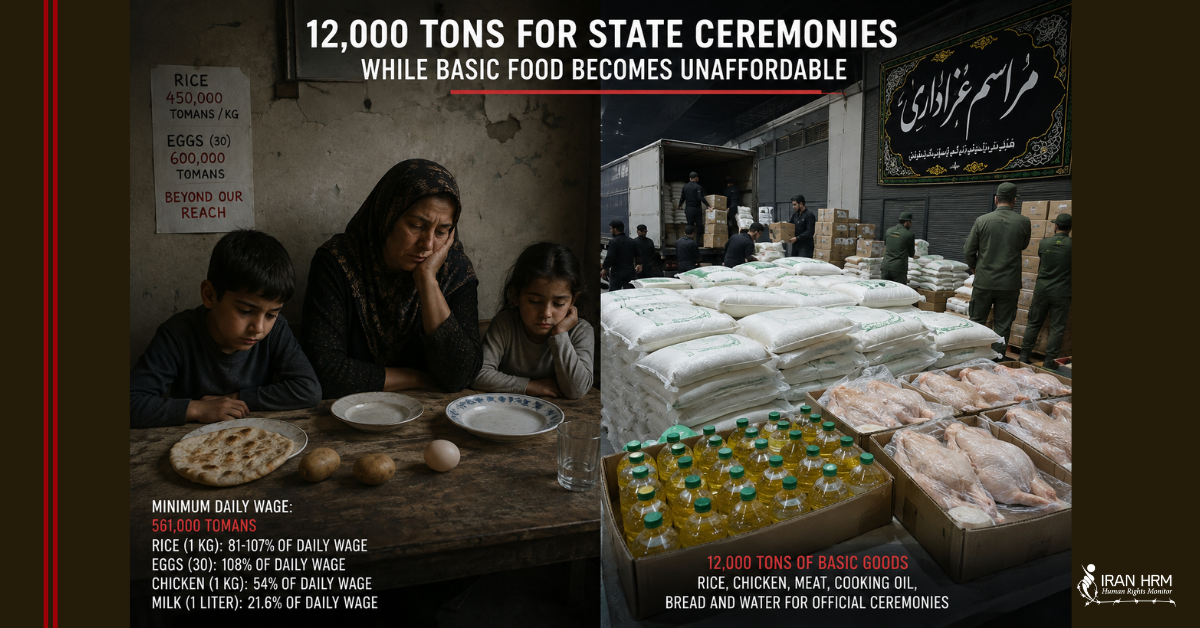
- Provision of 12,000 Tons of Basic Goods for Funeral Ceremonies (June 30, 2026 – Rokna): Official reports announced the procurement of 12,000 tons of basic commodities—including rice, chicken, meat, cooking oil, bottled water, and approximately two million loaves of bread—for Khamenei’s funeral ceremonies. This demonstrates that the commodity distribution and supply mechanism is fully active and capable whenever structural willpower exists.
- Supply of Subsidized Meat to Religious Committees (June 17, 2026 – Rokna): Guild officials reported the direct supply of meat to religious mourning groups (heyats) at rates approximately 50,000 Tomans cheaper than the free market price, whereas red meat has effectively been eliminated from the food basket of many low-income households due to declining purchasing power.
- Price Shocks in Basic Food Staples and Deepening Food Insecurity
- Rising Price of Rice (August 8, 2026 – Rokna): Retail prices for Iranian rice reached 450,000 to 595,000 Tomans [$2.93 to $3.87 Subsidized / $2.40 to $3.17 Free Market] per kilogram, marking the complete removal of this strategic staple from working-class tables.
- Rising Price of Potatoes (August 2, 2026 – Rokna): Potato prices reached 70,000 Tomans [$0.45 Subsidized / $0.37 Free Market] per kilogram, depriving poor households of even the cheapest dietary substitutes.
- Rising Price of Eggs (August 2, 2026 – Rokna): A tray of eggs reached 600,000 Tomans [$3.90 Subsidized / $3.20 Free Market], with individual eggs selling for up to 25,000 Tomans [$0.16 Subsidized / $0.13 Free Market], directly impacting the primary protein source for vulnerable groups.
- Price Shocks in Cooking Oil, Dairy, and Chicken (August 2, 2026 – Rokna): Statistical reports indicate annual price jumps of 190% for chicken, 150% for milk, 130% for yogurt, 344% for liquid cooking oil, and approximately 400% for solid cooking oil.
- Official Pricing of Dairy Products (July 26, 2026 – Rokna): Newly announced official rates—120,000 Tomans [$0.78 Subsidized / $0.64 Free Market] for a 1-liter bottle of milk and 265,000 Tomans [$1.72 Subsidized / $1.41 Free Market] for 2 kg of yogurt—directly expose vulnerable groups, particularly children and the elderly, to the risk of malnutrition.
- Increased Price of Unsubsidized Bread (June 28, 2026 – Rokna): A 30% to 60% price increase in unsubsidized bread has shattered the last livelihood stronghold for populations living below the absolute poverty line.
- Structural Gap Between Wages and the Poverty Line
- Worker Base Minimum Wage (April 10, 2026 – e-Estekhdam): The daily minimum wage for workers was set at 554,185 Tomans [$3.61 Subsidized / $2.95 Free Market], with the net monthly income for a married worker with two children standing at approximately 24.1 million Tomans [$156.96 Subsidized / $128.53 Free Market].
- Civil Servant Wages and the Poverty Line (February 16, 2026 – Zoman): Base monthly salaries for civil servants (18.7 million Tomans) [$121.79 Subsidized / $99.73 Free Market] remain at least 6 million Tomans below the estimated absolute poverty line.
Comparative Table: Purchasing Power of Daily Minimum Wage vs. Basic Food Costs
(Basis for calculation: Worker daily wage: 554,185 Tomans | Subsidized USD rate: 153,536 Tomans | Free Market USD rate: 187,500 Tomans)
| Basic Food Item | Approx. Rate (Tomans) | Rate in USD (Subsidized / Free) | Share of Daily Minimum Wage (554k Tomans) |
| 1 kg Iranian Rice | 450,000 to 595,000 | $2.93 – $3.87 / $2.40 – $3.17 | 81% to 107% of daily earnings |
| 1 Tray of Eggs (30 pcs) | 600,000 | $3.90 / $3.20 | 108% of daily earnings |
| 1 kg Potatoes | 70,000 | $0.45 / $0.37 | 12.5% of daily earnings |
| 1 Bottle Milk (1 Liter) | 120,000 | $0.78 / $0.64 | 21.6% of daily earnings |
| 1 kg Chicken | 300,000 | $1.95 / $1.60 | 54.1% of daily earnings |
Human Rights Analysis: From Livelihood Pressure to the Erosion of the Right to Life
- Weaponization of Poverty as a Denial of the Right to Life and Human Dignity
When access to bread, rice, and basic protein becomes unattainable, poverty transcends a mere economic condition and becomes an instrument for the erosion of physical and mental health, the breakdown of households, and the denial of human dignity. Under Article 25 of the Universal Declaration of Human Rights (UDHR) and the ICESCR, states are obligated to ensure the minimum standards necessary for health, well-being, and a dignified existence for all members of society.
- Discrimination in the Allocation of Public Resources (Violation of Non-Discrimination)
The stark contrast between the government’s inability to stabilize prices of basic staples for the general public and its capacity to procure and supply thousands of tons of commodities and millions of loaves of bread for official state ceremonies demonstrates direct discrimination in the distribution of public wealth. Pursuant to Article 2 of the ICESCR, the allocation of public resources based on political or ideological considerations is strictly prohibited and constitutes structural discrimination.
- State Responsibility in Creating the Social Determinants of Crime
The expansion of absolute poverty fosters a climate that drives an increase in livelihood-driven offenses. In circumstances where the state imposes severe penalties for such offenses, legal culpability does not rest solely with the individual; rather, primary responsibility lies with the state structure that has deprived individuals of a dignified livelihood, thereby pushing them toward high-risk survival behaviors.
- Societal Silencing and the Deprivation of Civic Agency
When the entirety of citizens’ time and energy is consumed by securing daily bread and basic survival, the right to protest, the right to political participation, and the capacity for “active civic engagement” are effectively extinguished. In this operational capacity, structural poverty acts as an indirect mechanism of social control and suppression.
Actionable Recommendations for International Human Rights Bodies
- Issuance of an Official Communication by the Special Rapporteur on the Right to Food:
Request the UN Special Rapporteur on the Right to Food to issue a formal allegation letter/communication to the Government of the Islamic Republic of Iran regarding the severe disparity between the minimum wage and the cost of the basic food basket, as well as the failure to uphold Minimum Core Obligations.
- Submission of a Shadow Report to the UN Human Rights Council:
Submit this document as a supplementary/shadow report within the framework of the Universal Periodic Review (UPR) to generate targeted international recommendations regarding wage reform and food security in Iran.
- International Oversight on Public Resource Allocation and Subsidized Exchange Rates:
Urge international bodies to monitor the allocation of subsidized foreign currency (Arz-e Tarjihi) and demand an end to the discriminatory and ideologically driven distribution of essential goods that favors state-affiliated entities over the general public.
- Inclusion of “Livelihood Deprivation” in the UN Special Rapporteur’s Mandate:
Call upon the UN Special Rapporteur on the Situation of Human Rights in the Islamic Republic of Iran to dedicate a distinct chapter in their official reports to the UN General Assembly focusing on the “gradual erosion of the right to life through structural poverty.”