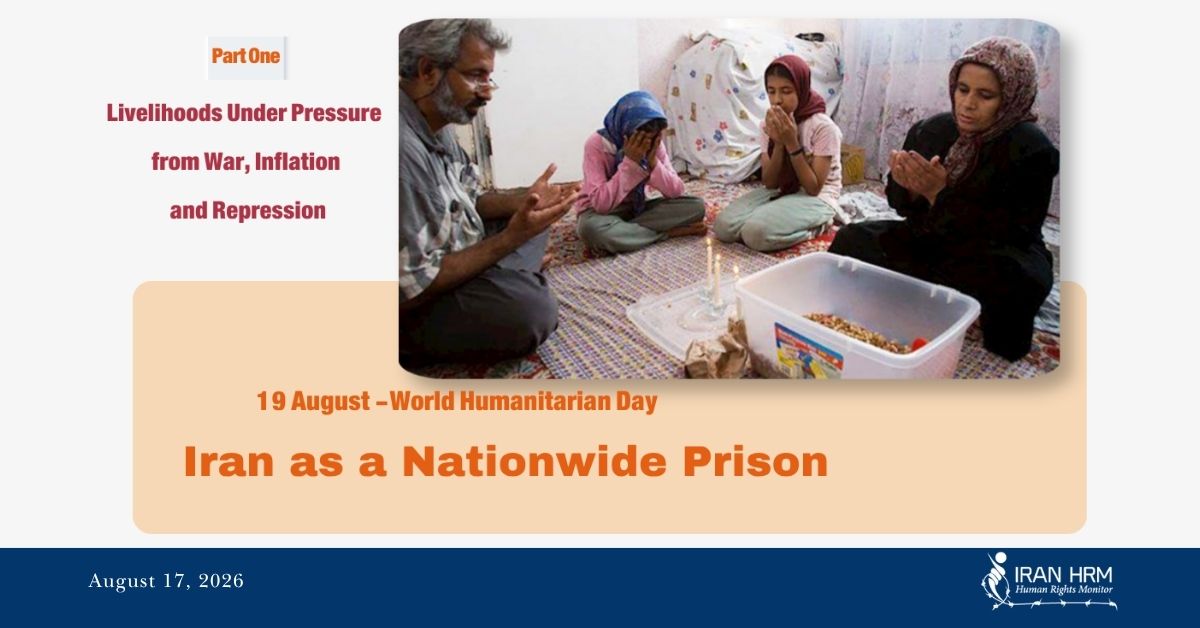
Livelihoods Under Pressure from War, Inflation and Repression
World Humanitarian Day is observed each year on 19 August in memory of the 22 humanitarian workers killed in the 19 August 2003 attack on the United Nations headquarters at the Canal Hotel in Baghdad. The occasion underscores the need to protect civilians and humanitarian personnel, and to uphold human dignity in armed conflicts and other emergencies. (United Nations and Office for the Coordination of Humanitarian Affairs, official World Humanitarian Day page)

In Iran, this occasion comes at a time when the livelihood crisis is directly affecting civilians’ ability to secure food, water, electricity, medicine and housing. In July 2026, year-on-year inflation stood at 87.9 per cent, while inflation for food and beverages reached 128.1 per cent. At the same time, the statutory minimum base wage covered only about 38.8 per cent of the estimated cost-of-living basket for a working household. This report examines the combined impact of war, sanctions, economic policy and the security response to livelihood-related protests. (Statistical Centre of Iran/IRNA, 29 July 2026; IRNA, 16 March 2026; ILNA, 24 March 2026)
The Impact of War on Everyday Life
The war that began on 28 February 2026 intensified existing pressure on goods and currency markets by disrupting transport and trade, complicating the financing and insurance of imports, damaging infrastructure and increasing uncertainty. The available data do not, however, permit every price increase to be attributed to the war. The World Bank reported that 12-month food inflation had already reached 98 per cent in February 2026, before the full effects of the war could have been reflected. The war therefore aggravated a crisis that had already developed under the combined effects of chronic inflation, financial and trade sanctions, foreign-exchange shortages and domestic economic decisions. (World Bank, 20 April and 22 May 2026)
“Poverty is expected to increase due to high food inflation, import shortages and other conflict-related shocks.”
World Bank, Iran Macro Poverty Outlook, April 2026
This distinction is necessary for human rights analysis. War damage, restrictions arising from sanctions and domestic policy do not have identical causes. In all three circumstances, however, the authorities are required to monitor foreseeable effects on food, water, housing, health care and household income, direct targeted assistance to vulnerable groups, and publish the necessary information transparently.
Livelihoods Approaching Collapse
A. Inflation and the Erosion of Purchasing Power
In July 2026, the price of a fixed basket of goods and services for households was, on average, 87.9 per cent higher than in July of the previous year. Pressure on food was more severe. Year-on-year increases reached 261.5 per cent for oils and fats, 147.1 per cent for milk, cheese and eggs, 145.2 per cent for red and white meat and related products, and 116.7 per cent for bread and cereals. The water, electricity and fuel category also recorded a year-on-year increase of 115.8 per cent. (Statistical Centre of Iran, Consumer Price Index report for July 2026, published 29 July 2026)
The Supreme Labour Council set the monthly minimum base wage for 2026/27 at 16.625 million tomans. The Wage Committee had estimated the cost-of-living basket for an average working household at 42.9 million tomans. The base wage therefore covered only about 38.8 per cent of that basket, even before the subsequent price surge in July. (IRNA, 16 March 2026; ILNA, 24 March and 25 July 2026)
According to verified information received, by August 2026 some varieties of Iranian rice were priced at 450,000 to 550,000 tomans per kilogram, while one kilogram of Liqvan cheese cost approximately 1.7 million tomans. For a worker earning about 21 million tomans a month, one kilogram of this cheese absorbed more than two days of daily income. In documented cases, water or electricity bills that had previously been about 300,000 tomans rose to between 800,000 and one million tomans.
B. Observable Human Consequences
The gap between the base wage and the cost-of-living basket means that, even before rent, health care, transport and education are paid in full, the statutory income of a minimum-wage worker is insufficient to meet the household costs used in the estimate. Under these conditions, a more than twofold increase in food costs also limits the possibility of substituting cheaper items, because price increases are not confined to one or two products and affect oil, dairy products, meat and bread simultaneously.
Information received also indicates that approximately 500,000 construction workers lost insurance coverage over a five-year period. This figure, reported through representatives of the workers’ trade associations, requires the Social Security Organisation to publish disaggregated data. If officially confirmed, the removal of insurance coverage during a period of rising health-care costs and employment insecurity would further increase the vulnerability of working households.
C. Protests Over Rising Prices and the Security Response
The protests of 28 December 2025 began in Tehran’s Grand Bazaar in response to the collapse in the value of the rial and the rising cost of living, before spreading to universities and other cities. On 30 December, the Government spoke of dialogue, but the subsequent response included mass arrests, communications shutdowns and prosecutions on national-security charges. By 23 January 2026, the United Nations Fact-Finding Mission stated that more than 24,000 people, including children, journalists and human rights defenders, had reportedly been arrested. This figure relates to the winter protest wave and should not be added to the estimate of more than 4,000 arrests after 28 February. (Reuters, 30 December 2025; OHCHR, 23 January 2026)
Inflation does not in itself constitute a human rights violation. The legal question is whether the authorities have taken effective, transparent and non-discriminatory measures to guarantee minimum access to food, water, health care and housing, and whether people who peacefully protested against livelihood conditions have, instead of being heard, faced arbitrary detention, vague national-security charges or the death penalty.
Families Under Compounded Pressure
Families of prisoners are situated at the intersection of two crises. At a time when the minimum wage covers less than 40 per cent of the estimated cost-of-living basket, the cost of purchasing water, food, medicine and hygiene products for a prisoner is transferred to the household budget. In Ward 5 of Greater Tehran Prison, waits of three to four months for an in-person visit, together with prolonged delays on visiting days, add transport costs and psychological strain.
The Government’s Economic Response
The Supreme Labour Council raised the 2026/27 minimum wage by 60 per cent, and the Social Security Organisation announced a 60 per cent increase in the pensions of minimum-rate recipients. These measures constituted the official response to declining purchasing power. Nevertheless, the July figures of 87.9 per cent year-on-year inflation overall and 128.1 per cent for food show that nominal increases in wages and pensions remained behind price growth. In the public sources reviewed up to 16 August 2026, no regular, disaggregated data were found that would permit an assessment of low-income groups’ actual access to food, medicine and housing.
Applicable Human Rights Standard
Articles 2 and 11 of the International Covenant on Economic, Social and Cultural Rights require the State to use the maximum of its available resources to realise, without discrimination, the right to an adequate standard of living, including adequate food and housing. This obligation does not require the State to guarantee the stability of all prices. However, the removal of essential support, the absence of targeted measures to protect minimum needs, or the non-transparent allocation of resources requires justification and human rights assessment where the consequences are severe and foreseeable.
Conclusion and Proposed Immediate Measures
The available data show that pressure on livelihoods is not the result of a single factor. Price increases had already taken hold before the war began, and the war intensified them through disruption to imports and transport and greater foreign-exchange uncertainty. The human rights measure is not inflation alone. The central questions are whether the authorities have used the maximum of available resources to preserve minimum access to food, medicine, housing and insurance, reported the effects of their policies transparently, and respected the right to peaceful protest. On World Humanitarian Day, the protection of civilians in Iran must begin with the guarantee of these basic needs.
- The Government should implement targeted and measurable support for food, medicine, housing, water, electricity and insurance for low-income groups, and publish the results.
- The effects of the war, sanctions and domestic economic decisions on prices, imports and access to essential goods should be monitored and reported separately.
- The rights to peaceful assembly and protest over livelihood conditions should be respected, and individuals detained solely for peaceful expression, organising or protest should be released.
- Detailed and verifiable data should be published on inflation affecting essential items, the cost-of-living basket, insurance coverage, and access to medicine and housing, so that support is based on the actual needs of vulnerable groups.
Selected Public Sources
The institution and date appear immediately after the relevant claim or quotation in the report. The list below is provided to facilitate retrieval of the original document or the nearest reliable public version. Internally verified information has been included without naming or publicly linking to the source in order to protect it.
- United Nations, official World Humanitarian Day page, accessed August 2026. Direct link
- Statistical Centre of Iran, ‘July inflation rate announced’, republished by IRNA, 29 July 2026. Direct link
- IRNA, ‘Tripartite agreement on a 60 per cent increase in workers’ minimum wages’, 16 March 2026. Direct link
- ILNA, ‘The approved wage does not meet the cost-of-living basket’, 24 March 2026. Direct link
- Reuters, livelihood protests begin and the Government announces readiness for dialogue, 30 December 2025. Direct link
- World Bank, Islamic Republic of Iran country page, accessed August 2026. Direct link
- World Bank, Commodity Markets Outlook, 20 April 2026. Direct link
- World Bank, ‘Food prices feel the heat as war rattles commodity markets’, 22 May 2026. Direct link
- OHCHR, ‘Iran: After unprecedented violence, priority must be on gathering evidence’, 23 January 2026. Direct link
- OHCHR, International Covenant on Economic, Social and Cultural Rights, 16 December 1966. Direct link