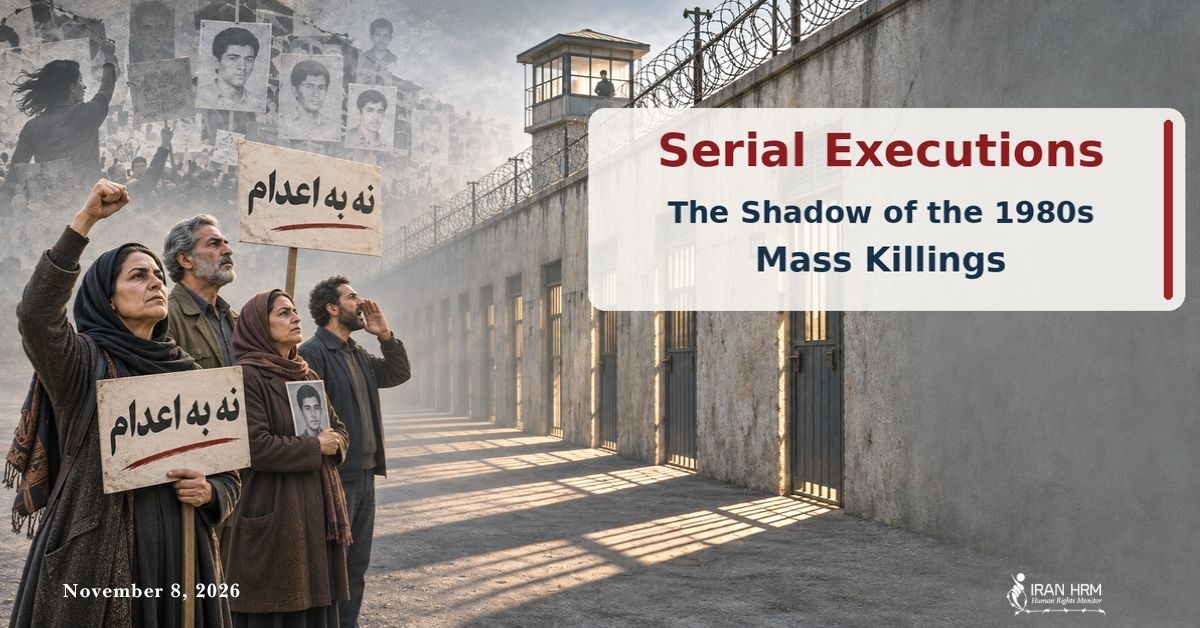
Escalating Executions and the Risk of Renewed Political Mass Killings
Since the nationwide protests of Dey 1404 (December 2025–January 2026), successive executions, new death sentences and the execution of co-defendants on different dates have raised serious concerns about the use of capital punishment for political repression and public intimidation in Iran. According to findings of the United Nations Fact-Finding Mission, at least 29 people had been executed in connection with these protests by the end of August 2026, and executions continued in subsequent months.

On 28 October 2026, Dr. Mai Sato, the United Nations Special Rapporteur on the situation of human rights in Iran, warned the Third Committee of the General Assembly: “There is no longer any legal avenue for expressing dissent.” She added: “Protesters have faced lethal violence or have subsequently been sentenced to death and executed.” Sato stressed that four decades of repression had not deterred Iranians from protesting but had instead deepened the grievances that drove them into the streets.
The Ali-Khani Square case in Isfahan, in which nine people were executed between July and November 2026 while six other prisoners remained at risk of execution, illustrates the continuing threat of death within a single joint case. The pattern recalls the political executions of the 1980s, particularly the mass killing of prisoners in the summer of 1988, although the scale and historical circumstances of the two periods are not identical.
By examining individual cases and the role of judicial and security institutions, this report asks whether successive executions and newly imposed death sentences form part of a pattern intended to intimidate society and deter further protests.
Serial Executions: From the Suppression of Protesters to the Continuing Terror of Their Families
The execution of people arrested in connection with the Dey 1404 protests continued for months after street demonstrations had ended. On 19 March 2026, Saleh Mohammadi, a 19-year-old wrestler, was executed in Qom alongside Mehdi Ghasemi and Saeed Davoudi. Their case concerned allegations that two members of the Basij had been killed during the protests.
In April 2026, four defendants linked to the events of 8 January on Damavand Street in Tehran were executed over several successive days: Amirhossein Hatami on 2 April, Shahin Vahedparast and Mohammadamin Biglari on 5 April, and Ali Fahim on 6 April. On 3 May, Ebrahim Dowlatabadi, Mehdi Rasouli and Mohammadreza Miri were also executed in Mashhad.
These cases demonstrate that executions of protest detainees were not confined to one city or one period. One of the clearest examples of executions continuing within a joint case emerged in Isfahan.
Ali-Khani Square, Isfahan: Nine Executions and Six More Prisoners Awaiting Their Fate
The Ali-Khani Square case concerns the events of 8 January 2026 and the killing of four security personnel during protests in Isfahan. According to Amnesty International, nine defendants in the case were executed on separate dates between July and November 2026: Erfan Esfandiari, Abolfazl Sepahi, Amirhossein Safari Hosseinabadi, Ghaem Hosseini, Amirhossein Maleki, Golmohammad Mohammadi, Alireza Raeisi, Alireza Sepahi and Amirhossein Ebrahimi Analoujeh.
The most recent reported executions in this group were those of Amirhossein Maleki and Amirhossein Ebrahimi Analoujeh on 3 November 2026 (12 Aban 1405).
Among those executed were two brothers, Abolfazl and Alireza Sepahi. According to information received from trusted sources inside Iran, Abolfazl was hanged in public. Alireza lost consciousness before his execution and was taken to hospital, but his death sentence was carried out after he recovered. The Sepahi family lost both sons in the same case.
Despite these nine executions, the case remains unresolved. Amnesty International has warned that six more prisoners face imminent execution: Abolfazl Ebrahimi, Ali Dashti, Javad Talebpour, Mehdi Eskandari, Sepehr Hounjani and Shervin Bagherian Jabali. According to the organisation, the Supreme Court has upheld their death sentences.
Executing nine defendants over several months, while six co-defendants still face execution, has consequences beyond the loss of those already killed. The families of those who remain have watched people tried in the same case being executed and now face the prospect of the same fate for their loved ones.
This highlights a disturbing feature of successive executions: the execution of one prisoner does not end the threat to other people sentenced to death in the same case; it can instead intensify their families’ anguish and fear.
Execution as a Threat Extending Beyond Prison Walls
Carrying out death sentences on different dates, particularly in joint cases, warrants independent examination of both judicial scheduling and its social consequences. Each announcement of an execution reminds the family of a prisoner whose sentence has not yet been carried out that they too may lose a loved one.
This human impact is especially clear in the Ali-Khani Square case, where completed executions and outstanding death sentences are two aspects of the same continuing situation. Some families are mourning their relatives; others remain under the shadow of an execution order.
The human rights question is not only why these people were sentenced to death, but whether staggered executions, alongside judicial and security threats, form part of a broader mechanism to intimidate protesters and deter society from demonstrating again.
Answering that question requires examining not only the executions already carried out but also the new death sentences imposed on other prisoners after the protests, which show that the threat of capital punishment continues.
New Death Sentences: The Expanding Circle of Prisoners at Risk After the Protests
While executions of people arrested during the Dey 1404 protests continued in prisons across Iran, new death sentences were also imposed on other protesters. Recent cases reported in Mashhad and Karaj indicate that prisoners continued to face capital punishment many months after the protests. Some were tried together, and serious questions remain about their defence rights and the evidence relied upon.
Mashhad: Death Sentences Against Several Protest Detainees
Matin Shabani, arrested during protests in Shandiz on 7 and 8 January 2026, was transferred to Vakilabad Prison in Mashhad. According to the case information, Branch Five of the Mashhad Revolutionary Court, presided over by Hossein Yazdankhah with Seyed Reza Javadmousavi as an associate judge, sentenced him to death on a charge of moharebeh (“enmity against God”) and allegations relating to damage to property and the burning of religious premises. However, the published information does not clarify what direct evidence the court presented of his personal involvement in these incidents.
In another case, Vahid Khedri-Khah, aged 34, who had been wounded by a bullet fired by government forces before his arrest, was sentenced to death alongside Matin Farnian, a 23-year-old man from Mashhad, and a third person. All three faced the charge of moharebeh before Branch Five of the Mashhad Revolutionary Court. Khedri-Khah and Farnian are held in Ward 6/1 of Vakilabad Prison, while the identity of the third defendant has not been disclosed.
The undisclosed identity of one person under sentence of death not only prevents public monitoring but also raises concerns about access to legal representation, whether the family has been informed and the risk of an execution without adequate notice.
Amir Delshad, another person arrested in connection with the Dey protests, was also sentenced to death by Branch Five of the Mashhad Revolutionary Court. The allegations include activities said to benefit an opposition group and participation in the protests. His appeal has been referred to the Supreme Court; the final status of his sentence requires further investigation.
A common feature of these cases is the use of national-security charges to impose death sentences, while the available information does not clarify the full evidentiary basis, how individual criminal responsibility was established or whether an effective defence was possible.
Karaj: Death Sentence Against an Artist and Animal Rights Activist
Homayoun Shabankareh, a 22-year-old artist and animal rights activist, was sentenced to death and confiscation of property by Branch Two of the Karaj Revolutionary Court on 5 November 2026. Mehdi Sabzevarnejad, also known as Sabzevari, has been identified as the judge hearing the case.
He was arrested on 14 May 2026 after officers raided his family home. According to the available information, Shabankareh was held in solitary confinement for 97 days in Hall 12 of Karaj Central Penitentiary. After a short period in a communal ward, he was again transferred to solitary confinement.
His principal charge was described as “intelligence cooperation with Israel against national security”. His case also refers to sending videos and news of the protests to media outside Iran, writing slogans and posting on Instagram. The court relied on an Islamic Revolutionary Guard Corps intelligence report, messages, emails and statements attributed to him.
The case material records Shabankareh as saying, “I did nothing.” The available account does not specify any operation he carried out or any identifiable damage caused by the alleged actions. Nevertheless, the court imposed the death penalty by relying on its legal interpretation of the offence of intelligence cooperation.
The significance of Shabankareh’s case lies in the way activities involving the dissemination of information and expression of political views appear alongside grave national-security accusations. Independent examination of the evidence and of whether the alleged conduct meets the strict international-law threshold for capital punishment is essential.
The Continuing Risk of Execution: From New Sentences to Prisoners Awaiting Implementation
The sentences handed down in Mashhad and Karaj, together with other cases that have already reached the Supreme Court, show that the threat of capital punishment continued to affect protest detainees and political opponents in the months following the demonstrations.
This is particularly concerning in light of the Ali-Khani Square case, where executions on different dates placed the remaining co-defendants at continuing and immediate risk.
In these circumstances, a death sentence is not merely a judicial decision concerning a prisoner’s future. For the prisoner and their family, the announcement itself marks the beginning of prolonged uncertainty, intensified by each subsequent report of an execution in a similar case.
Recurring death sentences, repeated involvement of Revolutionary Courts and the use of national-security charges in protest-related cases underscore the need to investigate the judicial mechanisms of repression and the responsibility of the institutions making these decisions.
Reproducing the Repressive Pattern of the 1980s: Capital Punishment as an Instrument of Intimidation
The wave of executions and death sentences after the Dey 1404 protests raises an alarming question about the judiciary’s role in political repression: has capital punishment, beyond individual prosecutions, become a means of instilling fear and preventing renewed demonstrations?
Death sentences on national-security charges, the repeated role of Revolutionary Courts, trials challenged on fair-trial grounds and successive executions indicate the need to investigate a broader pattern. Under such a pattern, an execution affects more than the individual whose life is taken: the prospect of further executions can keep families and society in prolonged anxiety and insecurity.
This recalls the mechanisms of political repression in the 1980s, particularly the mass killing of prisoners in the summer of 1988, when judicial and security institutions played a role in the large-scale elimination of political opponents. Although the historical circumstances and scale differ, capital punishment against opponents, the absence of effective fair-trial safeguards and families’ denial of justice and accountability are common features that cannot be ignored.
Four decades of political repression in Iran heighten concerns about the recurrence of these mechanisms. Establishing a coordinated policy of intimidation, however, requires examination of the links between official statements, judicial decisions and the timing of executions.
The central danger is the re-emergence of a pattern in which a death sentence ceases to be an individual punishment and becomes a continuing threat to political opponents and to society’s right to protest.
International Warnings, State Responsibility and the Urgent Need to Halt Executions
United Nations Warnings on the Execution of Protesters
Throughout 2026, United Nations human rights mechanisms repeatedly warned about the execution of protesters, unfair trials and the lack of judicial accountability in Iran. The Independent International Fact-Finding Mission reported that at least 29 people linked to the Dey 1404 protests had been executed by the end of August 2026 and expressed concern about dozens more prisoners at risk of execution.
In October 2026, Mai Sato, the UN Special Rapporteur on human rights in Iran, warned against using national-security charges to punish protesters, described the broadcast of televised confessions before trial as a serious human rights violation, and called for an end to executions and accountability for those responsible. She also stressed the importance of international mechanisms in the absence of effective domestic judicial accountability.
Violations of the Right to Life and the Possible Commission of Crimes Against Humanity
Under Article 6 of the International Covenant on Civil and Political Rights and the Human Rights Committee’s General Comment No. 36, the death penalty is permissible only for the “most serious crimes” involving intentional killing. Political and national-security offences that do not meet that threshold cannot lawfully justify deprivation of life.
Imposing or carrying out a death sentence on the basis of torture-induced confessions, without effective access to legal counsel or following proceedings lacking essential safeguards may constitute arbitrary deprivation of life. The Iranian authorities are obliged to investigate such cases independently, ensure accountability and provide effective remedies for victims and their families.
If independent investigations establish that the executions and other repressive acts formed part of a widespread or systematic attack against a civilian population, it would also be necessary to examine the criminal responsibility of perpetrators and those who ordered the acts for possible crimes against humanity.
Urgent Appeal: Preventing a Recurrence of Political Mass Killings
Ongoing executions and the threat of new executions demand immediate action by the international community.
This report calls upon the UN Human Rights Council, the Special Rapporteur on the situation of human rights in Iran, the Independent International Fact-Finding Mission and UN Member States to:
- Act to halt executions immediately and establish a formal moratorium on the death penalty, prioritising the protection of prisoners facing imminent execution.
- Demand disclosure of the names of prisoners under sentence of death, the status of their cases, their places of detention and official execution figures since the Dey 1404 protests.
- Initiate independent investigations into the execution of protesters, unfair trials, torture, forced confessions and the responsibility of security and judicial institutions.
- Preserve evidence of human rights violations for future proceedings and accountability, while protecting the safety of families, witnesses and confidential sources inside Iran.
- Prioritise ending executions and protecting prisoners’ lives in diplomatic engagement with the Islamic Republic and support lawful mechanisms of accountability.
The political executions of the 1980s demonstrated how a lack of accountability can enable grave and irreversible violations of the right to life. Continued successive executions today raise the risk of a recurrence of that pattern.
Preventing future executions must not wait until the list of victims is complete. Every death sentence not yet carried out represents an opportunity to save a human life—an opportunity irretrievably lost once the execution takes place.
Documentary Annexes
The two accompanying lists contain the names of people executed in connection with the nationwide Dey 1404 protests and prisoners sentenced to death after those protests. Their details were received and reviewed through reliable, trusted channels inside Iran. Given the authorities’ lack of transparency, restricted access to prison and judicial records, and the absence of complete official statistics, the lists are neither exhaustive nor final; the actual numbers of those executed and sentenced to death may be higher. The identities of confidential sources are withheld for their protection.
- Annex I: People Executed in Connection with the December 2025–January 2026 Protests
| People Executed in Connection with the December 2025–January 2026 Protests | 20 entries | |||||
| Received through trusted channels inside Iran; non-exhaustive and provisional | As of 6 November 2026 | |||||
| No. | Full Name (Romanised) | Date of Arrest | Prison / Place of Execution | Alleged Charge | Date of Execution |
| 1 | Saleh Mohammadi | Not recorded | Qom (public execution) | Alleged killing of two Basij members during the January 2026 protests | 19 March 2026 |
| 2 | Mehdi Ghasemi | Not recorded | Qom (public execution) | Alleged killing of two Basij members during the January 2026 protests | 19 March 2026 |
| 3 | Saeed Davoudi | Not recorded | Qom (public execution) | Alleged killing of two Basij members during the January 2026 protests | 19 March 2026 |
| 4 | Amirhossein Hatami | Not recorded | Ghezel Hesar Prison | Moharebeh (enmity against God) and efsad-e fel-arz (corruption on earth); events at Basij Base 185 in Tehran | 2 April 2026 |
| 5 | Shahin Vahedparast | Not recorded | Ghezel Hesar Prison | Moharebeh (enmity against God) and efsad-e fel-arz (corruption on earth); events at Basij Base 185 in Tehran | 5 April 2026 |
| 6 | Mohammadamin Biglari | Not recorded | Ghezel Hesar Prison | Moharebeh (enmity against God) and efsad-e fel-arz (corruption on earth); events at Basij Base 185 in Tehran | 5 April 2026 |
| 7 | Ali Fahim | Not recorded | Ghezel Hesar Prison | Moharebeh (enmity against God) and efsad-e fel-arz (corruption on earth); events at Basij Base 185 in Tehran | 6 April 2026 |
| 8 | Ebrahim Dowlat Abadi | Not recorded | Vakilabad Prison | Alleged leadership of the 2025–26 uprising in Mashhad and alleged participation in the killing of several security personnel | 3 May 2026 |
| 9 | Mehdi Rasouli | Not recorded | Vakilabad Prison | Alleged killing of security officer Hamidreza Yousefinejad in the Tabarsi area of Mashhad during the 2025–26 uprising; possession of a Molotov cocktail and a homemade sword | 3 May 2026 |
| 10 | Mohammadreza Miri | Not recorded | Vakilabad Prison | Alleged killing of security officer Hamidreza Yousefinejad in the Tabarsi area of Mashhad during the 2025–26 uprising; possession of a Molotov cocktail and a homemade sword | 3 May 2026 |
| 11 | Fath ollah Avari | Not recorded | Hamedan | Alleged killing of police Major Mohammadjavad Bakhshian, described in the source as a criminal officer, during the 2025–26 uprising | 2 June 2026 |
| 12 | Erfan Esfandiari | Not recorded | Isfahan | Alleged killing of four police and Basij personnel during the 2025–26 uprising | 19 July 2026 |
| 13 | Gol Mohammad Mohammadi | Not recorded | Isfahan | Moharebeh (enmity against God); Ali-Khani Square case in Isfahan | 19 July 2026 |
| 14 | Abolfazl Sepahi | Not recorded | Public execution (location unspecified) | Moharebeh (enmity against God); alleged killing of four Basij members | 28 July 2026 |
| 15 | Amirhossein Safari Hossein Abadi | Not recorded | Public execution (location unspecified) | Moharebeh (enmity against God); alleged killing of four Basij members | 28 July 2026 |
| 16 | Ghaem Hosseini | Not recorded | Dastgerd Prison, Isfahan | Moharebeh (enmity against God); Ali-Khani Square case in Isfahan | 20 August 2026 |
| 17 | Alireza Sepahi | Not recorded | Dastgerd Prison, Isfahan | Moharebeh (enmity against God); Ali-Khani Square case in Isfahan | 5 October 2026 |
| 18 | Alireza Raeisi | Not recorded | Dastgerd Prison, Isfahan | Moharebeh (enmity against God); Ali-Khani Square case in Isfahan | 5 October 2026 |
| 19 | Amirhossein Maleki | Not recorded | Dastgerd Prison, Isfahan | Moharebeh and efsad-e fel-arz through acts against national security and creating widespread insecurity by drawing a weapon | 3 November 2026 |
| 20 | Amirhossein Ebrahimi Analoujeh | Not recorded | Dastgerd Prison, Isfahan | Moharebeh and efsad-e fel-arz through acts against national security and creating widespread insecurity by drawing a weapon | 3 November 2026 |
- Annex II: Prisoners Sentenced to Death Following the December 2025–January 2026 Protests
| Prisoners Sentenced to Death Following the December 2025–January 2026 Protests | 134 entries | ||||
| Received through trusted channels inside Iran; non-exhaustive and provisional | As of 6 November 2026 | ||||
| No. | Full Name (Romanised) | Date of Arrest | Prison | Alleged Charge |
| 1 | Ehsan Hosseini Pour Hesarlu | 8 January 2026 | Not recorded | Setting fire to a mosque in Pakdasht, reportedly causing the deaths of two officers; operational action against internal security through active participation in unrest in Pakdasht on 8 January 2026 |
| 2 | Matin Mohammadi | 8 January 2026 | Not recorded | Setting fire to a mosque in Pakdasht, reportedly causing the deaths of two officers; operational action against internal security through active participation in unrest in Pakdasht on 8 January 2026 |
| 3 | Erfan Amiri | 8 January 2026 | Not recorded | Setting fire to a mosque in Pakdasht, reportedly causing the deaths of two officers; operational action against internal security through active participation in unrest in Pakdasht on 8 January 2026 |
| 4 | Abolfazl Karimi | Inconsistent date recorded (requires review) | Unspecified | Unspecified |
| 5 | Mohsen Eslam Khah | Year 1404 (Solar Hijri) | Bukan | “Moharebeh, corruption on earth and intentional killing” |
| 6 | Mohammad Salehi | 13 January 2026 | Dastgerd Prison, Isfahan | Moharebeh; throwing Molotov cocktails at a police station, allegedly causing the deaths of security personnel (described in the source as repressive forces) |
| 7 | Majid Nasiri | 4 January 2026 | Adelabad Prison, Shiraz | “Setting fire to a base and killing a special police unit officer” |
| 8 | Shahab Dadkhah | 4 January 2026 | Adelabad Prison, Shiraz | “Setting fire to a base and killing a special police unit officer” |
| 9 | Unidentified man | 4 January 2026 | Adelabad Prison, Shiraz | “Setting fire to a base and killing a special police unit officer” |
| 10 | Maryam Hedavand Miri | 4 January 2026 | Evin Prison | Moharebeh in connection with the fire at Seyyed al-Shohada Mosque in Pakdasht, in which two people died |
| 11 | Masih Abbaskhani Davanlou | 8 January 2026 | Sari | Moharebeh through the alleged killing of a Basij member named Amin Ziaei |
| 12 | Mansour Jafari | 4 January 2026 | Isfahan | Moharebeh (enmity against God) |
| 13 | Shahin Soleimani | 4 January 2026 | Isfahan | Moharebeh (enmity against God) |
| 14 | Hossein Ghaleh Beigi Ghaleh Beigi | 4 January 2026 | Isfahan | Moharebeh (enmity against God) |
| 15 | Reza Moazzeni | 4 January 2026 | Isfahan | Moharebeh (enmity against God) |
| 16 | Yaser Mokhtari | 4 January 2026 | Isfahan | Moharebeh (enmity against God) |
| 17 | Moslem Heydari | 4 January 2026 | Isfahan | Moharebeh (enmity against God) |
| 18 | Ramezan Asadi | 4 January 2026 | Isfahan | Moharebeh (enmity against God) |
| 19 | Abolfazl Hashemian | 4 January 2026 | Isfahan | Moharebeh (enmity against God) |
| 20 | Javad Taleb Pour | 4 January 2026 | Isfahan | Moharebeh (enmity against God) |
| 21 | Danial Harouni | 4 January 2026 | Isfahan | Moharebeh (enmity against God) |
| 22 | Mehdi Eskandari | 4 January 2026 | Isfahan | Moharebeh (enmity against God) |
| 23 | Navid Shirani | 4 January 2026 | Isfahan | Moharebeh (enmity against God) |
| 24 | Seyedreza Hassanlou | 4 January 2026 | Isfahan | Moharebeh (enmity against God) |
| 25 | Davoud Amin Zadeh | 4 January 2026 | Isfahan | Moharebeh (enmity against God) |
| 26 | Mobin Soltani | 4 January 2026 | Isfahan | Moharebeh (enmity against God) |
| 27 | Pejman Haghighian | 4 January 2026 | Isfahan | Moharebeh (enmity against God) |
| 28 | Saeed Zarei Kordshouli | 4 January 2026 | Adelabad Prison, Shiraz | Alleged killing of a Basij member during the 2025–26 uprising |
| 29 | Hamidreza Fathi | 4 January 2026 | Adelabad Prison, Shiraz | Alleged killing of a Basij member during the 2025–26 uprising |
| 30 | Abdolreza Fathi | 4 January 2026 | Adelabad Prison, Shiraz | Alleged killing of a Basij member during the 2025–26 uprising |
| 31 | Hamidreza Sabet Rai | 4 January 2026 | Adelabad Prison, Shiraz | Alleged killing of a Basij member during the 2025–26 uprising |
| 32 | Ali Pisheh Varzadeh | 9 January 2026 | Lakan Prison, Rasht | Participation in making incendiary devices, including Molotov cocktails; involvement in setting fire to public and administrative buildings, including the judiciary building |
| 33 | Reza Pisheh Varzadeh | 9 January 2026 | Lakan Prison, Rasht | Participation in making incendiary devices, including Molotov cocktails; involvement in setting fire to public and administrative buildings, including the judiciary building |
| 34 | Mohammadreza Abdollah Pour | 4 January 2026 | Ghezel Hesar Prison | Espionage and alleged killing of government personnel |
| 35 | Amirmohammad Zare | 4 January 2026 | Ghezel Hesar Prison | Espionage and alleged killing of government personnel |
| 36 | Vahid Ghasemi | 17 February 2026 | Vakilabad Prison, Mashhad | “Encouraging participation in protests”; “propaganda against the state”; “insulting the Supreme Leader”; and “insulting religious sanctities” |
| 37 | Arman Marefati | 4 January 2026 | Ghezel Hesar Prison | Acts against security; destruction of public property; participation in burning Jafari Mosque and Imam Hadi Seminary in Kuy-e Nasr, Tehran |
| 38 | Esmaeil Ramezan Pour | 4 January 2026 | Yazd | Moharebeh; assembly and collusion to commit an offence against internal national security |
| 39 | Benyamin Naghdi | 3 January 2026 | Adelabad Prison, Shiraz | Moharebeh on the basis of confronting government forces with a gas cylinder |
| 40 | Hassan Amiri | 5 March 2026 | Ghezel Hesar Prison | Espionage for Israel |
| 41 | Hossein Amiri | 5 March 2026 | Ghezel Hesar Prison | Espionage for Israel |
| 42 | Kaveh Arabian | 12 January 2026 | Yazd | Moharebeh and setting fire to public property with intent to undermine national security; alleged killing of a Basij member |
| 43 | Ali Danesh Parvar | 9 January 2026 | Yazd | Moharebeh for the alleged killing of a security officer and actions intended to undermine national security |
| 44 | Mohammadreza Eyvezi | Late 2025–early 2026 | Ghezel Hesar Prison | “Espionage for the Zionist regime” through sending images and videos and providing the address of a Basij base to the Iran International network |
| 45 | Alireza Peyghambari | 9 January 2026 | Greater Tehran Prison | Moharebeh (enmity against God) |
| 46 | Peyman Ganji | 4 January 2026 | Greater Tehran Prison | Burning public property; moharebeh |
| 47 | Mohammad Naghi Zadeh | 4 January 2026 | Ghezel Hesar Prison | Sabb al-nabi (insulting the Prophet) |
| 48 | Kamal Khan Babaei | 9 January 2026 | Choubindar Prison, Qazvin | Destruction of public property and moharebeh (breaking a camera) |
| 49 | Ghasem Aslani | 4 January 2026 | Arak | Moharebeh (enmity against God) |
| 50 | Ali Mahluji | 12 January 2026 | Arak | Moharebeh (enmity against God) |
| 51 | Hesam Eisaei | 4 January 2026 | Arak | Moharebeh (enmity against God) |
| 52 | Erfan Khalili | 4 January 2026 | Arak | Moharebeh (enmity against God) |
| 53 | Hossein Shokouhi | 3 February 2026 | Arak | Moharebeh (enmity against God) |
| 54 | Mehdi Nazer | 11 January 2026 | Unspecified | “Attacking a mosque with Molotov cocktails”; “attending unlawful gatherings”; and “assembly and collusion” |
| 55 | Mahnaz Chardoli | 11 January 2026 | Unspecified | “Attacking a mosque with Molotov cocktails”; “attending unlawful gatherings”; and “assembly and collusion” |
| 56 | Vahid Khan Sanami | 5 March 2026 | Greater Tehran Prison | Moharebeh (enmity against God) |
| 57 | Shervin Bagherian Jabali | 8 January 2026 | Dastgerd Prison, Isfahan | Ali-Khani Square case; alleged killing of four security officers |
| 58 | Ali Dashti | 8 January 2026 | Dastgerd Prison, Isfahan | Ali-Khani Square case; alleged killing of four security officers |
| 59 | Abolfazl Ebrahimi | 8 January 2026 | Dastgerd Prison, Isfahan | Ali-Khani Square case; alleged killing of four security officers |
| 60 | Mojtaba Dehbandi | Not recorded | Adelabad Prison, Shiraz | Moharebeh through setting fire to public premises; acts against national security by sheltering protesters |
| 61 | Kianoush Hamzeh-ei Kazerouni | Not recorded | Adelabad Prison, Shiraz | Moharebeh through setting fire to public premises; acts against national security by sheltering protesters |
| 62 | Ahad Shokouhian | 15 January 2026 | Ghezel Hesar Prison | Participation in two alleged intentional killings; acts against national security; assembly and collusion against national security; and destruction of public property with intent to oppose the Islamic Republic |
| 63 | Akbar Arab Zadeh | 10 January 2026 | Dastgerd Prison, Isfahan | Setting fire to a Basij building, resulting in the deaths of several Basij members |
| 64 | Mehdi Arab Zadeh | 10 January 2026 | Dastgerd Prison, Isfahan | Setting fire to a Basij building, resulting in the deaths of several Basij members |
| 65 | Mehdi Zarif | 10 January 2026 | Vakilabad Prison, Mashhad | Destruction of public property; setting fire to government premises; moharebeh |
| 66 | Ilya Akbari | 10 January 2026 | Vakilabad Prison, Mashhad | Destruction of public property; setting fire to government premises; moharebeh |
| 67 | Sajjad Cheraghi | 10 January 2026 | Vakilabad Prison, Mashhad | Destruction of public property; setting fire to government premises; moharebeh |
| 68 | Matin Shabani | 10 January 2026 | Vakilabad Prison, Mashhad | Destruction of public property; setting fire to government premises; moharebeh |
| 69 | Farshad Hossein Pour | 10 January 2026 | Vakilabad Prison, Mashhad | Destruction of public property; setting fire to government premises; moharebeh |
| 70 | Majid Hossein Pour | 10 January 2026 | Vakilabad Prison, Mashhad | Destruction of public property; setting fire to government premises; moharebeh |
| 71 | Hossein Rasouli Nasab | 10 January 2026 | Vakilabad Prison, Mashhad | Destruction of public property; setting fire to government premises; moharebeh |
| 72 | Ali Zaghi | 10 January 2026 | Vakilabad Prison, Mashhad | Destruction of public property; setting fire to government premises; moharebeh |
| 73 | Mohammad Azari | 4 January 2026 | Bojnurd | Moharebeh; corruption on earth; intentional killing; alleged participation in intentional killing; deliberate destruction; arson; incitement; inciting people to war; disruption of public order |
| 74 | Reza Rezapour | 4 January 2026 | Bojnurd | Moharebeh; corruption on earth; intentional killing; alleged participation in intentional killing; deliberate destruction; arson; incitement; inciting people to war; disruption of public order |
| 75 | Hossein Mehrangiz | 4 January 2026 | Bojnurd | Moharebeh; corruption on earth; intentional killing; alleged participation in intentional killing; deliberate destruction; arson; incitement; inciting people to war; disruption of public order |
| 76 | Sajjad Shamsaei | 4 January 2026 | Bojnurd | Moharebeh; corruption on earth; intentional killing; alleged participation in intentional killing; deliberate destruction; arson; incitement; inciting people to war; disruption of public order |
| 77 | Ali Babri | 4 January 2026 | Bojnurd | Moharebeh; corruption on earth; intentional killing; alleged participation in intentional killing; deliberate destruction; arson; incitement; inciting people to war; disruption of public order |
| 78 | Amirhossein Nazarzadeh | 4 January 2026 | Bojnurd | Moharebeh; corruption on earth; intentional killing; alleged participation in intentional killing; deliberate destruction; arson; incitement; inciting people to war; disruption of public order |
| 79 | Sajjad Sang Sefidi | 4 January 2026 | Bojnurd | Moharebeh; corruption on earth; intentional killing; alleged participation in intentional killing; deliberate destruction; arson; incitement; inciting people to war; disruption of public order |
| 80 | Mostafa Rajabali Zadeh | 4 January 2026 | Bojnurd | Moharebeh; corruption on earth; intentional killing; alleged participation in intentional killing; deliberate destruction; arson; incitement; inciting people to war; disruption of public order |
| 81 | Amirhossein Sarban | 4 January 2026 | Bojnurd | Moharebeh; corruption on earth; intentional killing; alleged participation in intentional killing; deliberate destruction; arson; incitement; inciting people to war; disruption of public order |
| 82 | Mehdi (Sikan) Roshani | 3 February 2026 | Ilam | Alleged killing of a police officer named Ehsan Aghajani in Malekshahi |
| 83 | Rasoul Rezaei | 10 March 2026 | Vakilabad Prison, Mashhad | Moharebeh; no information is available about the specific conduct underlying Rasul Rezaei’s death sentence |
| 84 | Afshar Shah Ahmadi | 10 January 2026 | Dastgerd Prison, Isfahan | Participation in setting fire to a police station |
| 85 | Iman Shafaei | 10 January 2026 | Dastgerd Prison, Isfahan | Participation in setting fire to a police station |
| 86 | Sadreddin Ahmadzadeh | 10 January 2026 | Dastgerd Prison, Isfahan | Participation in setting fire to a police station |
| 87 | Morteza Zamani | 8 January 2026 | Not recorded | Moharebeh; destruction and burning of public property |
| 88 | Mehdi Ranjbar | 8 January 2026 | Not recorded | Moharebeh; destruction and burning of public property |
| 89 | Mehran Seyedzadeh | 4 January 2026 | Dastgerd Prison, Isfahan | Alleged involvement in the deaths of two Basij members during the January 2026 protests |
| 90 | Sepehr Amirzadeh | 13 January 2026 | Dastgerd Prison, Isfahan | Providing medical assistance to people injured during the January 2026 protests |
| 91 | Mohammad Zanganeh | 31 March 2026 | Vakilabad Prison, Mashhad | Previous judgment: assembly and collusion to commit offences against internal and external national security; subsequently moharebeh (other charges omitted in source) |
| 92 | Mohsen (Mehrdad) Takash | Last week of January 2026 | Dastgerd Prison, Isfahan | Moharebeh (enmity against God) |
| 93 | Pouria Hosseini Mofrad | 14 January 2026 | Vakilabad Prison, Mashhad | “Acts against national security”; “assembly and collusion”; and “operational activity disrupting national security” for an opposition group |
| 94 | Reza Omidvari | December 2025–January 2026 | Yazd | Not disclosed |
| 95 | Amirmohammad Mojallal Choubari | 2 January 2026 | Ghezel Hesar Prison | “Assembly and collusion to commit an offence against national security”; “disrupting public order and peace by participating in unrest” |
| 96 | Hossein Nazari | December 2025–January 2026 | Vakilabad Prison, Mashhad | Links with hostile states and groups; assembly and collusion to commit offences against national security |
| 97 | Mohammadmehdi Asadi | Between 3 February and 15 March 2026 | Dastgerd Prison, Isfahan | Moharebeh; aiding and abetting moharebeh; damage to public property treated as moharebeh; assembly and collusion; propaganda against the state |
| 98 | Navid Elyasi | Between 3 February and 15 March 2026 | Dastgerd Prison, Isfahan | Moharebeh; aiding and abetting moharebeh; damage to public property treated as moharebeh; assembly and collusion; propaganda against the state |
| 99 | Mehrdad Boueri | Between 3 February and 15 March 2026 | Dastgerd Prison, Isfahan | Moharebeh; aiding and abetting moharebeh; damage to public property treated as moharebeh; assembly and collusion; propaganda against the state |
| 100 | Parsa Jafari | Between 3 February and 15 March 2026 | Dastgerd Prison, Isfahan | Moharebeh; aiding and abetting moharebeh; damage to public property treated as moharebeh; assembly and collusion; propaganda against the state |
| 101 | Mehdi Jafari | Between 3 February and 15 March 2026 | Dastgerd Prison, Isfahan | Moharebeh; aiding and abetting moharebeh; damage to public property treated as moharebeh; assembly and collusion; propaganda against the state |
| 102 | Abolfazl Dadgostar | Between 3 February and 15 March 2026 | Dastgerd Prison, Isfahan | Moharebeh; aiding and abetting moharebeh; damage to public property treated as moharebeh; assembly and collusion; propaganda against the state |
| 103 | Taraneh Rahimi | Between 3 February and 15 March 2026 | Dfkaf Dowlat Lbak Ahtkaf | Moharebeh; aiding and abetting moharebeh; damage to public property treated as moharebeh; assembly and collusion; propaganda against the state |
| 104 | Ahmadreza Saeedi | Between 3 February and 15 March 2026 | Dastgerd Prison, Isfahan | Moharebeh; aiding and abetting moharebeh; damage to public property treated as moharebeh; assembly and collusion; propaganda against the state |
| 105 | Armin Gholami | Between 3 February and 15 March 2026 | Dastgerd Prison, Isfahan | Moharebeh; aiding and abetting moharebeh; damage to public property treated as moharebeh; assembly and collusion; propaganda against the state |
| 106 | Mehdi Mansouri | Between 3 February and 15 March 2026 | Dastgerd Prison, Isfahan | Moharebeh; aiding and abetting moharebeh; damage to public property treated as moharebeh; assembly and collusion; propaganda against the state |
| 107 | Ali Asghar (Alireza) Peyghambari | Year 1404 (Solar Hijri) | Dfkaf Zdghhad Adj | Conflicting sources: initial reports described the capital charge as moharebeh |
| 108 | Mehran Babamir | Not recorded | Gdkaaf | Moharebeh (enmity against God) |
| 109 | Ehsan Amiri | Not recorded | Gdkaaf | Moharebeh (enmity against God) |
| 110 | Farid Khaledi | Not recorded | Gdkaaf | Moharebeh (enmity against God) |
| 111 | Saeed Norouzi | Not recorded | Gdkaaf | Moharebeh (enmity against God) |
| 112 | Omid Goudarzvand Chegini | 8 January 2026 | Choubindar Prison, Qazvin | Damage to the entrance of the Qazvin Governorate building |
| 113 | Mahboubeh Shabani | Year 1404 (Solar Hijri) | Vakilabad Prison, Mashhad | “Operational activity to strengthen Israel, the United States and agents associated with opposition groups”; a moharebeh allegation was also raised during the investigation |
| 114 | Arman Almasi | Year 1404 (Solar Hijri) | Hdadg Adaa | “Setting fire to a Ministry of Intelligence vehicle in Mahallat” and filming the burning of public property |
| 115 | Masoud Toushmalani | December 2025–January 2026 | Ghezel Hesar Prison | Moharebeh; assembly and collusion to undermine national security; operational acts for hostile states |
| 116 | Sirvan Shabani | Year 1404 (Solar Hijri) | Ghezel Hesar Prison | Moharebeh; assembly and collusion to undermine national security; operational acts for hostile states |
| 117 | Khosrow Mohammadi Nia | December 2025–January 2026 | Ghezel Hesar Prison | Moharebeh; assembly and collusion to undermine national security; operational acts for hostile states |
| 118 | Mehdi Nami | Year 1404 (Solar Hijri) | Ghezel Hesar Prison | Corruption on earth and moharebeh through operational activity for the United States and Israel |
| 119 | Mohsen Babaeian | Not recorded | Greater Tehran Prison | Moharebeh (enmity against God) |
| 120 | Borzou Rezaei | 5 March 2026 | Greater Tehran Prison | Cooperation with hostile states |
| 121 | Hadi Abbasian | Year 1405 (Solar Hijri) | Zgdqaf | Posting on social media about the uprising |
| 122 | Homayoun Shabankar | Year 1405 (Solar Hijri) | Hdadg Adj | Espionage, allegedly through sending images of areas attacked during the war to the enemy |
| 123 | Ilya Ben Rashid | Year 1404 (Solar Hijri) | Dastgerd Prison, Isfahan | Moharebeh through participation in destroying public property; assembly and collusion to commit offences against national security; propaganda against the state |
| 124 | Hassan Golshan Nejad | Year 1404 (Solar Hijri) | Vakilabad Prison, Mashhad | Operational activity for Israel; moharebeh; assembly and collusion; insulting the Supreme Leader of the Islamic Republic; responding to a call by Prince Reza Pahlavi |
| 125 | Amirreza Rezaei | Not recorded | Greater Tehran Prison | Espionage |
| 126 | Mehdi (surname unknown) | Not recorded | Greater Tehran Prison | Espionage |
| 127 | Vahid Ghahremani | Not recorded | Greater Tehran Prison | Espionage |
| 128 | Omran Amani | Not recorded | Greater Tehran Prison | Moharebeh (enmity against God) |
| 129 | Shahab Zohdi | 8 January 2026 | Ghezel Hesar Prison | Moharebeh; corruption on earth; setting fire to public facilities; assembly and collusion to commit offences against internal and external security |
| 130 | Shayan Shakibaei | Year 1404 (Solar Hijri) | Adhaf | The precise charge underlying the death sentence has not been publicly disclosed; HRANA previously reported an allegation of “leading protests” |
| 131 | Matin Farnian | Year 1404 (Solar Hijri) | Vakilabad Prison, Mashhad | Moharebeh (enmity against God) |
| 132 | Vahid Khedri Khah | Year 1404 (Solar Hijri) | Vakilabad Prison, Mashhad | Moharebeh; earlier reports also mentioned “leading protests”, “propaganda against the state” and “forming or managing groups to undermine security” |
| 133 | Amir Delshad | Not recorded | Vakilabad Prison, Mashhad | Operational acts detrimental to security and national interests for an opposition group through active participation in the January 2026 protests; arson and damage to public property |
| 134 | Sepehr Hounjani | Not recorded | Not recorded | Ali-Khani Square case, Isfahan |