Cases of Political Prisoners Sentenced to Death in Iran
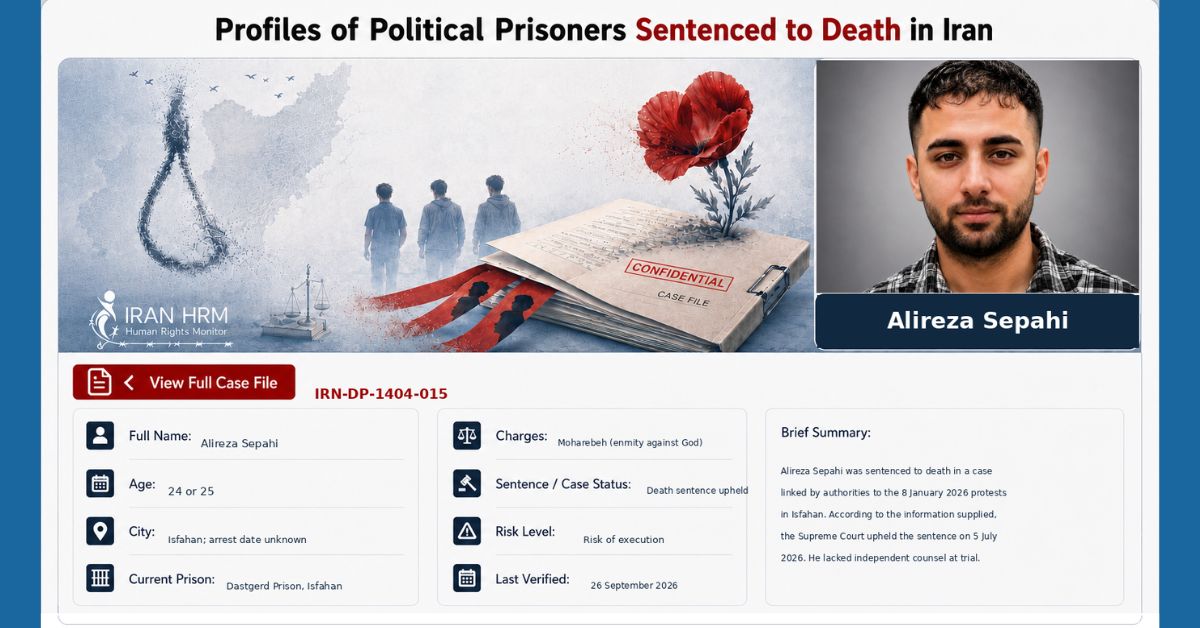
Case No. 15 | Case ID: IRN-DP-1404-015 | Last reviewed: 26 September 2026

| Alireza Sepahi, born in 2001–02 in Isfahan, is under sentence of death in the Alikhani Square case. After the sentence was upheld, his lawyer said that a retrial request authorised by the Supreme Court had been rejected without a hearing and the case returned for enforcement. His last reported place of detention is Dastgerd Prison, Isfahan; developments after 2 September 2026 are unknown. |
Key Case Information
| Category | Information |
| Full name | Alireza Sepahi |
| Date of birth | 2001–02; exact date unknown |
| Age | 24 or 25 |
| Occupation before arrest | Unknown |
| Family status | Unknown |
| Date and place of arrest | After 8 January 2026, Isfahan; exact date unknown |
| Charges | Moharebeh (enmity against God), charged by the authorities |
| Court | Isfahan Revolutionary Court; branch unspecified |
| Judge | Mohammad Barati Darcheh and Mohammad Tavakoli (known as Vakili), per supplied information |
| Lawyer | Court-appointed counsel at first instance; Shahrzad Shahbazi for retrial |
| Sentence | Four death sentences, per supplied information; case returned for enforcement |
| Current place of detention | Dastgerd Prison, Isfahan, as last reported |
Human and Personal Background
Alireza Sepahi was born in 2001–02 in Isfahan. He was the cousin of Abolfazl Sepahi Badjani, who was executed on 28 July 2026. According to the information supplied, the two men were also related by marriage and met family members before their scheduled executions. Independent information about Alireza’s occupation, education and marital status is unavailable.
Arrest, Trial and Sentencing
Alireza Sepahi was arrested in Isfahan after the protests of 8 January 2026; the exact date is unknown. Reports allege that officers shot him in the leg at arrest and that he and other defendants were tortured during interrogation. He had court-appointed counsel at first instance and, according to the information supplied, lacked independent counsel and full access to the case file through his lawyers.
The authorities announced that four members of the Basij were killed during events in Alikhani Square. They charged Alireza with moharebeh (enmity against God) in a case connected to those events. The available information does not establish the evidence attributing the killings to him personally. According to the reports supplied, he received four death sentences. On 5 July 2026, the Supreme Court upheld the death sentences of 12 defendants in the case.
He was reportedly scheduled for execution at dawn on 28 July 2026 alongside Abolfazl Sepahi Badjani and Amirhossein Safari Hosseinabadi, but was taken to hospital after a medical event described as a stroke. He returned to Dastgerd Prison two days later; the other two men were executed that day. On 2 September, his lawyer Shahrzad Shahbazi said that Branch 39 of the Supreme Court had authorised a retrial, but an equivalent branch of the Isfahan Revolutionary Court rejected the request without holding a hearing or hearing the defence, and returned the case to the enforcement office.
Government Response and Conduct
The authorities’ stated position concerns the killing of four Basij members and their pursuit of related charges. The available information contains no judicial response to counsel’s objection to the retrial process, or any outcome of an investigation into the reported shooting and torture.
Current Status and Risk of Execution
The last reported place of detention is Dastgerd Prison in Isfahan. The latest specified judicial development is counsel’s statement of 2 September 2026 that the retrial request had been rejected and the case returned for enforcement. The outcome of a further request counsel intended to lodge, any stay of execution and developments after that date are unknown.
Human Rights and Fair Trial Analysis
Right to life: The case concerns four deaths that require independent investigation. Individual criminal responsibility can be established only on reviewable evidence in a fair trial. Execution before serious procedural concerns are resolved would raise grave concerns under Article 6 of the International Covenant on Civil and Political Rights, given the irreversible nature of capital punishment.
Fair trial: The reported denial of independent counsel and full file access, together with counsel’s account of a retrial request rejected without a hearing, raise serious questions about an effective opportunity to defend the case and the guarantees of Article 14 of the Covenant.
Prohibition of torture: The reported shooting at arrest and torture in interrogation require independent investigation. No statement possibly obtained under torture should be used to support a conviction. His reported medical condition also calls for appropriate assessment and care.
Conclusion
Alireza Sepahi’s case has reportedly returned for enforcement, while specific questions about his defence, retrial and treatment remain unanswered. Execution must be halted pending effective examination of these matters.
Urgent Appeal
United Nations bodies, governments and international human rights organisations are urged to protect the rights of Alireza Sepahi and prevent his execution.
- Immediately halt any step towards execution and formally disclose his current judicial status.
- Quash the death sentences and transparently disclose the outcome of all retrial requests.
- Guarantee immediate and confidential access to counsel of choice and all material needed for the defence.
- Provide the judgment, evidence and legal grounds for the sentence to counsel and competent oversight bodies.
- Independently investigate the reported shooting and torture and examine his medical records.
- Ensure any retrial is heard by an independent and impartial court without recourse to the death penalty.
- Guarantee family contact and access to necessary medical care.