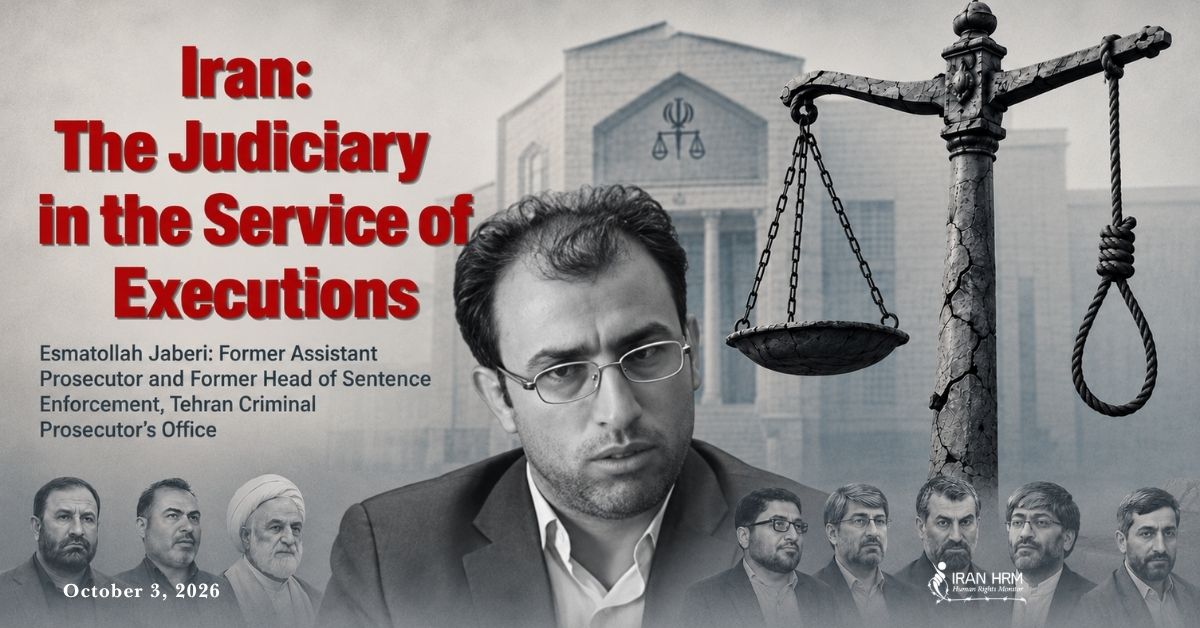
Iran: The Judiciary in the Service of Executions
The series Iran: The Judiciary in the Service of Executions examines the role of judicial officials and institutions in the issuance and enforcement of death sentences and corporal punishments in Iran. Examining these roles helps clarify how a judicial ruling moves from issuance and confirmation to enforcement, and which officials bear responsibility at each stage.

According to compiled figures, at least 2,167 people were executed in Iran in 2025, compared with 993 in 2024. A further 1,069 executions were recorded during the first eight months of 2026. This increase once again highlights the central place of capital punishment in the functioning of Iran’s judicial system.
Esmatollah Jaberi, a former assistant prosecutor and head of sentence enforcement at the Tehran Criminal Prosecutor’s Office, was among the officials involved for years in the enforcement stage of retribution sentences and corporal punishments. His name is associated with cases including the executions of Behnoud Shojaee and Shahla Jahed, as well as the enforcement of three amputation sentences.[1]
Judicial Career and Enforcement Role
According to an interview published by Mehr News Agency in August 2011, Jaberi entered the Tehran Criminal Prosecutor’s Office in spring 2005 and worked in this field for six years.[1]
The introduction to that interview referred to his involvement in approximately 350 qisas cases, and Jaberi stated that he had succeeded in obtaining the consent of victims’ families in 180 cases. The same interview linked him to the enforcement of sentences in several high-profile cases, including that of Shahla Jahed.[1]
Within the sentence enforcement unit, Jaberi’s responsibilities related to the stage following the issuance and confirmation of a judgment, including the follow-up of enforcement procedures and participation in the final implementation of the punishment.
Behnoud Shojaee: Executed for an Offence Committed at the Age of 17
Behnoud Shojaee was 17 years old when the fatal altercation took place on 18 June 2005. Branch 74 of the Tehran Criminal Court sentenced him to qisas on 2 October 2006. After several postponements, the sentence was carried out at dawn on 11 October 2009 in Evin Prison.[2]
Behnoud was denied access to a lawyer during his initial trial. He maintained that he had struck only one blow, while the forensic report referred to multiple injuries. Amnesty International reported that this discrepancy was not effectively examined.[2]
His execution was postponed approximately six times. His lawyer, Mohammad Mostafaei, together with civil society figures and several artists, sought to obtain the victim’s family’s consent to spare his life. Approximately 200 people also gathered outside Evin Prison on the night before the execution in an effort to persuade the victim’s family to grant forgiveness.[2]
Several days before the execution, Amnesty International issued an urgent action warning that Behnoud faced imminent execution and reiterated that international law prohibits the execution of persons for offences committed when they were under the age of 18.[3]
In his 2011 interview, Jaberi also spoke about this case and said that media attention generated by the defence lawyer had made efforts to secure the family’s consent more difficult.[1]
Shahla Jahed: Executed After Years of Challenges to the Proceedings
Khadijeh Jahed, widely known as Shahla Jahed, was executed at dawn on 1 December 2010 in Evin Prison.[4]
She had been accused of murdering Laleh Saharkhizan, the wife of Nasser Mohammadkhani. Shahla confessed at one stage of the proceedings but later retracted her confession. Before the execution, Amnesty International stated that there were serious grounds for concern regarding the fairness of the proceedings and the possibility that her confession had been obtained under coercion.[5]
Her lawyer, Abdolsamad Khorramshahi, sought a review of the case and argued that the investigation had not been properly conducted. In November 2005, the execution was halted to allow further review. In 2008, the then-head of the judiciary again overturned the sentence and referred to “procedural flaws”; nevertheless, Shahla was subsequently sentenced to death again.[5]
On the day of the execution, Amnesty International reiterated that there were serious concerns regarding the fairness of the trial and the evidence relied upon against Shahla. The organisation reported that the execution took place at approximately 5 a.m. in Evin Prison.[4]
The 2011 interview also listed Shahla Jahed’s case among those in which Jaberi had played an enforcement role.[1]
Years later, Jaberi again discussed the Shahla Jahed case and capital punishment during an appearance on the television programme Mesl-e Mah.[6]
Amputation: Three Corporal Punishment Cases
In the same 2011 interview, Jaberi stated that, in addition to death sentences, he had enforced three amputation sentences. He referred to two Afghan nationals and one other convicted person.[1]
Amputation is a punishment that permanently removes part of a person’s body, and its consequences do not end with the enforcement of the sentence. Such punishment can permanently affect daily life, the ability to work, and personal independence.
Jaberi’s own statements indicate that his role was not limited to executions and that he also participated in the enforcement of corporal punishments.
Other Cases
The 2011 interview also associated Jaberi with several other cases, including the case known as the “Red Rope”, the case of a former boxing champion, and a murder case in Sa’adat Abad.[1]
He also referred to the case of Sina Paymard, a juvenile offender who was spared execution after efforts succeeded in obtaining the victim family’s consent.
Jaberi’s View of Capital Punishment
One of the most significant records of Jaberi’s public views on the death penalty is his appearance on the television programme Mesl-e Mah in May 2020. In the closing part of the programme, he was recorded as saying: “Blessed is the murderer who is executed.”[6]
This view presents qisas and execution not only as judicial punishments, but also within a religious and eschatological framework.
Such statements carry particular significance when made by an official who was personally involved for years in the enforcement of death sentences and corporal punishments.
Human Rights Assessment
The execution of persons for offences committed when they were under the age of 18 is incompatible with Article 6(5) of the International Covenant on Civil and Political Rights and Article 37 of the Convention on the Rights of the Child.
The case of Behnoud Shojaee is of particular significance because he was 17 years old at the time of the offence and was executed despite Iran’s obligations under international law.[2][3]
United Nations documentation had also identified Behnoud Shojaee, prior to his execution, among individuals facing the death penalty for offences committed while under the age of 18.[7]
In Shahla Jahed’s case, the retraction of her confession, her lawyer’s objections to the quality of the investigation, and the repeated reviews of the case underscore the importance of full compliance with fair trial guarantees.[4][5]
Amputation is also incompatible with the prohibition of cruel, inhuman or degrading punishment under Article 7 of the International Covenant on Civil and Political Rights.
Responsibility for the enforcement of such punishments is not limited to the judge who issues the sentence. Issuance, confirmation, authorisation and physical enforcement are distinct stages of a single process, and the role of each official should be assessed according to their documented responsibilities and actions.
Conclusion
The record of Esmatollah Jaberi illustrates the role of sentence enforcement officials in carrying out punishments that result in death or permanent bodily harm.
The execution of Behnoud Shojaee, the execution of Shahla Jahed, the enforcement of three amputation sentences, and Jaberi’s public statements on capital punishment are among the most significant documented elements of his record.
Accountability in such cases cannot be limited to the stage at which the judgment is issued. Those involved in confirming, authorising and carrying out the final punishment should also be examined within the scope of their documented authority and conduct.
A halt to executions, an end to corporal punishment, and independent review of cases involving allegations of coerced confessions, denial of defence rights or serious procedural deficiencies are necessary to protect the right to life and human dignity.
Sources and Documents
[1] Interview with Esmatollah Jaberi, Mehr News Agency, August 2011, published under the title Untold Stories of Iran’s Execution Official. The original Mehr page was not directly accessible during the present review, but the interview text has been preserved in contemporaneous archives with explicit attribution to Mehr. It includes Jaberi’s entry into the Tehran Criminal Prosecutor’s Office in spring 2005, references to approximately 350 cases, 180 cases in which consent was obtained, the Shahla Jahed case, statements regarding Behnoud Shojaee, and the enforcement of three amputation sentences.
[2] Amnesty International, 13 October 2009, Latest Juvenile Execution in Iran Condemned. Includes Behnoud Shojaee’s age at the time of the offence, the date of the offence, the date of conviction, the absence of legal representation during the initial trial, repeated postponements of the sentence, and the execution in Evin Prison.
[3] Amnesty International, 9 October 2009, urgent action concerning Behnoud Shojaee and Safar Angooti, document MDE 13/103/2009; warning that Behnoud’s execution was scheduled for 11 October 2009.
[4] Amnesty International, 1 December 2010, report on the execution of Shahla Jahed in Evin Prison and concerns regarding the fairness of the trial and the evidence used against her.
[5] Amnesty International, 30 November 2010, appeal to halt the execution of Shahla Jahed; includes her retracted confession, her lawyer’s objections to the investigation, previous suspensions of the execution, and orders for renewed investigation.
[6] Video and report concerning Esmatollah Jaberi’s appearance on the television programme Mesl-e Mah, May 2020, including the statement: “Blessed is the murderer who is executed.”
[7] United Nations Human Rights Council, communications report of the Special Rapporteur on torture, document A/HRC/10/44/Add.4; Behnoud Shojaee was listed among persons facing execution for offences committed while under the age of 18.