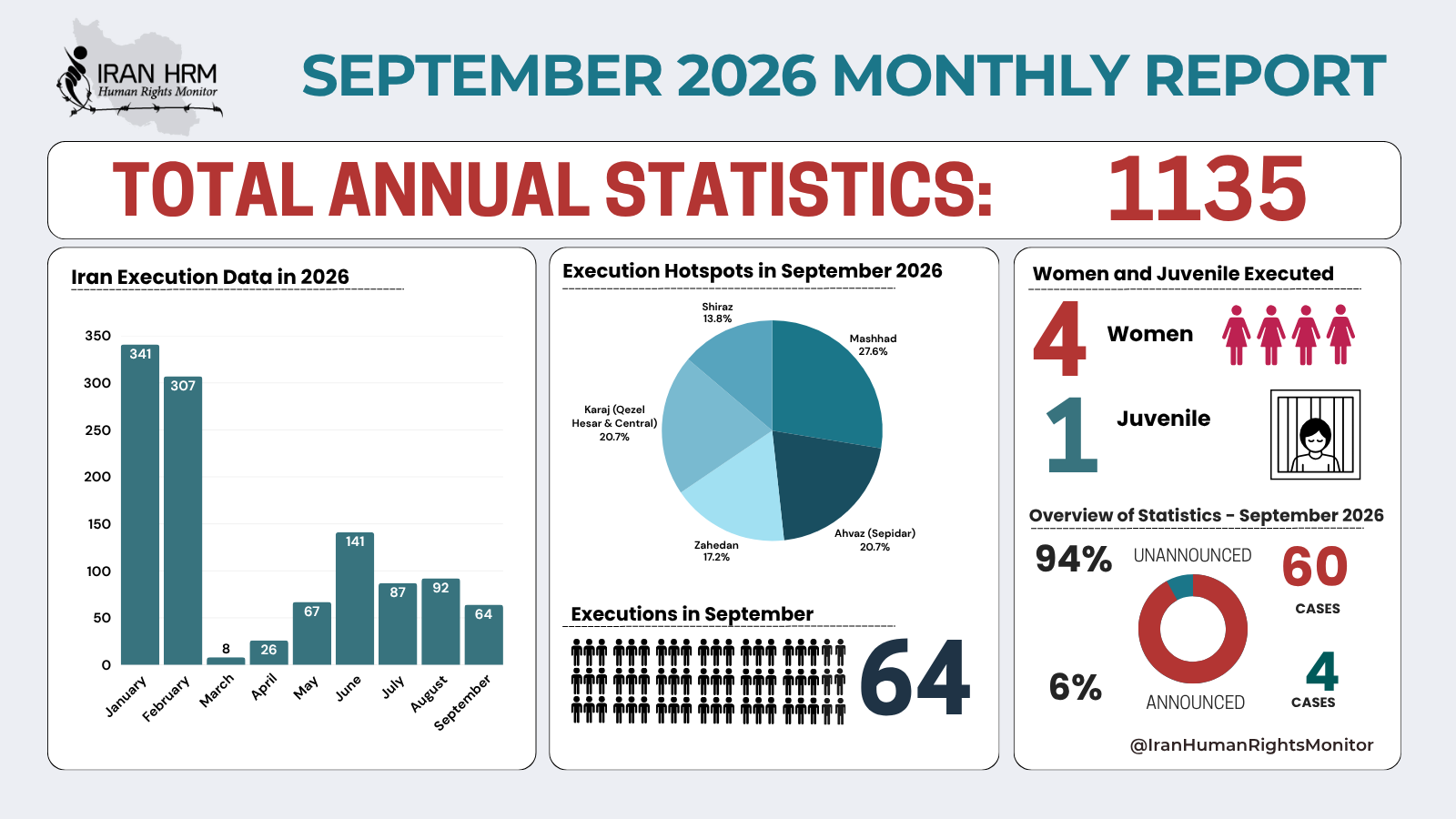
During the month of September 2026, the human rights situation in the Islamic Republic of Iran deteriorated significantly, characterized by an alarming surge in the use of the death penalty and an intensified crackdown on political dissidents, protest detainees, and ethnic minorities. According to data compiled by Iran Human Rights Monitor (Iran HRM), a total of 64 executions were carried out in September alone. Of these 64 executions, only four were officially announced by the state judiciary or government-controlled media, leaving 60 executions unannounced and conducted in secret, illustrating a deliberate attempt by the authorities to obscure the true scale of capital punishment.

Among those executed in September were four women and one person who was a minor at the time of the alleged offence.
Additionally, at least two individuals arrested during popular uprisings were executed, and one prisoner was hanged on charges of espionage. This spike in executions reveals a systemic pattern of utilizing capital punishment to suppress public anger, terrorize local communities, and prevent the resurgence of nationwide protests.
Detailed Breakdown of September Executions
The executions carried out in September 2026 targeted various demographics, including women, political prisoners, ethnic minorities, and minor offenders. Below is a detailed chronological cataloging of the confirmed cases:
September 2, 2026: A series of coordinated executions took place, resulting in the death of eight prisoners. In Vakilabad Prison in Mashhad, Omid Rakhshani, Ansar Nami, and Nazif Rasul-Khandeh were hanged. In Adelabad Prison in Shiraz, Aziz Roshanaei and Yaser Momeni were executed. Concurrently, Ali Mir-Rezaei was executed in Babol, Ahmad Haji-Hasani in the Central Prison of Gorgan, and Vali-Jan Norzay in Rafsanjan Prison.
September 5, 2026: Reza Salimi was executed in the Central Prison of Semnan.
September 6, 2026: Four prisoners were executed in Vakilabad Prison in Mashhad. Among them was Fatemeh Jahangard, a 40-year-old woman, alongside Mohammadreza Mohammadparast, Mehrdad Mokhtari, and Seyed-Rasoul Davari.
September 8, 2026: Ezzat Asgari was executed in the northern city of Behshahr.
September 9, 2026: Four prisoners were hanged. Three of them, Shahrokh Pouresmaeili, Hossein Ghasemzadeh, and Mohammad-Yousef Eisazehi (Rigi), were executed in Dastgerd Prison in Isfahan. The fourth, Mohammadreza Neirang, was executed in the Central Prison of Yazd.
September 13, 2026: Six prisoners were executed across various regional facilities. Amanullah Nazarkhani and Hashem Rakhshani were hanged in Zabol Prison; Asghar Pishahang in Zahedan Prison; Mohammad Mousazeh in Iranshahr Prison; and Yousef Abil alongside Farzad Ahmadpour in Jiroft Prison.
September 14, 2026: Abdolrahim Narouei-Rozaneh was executed in Dastgerd Prison in Isfahan.
The disproportionate execution of Baluch citizens, with at least nine individuals belonging to this minority group hanged during the late-August to late-September cycle, remains a major area of concern, indicating a targeted campaign against marginalized ethnic communities.
The Execution of Uprising Prisoners and Dissidents
In September 2026, the Iranian authorities executed multiple individuals detained during protests.
On September 30, 2026, the judiciary executed two young protesters, Ali Hemmati (21) and Majid Nik-Andish (25), in Mashhad. State-controlled media and the judiciary identified them as ‘leaders of the riots in Tabarsi, Mashhad,’ accusing them of being key field actors during the January protests. The charges brought against them included ‘acting against national security,’ ‘severe disruption of public order,’ and ‘clashing with security forces.’
Furthermore, on September 19, 2026, the regime’s judiciary announced the execution of Hossein Pedaran in Isfahan’s Dastgerd Prison on charges of espionage and intelligence cooperation with external entities.
Judicial Repression and the Issuance of New Death Sentences
In addition to carrying out executions, the Revolutionary Courts issued several new death sentences. In Isfahan, judge Morteza Barati and prosecutor Mohammad-Reza Tavakoli, operating out of the Isfahan Revolutionary Court, sentenced 10 uprising prisoners to death in the collective case known as ‘Isfahan’s Shohada Square.’ The prisoners facing capital punishment in this case are Taraneh Rahimi, Navid Elyasi, Abolfazl Dadgostar, Mehdi Mansouri, Ahmad-Reza Saeedi, Mehrdad Boeiri, Mohammad-Mehdi Asadi, Armin Gholami, Parsa Jafari, and Mehdi Jafari.
Six co-defendants in the same case were handed lengthy prison terms, including Romina Rahimi (sister of Taraneh Rahimi) and Milad Boeiri, who both received 25 years in prison. Hamed Mehr-elian was sentenced to 15 years, while Setayesh Saedi, Sajjad Abedi, and Ali Boeiri each received 5-year prison terms.
In a separate ruling by Branch 5 of the Isfahan Revolutionary Court, Leila Abolhasani, a mother of two teenage girls arrested during protests in Shahin Shahr, was sentenced to death. Meanwhile, the death sentence of Ali-Asghar Peighambari, arrested during the January protests, was upheld by the Supreme Court, and he was subsequently transferred from Fashafouyeh Prison to Ghezel Hesar Prison in Karaj, putting him at imminent risk of execution.
Systematic Deprivation and Medical Neglect in Prisons
Prisoners across Iran faced deteriorating sanitary conditions and deliberate medical neglect. In Isfahan’s Dastgerd Prison, a meningitis outbreak that began in July expanded rapidly due to a complete lack of medical care and isolation protocols. On August 20, 2026, an 18-year-old prisoner named Ali Hashemi died of cardiac arrest following an injection in the prison clinic, with authorities refusing to provide an explanation to his family.
Conditions in Langeroud Prison in Qom (Qom Central Prison) reached a critical level. Severe environmental pollution and lack of basic hygiene facilities resulted in a widespread infestation of bedbugs, lice, and other vermin, leading to skin diseases among hundreds of inmates. Outbreaks of COVID-19 and influenza were also reported, while daily food rations were drastically reduced.
In Evin Prison, the new head of the visitation hall, an official identified as Rezaei, halved the duration of cabin and in-person visits for female prisoners, leading to a protest by families on September 6. Additionally, Ward 7 of Evin Prison experienced extreme overcrowding following the transfer of 60 prisoners from Fashafouyeh Prison, compounding issues of extreme heat, lack of ventilation, and bedbug infestations.
In Urmia Central Prison, guards confiscated personal appliances such as refrigerators and televisions that political prisoners had purchased at their own expense. In Mashhad’s Vakilabad Prison, authorities raided the cell of political prisoner Mohammad Javad Vafaei Sani, a boxing champion on death row, confiscating his sports equipment and denying him access to newspapers.
Exile and Retaliation against Political Prisoners
Political prisoners continue to face arbitrary transfers and punitive measures. On September 8, 2026, 40-year-old political prisoner Parisa Kamali was removed from Yazd Prison at midnight without prior warning and exiled to Bandar Abbas Prison. Arrested in Isfahan in 2024, Kamali was serving a six-year sentence coupled with two years of internal exile in Sarbaz County, Sistan and Baluchestan, on charges of membership in the People’s Mojahedin Organization of Iran (PMOI/MEK). Prior to her transfer, prison authorities had denied her essential medication in retaliation for messages she had written protesting the executions of political prisoners.
Destruction of Evidence of the 1988 Massacre
On September 13, 2026, the state-run Prisons Organization, headed by Heydar Asiabi, began the physical demolition of Gohardasht Prison in Karaj. Gohardasht was one of the primary sites of the 1988 massacre, where thousands of political prisoners were systematically executed. Human rights advocates and international legal experts, including former UN Special Rapporteur Professor Javaid Rehman, have previously documented that the Iranian regime is engaged in a systematic campaign to destroy physical evidence, including mass grave sites in Behesht-e Zahra (Plot 41), Khavaran, Tabriz, Ahvaz, and Mashhad, to obstruct accountability and truth-seeking efforts.
The ‘No to Executions Tuesdays’ Campaign
In response to the surge in capital punishment, prisoners in 66 prisons across Iran observed the 141st week of the ‘No to Executions Tuesdays’ hunger strike on October 6, 2026. The campaign issued a statement condemning the death penalty as a tool of state-sanctioned murder designed to silence dissent, and called on the international community to take immediate steps to halt the gallows.
Conclusion and Call for Urgent International Action
The systematic use of the death penalty, the execution of political protesters and women, and the deliberate destruction of historical crime scenes highlight the ongoing human rights crisis in Iran. Continued diplomatic engagement and trade relations with the Iranian regime must be made strictly conditional on a verifiable halt to executions and the improvement of prison conditions.
Iran Human Rights Monitor (Iran HRM) calls upon the United Nations, the Human Rights Council, the High Commissioner for Human Rights, and all international human rights organizations to intervene immediately. We urge the establishment of an international fact-finding mission to investigate the conditions inside Iranian prisons, particularly Dastgerd Prison, and to pressure the Iranian judiciary to halt all pending death sentences.