WORLD DAY AGAINST THE DEATH PENALTY
10 OCTOBER 2026

Introduction
The World Day Against the Death Penalty was first observed on 10 October 2003 at the initiative of the World Coalition Against the Death Penalty. Marked annually on 10 October, it seeks to draw international attention to the right to life, the situation of prisoners under sentence of death and the need to abolish capital punishment.¹
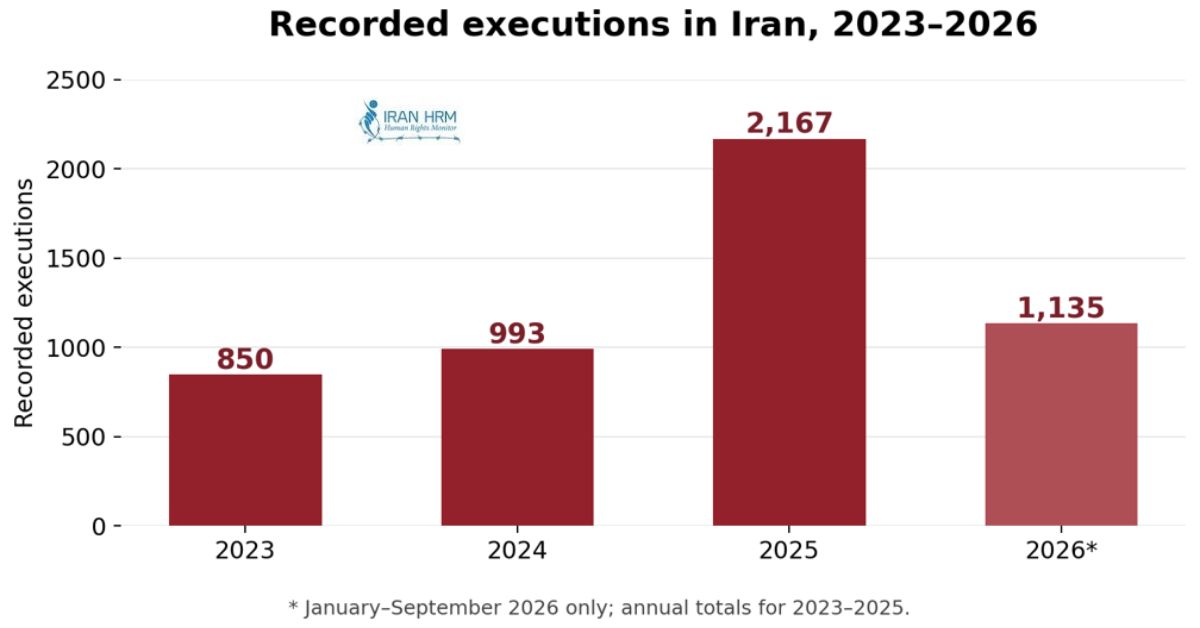
As the observance enters its twenty-fourth year, the number of executions recorded in Iran presents a deeply concerning picture. At least 2,167 people were executed in 2025, compared with 993 in 2024 and 850 in 2023. A further 1,135 executions were recorded during the first nine months of 2026. These figures represent the minimum number of documented cases; the actual total may be higher.
 Alongside the rising number of executions, the execution of detained protesters and political prisoners, new death sentences in security-related cases and public instructions by senior judicial officials to expedite proceedings have raised serious concerns regarding the right to life and fair trial guarantees. This report focuses on the judiciary’s stated policies, prominent political execution cases, prisoners at risk of execution, protests within prisons and responses by international human rights mechanisms.
Judicial policy and directives to expedite executions
Gholamhossein Mohseni-Ejei, Head of the Judiciary of the Islamic Republic of Iran, repeatedly called for faster proceedings in protest-related and security cases during 2025 and the first months of 2026. In January 2026, he stressed the need for swift action against detained protesters; on 16 February 2026, he instructed prosecutors to issue indictments more rapidly against individuals he described as the “main elements of the unrest”.
On 7 April 2026, Mohseni-Ejei called upon his First Deputy, Hamzeh Khalili, to increase and accelerate the issuance of death sentences and confiscation orders. This directive reflects the stated position of the judiciary’s senior leadership. Establishing a direct connection to a particular execution would require scrutiny of decisions taken by prosecutors, courts and the Supreme Court in that case.
On 19 and 20 April 2026, the Head of the Judiciary called for extraordinary, expedited handling of cases involving individuals accused of collaborating with the enemy. On 30 April, he defended swift punishment for those he described as having “blood on their hands”. These remarks should be recorded as official positions, not as proof of the allegations against any particular individual.
In capital cases, expedited proceedings must not curtail the time and facilities needed to prepare a defence, effective access to legal counsel, investigation of torture allegations or the possibility of judicial review. Articles 6 and 14 of the International Covenant on Civil and Political Rights (ICCPR) provide the principal standards for assessing these safeguards.²
Political executions and cases linked to protests
On 19 March 2026, Saleh Mohammadi, Mehdi Ghasemi and Saeed Davoudi were publicly executed in Qom. Their cases were linked to the protests of December 2025–January 2026. Serious concerns have been raised about their trials, contested confessions and the failure to investigate allegations of torture.³
Between 30 March and 4 April 2026, six political prisoners accused of links to the People’s Mojahedin Organization of Iran (PMOI/MEK) were executed at Ghezel Hesar Prison. Mohammad Taghavi Sangdehi and Akbar Daneshvarkar were executed on 30 March; Babak Alipour and Pouya Ghobadi on 31 March; and Vahid Baniamerian and Abolhassan Montazer on 4 April. Human rights reports described several of these executions as secret and stated that families and lawyers had not been given advance notice.³
Amirhossein Hatami, a young detainee arrested in connection with the January 2026 protests, was executed at Ghezel Hesar Prison on 2 April 2026. His case had been heard by Branch 15 of the Tehran Revolutionary Court. Judicial authorities alleged his involvement in an attack on, and damage to, a security facility; human rights organisations, by contrast, raised concerns about fair trial safeguards and reliance on disputed confessions.³
Further executions of protest detainees were recorded in Shahroud, Mashhad and Isfahan in the following months. Alireza Hemmati Sistani and Majid Nikandish were executed in Mashhad on 30 September 2026. Reports concerning their case alleged torture, prolonged solitary confinement and coerced confessions. On 5 October, Alireza Sepahi and Alireza Raisi, defendants in a case connected to the Isfahan protests, were also executed.
Recurring reports of restrictions on access to lawyers of choice, disputed confessions, expedited hearings and inadequate notification of families underscore the need for independent examination of the actions of Revolutionary Courts, prosecutors and detaining authorities. United Nations experts have also expressed concern about these practices in official communications.⁴
Political and religious prisoners under sentence of death
In its statement of 29 September 2026, marking week 140 of the “No to Execution Tuesdays” campaign, the campaign estimated that nearly 200 political and religious prisoners were under sentence of death. This estimate covers political and religious prisoners and some individuals detained in connection with protests; it must not be presented as the total number of death-row prisoners nationwide.
Women reported to have received death sentences include Zahra Shahbaz Tabari, Arghavan Fallahi, Bita Ali-Hemmati, Parisa Kamali and Pakhshan Azizi. Mahboubeh Shabani has faced a charge potentially carrying the death penalty, but the available information does not establish that a final death sentence has been issued against her.
Shervin Bagherian and other defendants in the Alikhani Square case in Isfahan also faced death sentences, several of which have been carried out. Ehsan Faridi, a 22-year-old student; Farshad Etemadi-Fard; Amirhassan Akbari-Monfared; and Seyed Mohammad Javad Vafaei Sani, a boxing coach, have likewise been identified in available reports as prisoners under sentence of death.
The case of Mohsen Eslamkhah, linked to the 2022 protests, is of particular concern because the alleged offence occurred when he was under 18 years of age. United Nations experts have raised concerns about his death sentence, allegations of torture and violations of due process guarantees. Article 6 of the ICCPR and Article 37 of the Convention on the Rights of the Child prohibit the death penalty for offences committed by persons below 18 years of age.⁵
Prisoners’ protest: “No to Execution Tuesdays”
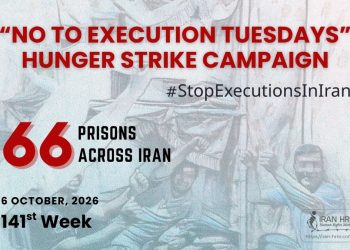
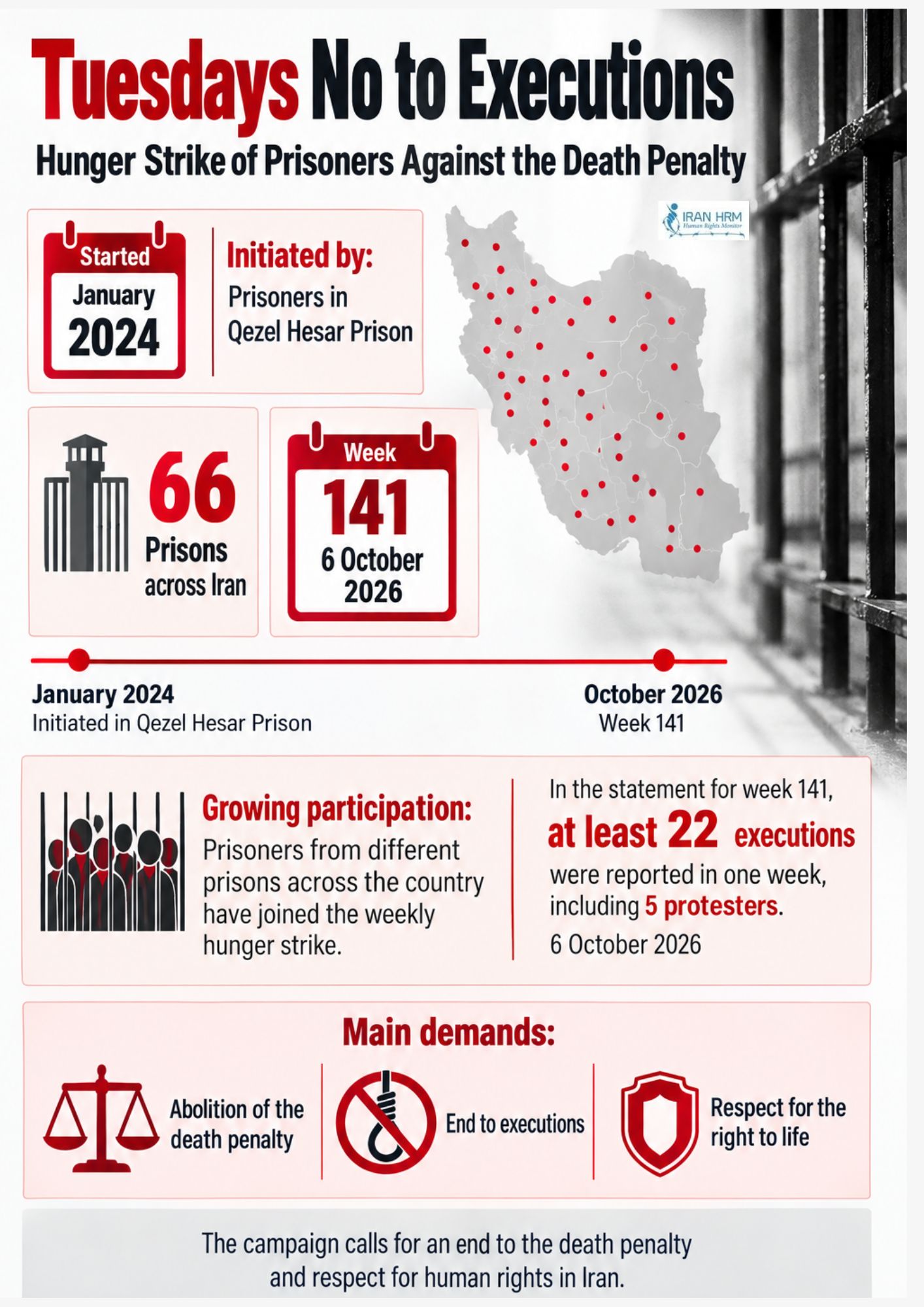
The “No to Execution Tuesdays” campaign began at Ghezel Hesar Prison in January 2024 and expanded to other prisons through weekly hunger strikes. According to the campaign’s own statement, its 141st consecutive week of action took place on 6 October 2026, with participation reported in 66 prisons.
In the same statement, participating prisoners reported at least 22 executions in the preceding week, including five protesters, and called for an immediate halt to executions. The campaign’s continuity has made opposition to capital punishment a sustained and organised form of protest originating within Iran’s prisons.
International reactions and Iran’s obligations
On 13 January 2026, Volker Türk, United Nations High Commissioner for Human Rights, warned of the possible use of the death penalty against protesters through expedited proceedings. On 20 February, Amnesty International expressed concern that at least 30 people linked to the protests faced the risk of death sentences or execution, including persons who had been children at the time of the alleged offences.⁶
In July 2026, the Independent International Fact-Finding Mission on the Islamic Republic of Iran called for an immediate halt to the execution of protesters. On 28 August, independent United Nations experts warned in communication OL IRN 16/2026 that broad and vaguely worded provisions of the new espionage law could result in death sentences for conduct falling outside the threshold of the “most serious crimes”.⁷ ⁸
On 9 October 2026, one day before the World Day Against the Death Penalty, Mai Sato, the United Nations Special Rapporteur on the situation of human rights in the Islamic Republic of Iran, announced that she and several other United Nations experts had issued a statement concerning the use of the death penalty in Iran.
The announcement followed earlier warnings by United Nations experts regarding the execution of protest detainees, torture, forced confessions and proceedings lacking adequate safeguards. In particular, the experts had raised concerns about 12 defendants connected to the Alikhani Square incidents in Isfahan and the requirement to establish each defendant’s individual criminal responsibility.
In General Comment No. 36, the United Nations Human Rights Committee interprets the “most serious crimes” threshold in Article 6 of the ICCPR as covering crimes of extreme gravity involving intentional killing. Accordingly, the death penalty for offences not involving intentional killing, including drug offences and many security-related charges, is incompatible with that interpretation. Even in intentional homicide cases, serious violations of fair trial guarantees can render an execution an arbitrary deprivation of life.⁹
Conclusion and calls for urgent action
The rising number of executions, the execution of political prisoners and detained protesters, and public instructions by senior judicial officials to accelerate severe punishments underscore the need for urgent, independent scrutiny of Iran’s judicial system. In cases involving torture, coerced confessions, denial of counsel or infringements of defence rights, the irreversible punishment of death may violate the right to life.
United Nations human rights mechanisms and Member States are urged to act towards an immediate halt to executions and the establishment of a formal moratorium on the death penalty; ensure independent review of sentences imposed following unfair trials; investigate allegations of torture and coerced confessions; and take prompt, effective steps to protect prisoners at risk of execution.
When capital punishment is imposed in the context of protest repression and violations of fundamental procedural safeguards, it ceases to be solely a matter of penal policy and directly engages the State’s responsibility to protect the right to life. Accountability for such violations, and action to prevent further executions, must not be delayed.
Public source notes
- World Coalition Against the Death Penalty, history of the World Day Against the Death Penalty, first observed in 2003. https://worldcoalition.org/who-we-are/presentation-history/
- International Covenant on Civil and Political Rights, Articles 6 and 14. https://www.ohchr.org/en/instruments-mechanisms/instruments/international-covenant-civil-and-political-rights
- Amnesty International, report on the execution of four political prisoners and the risk faced by other protesters, March 2026. https://www.amnesty.org/en/latest/news/2026/03/iran-seven-protesters-and-dissidents-at-risk-of-imminent-execution-after-four-men-arbitrarily-executed-in-secret-within-24-hours/
- United Nations Special Procedures, communication UA IRN 7/2026 concerning protest detainees and fair trial safeguards. https://spcommreports.ohchr.org/TMResultsBase/DownLoadPublicCommunicationFile?gId=31002
- United Nations experts, communication UA IRN 8/2026, 28 May 2026, concerning prisoners at risk of execution. https://spcommreports.ohchr.org/TMResultsBase/DownLoadPublicCommunicationFile?gId=31026
- Amnesty International, warning concerning at least 30 people at risk of the death penalty in connection with protests, February 2026. https://www.amnesty.org/en/latest/news/2026/02/iran-children-among-30-people-at-risk-of-the-death-penalty-amid-expedited-grossly-unfair-trials-connected-to-uprising/
- Independent International Fact-Finding Mission on the Islamic Republic of Iran, call to halt the execution of protesters, July 2026. https://www.ohchr.org/en/press-releases/2026/07/iran-un-fact-finding-mission-urgently-calls-iran-immediately-halt-protest
- United Nations experts, communication OL IRN 16/2026, 28 August 2026, concerning the law on espionage and cooperation with hostile States. https://spcommreports.ohchr.org/TMResultsBase/DownLoadPublicCommunicationFile?gId=31256
- United Nations Human Rights Committee, General Comment No. 36 on Article 6 of the ICCPR (right to life). https://www.ohchr.org/en/calls-for-input/general-comment-no-36-article-6-right-life