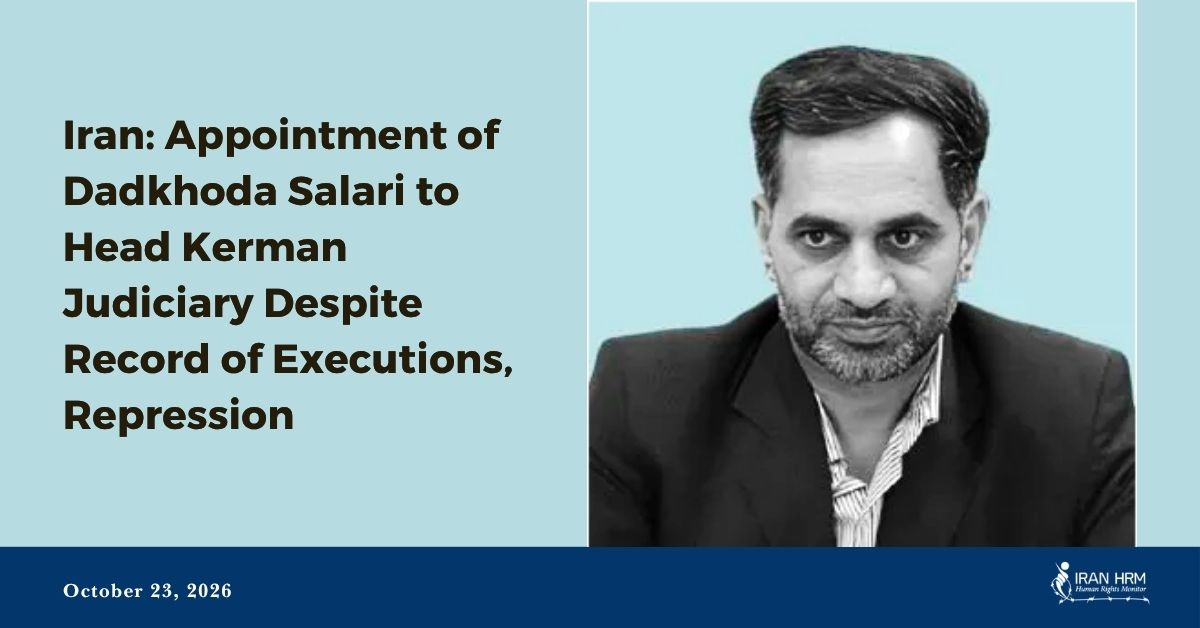
The appointment of a judicial official with a long record linked to executions, suppression of protests, restrictions on freedom of expression, and discrimination against Baha’is has raised renewed concerns about the human rights situation in Iran.
Executive Summary

This report examines the judicial record of Dadkhoda Salari Manzari, the newly appointed Head of the Judiciary of Kerman Province. An assessment of his performance throughout various positions, from presiding over the Kerman Revolutionary Court to serving as Prosecutor of Kerman Province and later as Director General of the Provincial Inspectorate, reveals a persistent pattern of violations of fundamental human rights.
Available documentation indicates his involvement, either through direct judicial authority or managerial responsibility, in cases involving the widespread issuance and implementation of death sentences, including the execution of an individual for an offense allegedly committed at the age of 16, the arrest of protesters, restrictions on online freedom of expression, systematic pressure against members of the Baha’i community, interference with citizens’ right to privacy, and judicial actions against family members of activists and justice-seekers.
His appointment as Head of the Kerman Judiciary without any independent review of these allegations raises serious concerns regarding the continued lack of accountability and the persistence of impunity within the judicial system of the Islamic Republic of Iran.
Introduction
On 20 October 2026, Gholam-Hossein Mohseni Eje’i, Head of the Judiciary of the Islamic Republic of Iran, appointed Dadkhoda Salari Manzari as Head of the Judiciary of Kerman Province. The position grants him broad authority over the supervision of courts, prosecutors’ offices, enforcement of judicial decisions, and judicial policymaking throughout the province.
Given Salari’s new position and his significant role in judicial processes over the past two decades, an examination of his record in light of Iran’s international human rights obligations is warranted. The findings of this report indicate that substantial aspects of his documented record appear inconsistent with Iran’s obligations under the International Covenant on Civil and Political Rights (ICCPR), the Convention on the Rights of the Child (CRC), the Universal Declaration of Human Rights (UDHR), and other international human rights standards.
Violations of the Right to Life and Extensive Use of the Death Penalty
One of the most significant aspects of Dadkhoda Salari’s record is his documented role and supervisory responsibility in relation to the issuance and implementation of death sentences.
Available documentation indicates that dozens of individuals were executed or sentenced to death in narcotics-related and qisas (retribution-in-kind) cases during periods in which he exercised judicial authority or prosecutorial oversight.
Documented cases include:
- The execution of four prisoners, Akbar M., Zahir G., Saeed J., and Khodabakhsh A., in February 2011;
- The execution of 10 prisoners at Kerman Central Prison in May 2014, whose full identities were not publicly disclosed;
- The execution of five prisoners in September 2014, including Hossein Shahriari, Abbas Pourizdan-Panah, Hamid Mir, Mohammad Hosseini, and one unnamed female prisoner;
- In September 2014, eight defendants, Gholam Shiheki Atraqi, Hamzeh Aboureza Atraqi, Nourbakhsh Abouzar Atraqi, Monijeh Khuzestani Atraqi, Ghadamali Tavakoli, Hossein Tavakoli Atraqi, Gholamreza Azizabadi Atraqi, and Bahram Sabouri, received a total of 13 death sentences. Gholam Shiheki Atraqi and Hamzeh Aboureza Atraqi were each sentenced to death three times, Nourbakhsh Abouzar Atraqi received two death sentences, and the remaining five defendants were each sentenced to death once. The imposition of multiple death sentences against a single individual, despite the fact that execution can only be carried out once, underscores the symbolic and intimidation-driven nature of such punishments.
- The execution of seven prisoners in January 2015, amid a lack of transparency concerning their identities, judicial proceedings, and access to legal safeguards;
- The mass execution of at least 12 prisoners in December 2018, including Abdolghani Qalandarzehi, Yaghoub Qalandarzehi, Jalil Khodabakhsh, Yousef Jalaleddin, and two prisoners bearing the surname Shahbakhsh;
- The execution of Nabi Nouti-Zehi and Ebrahim Ghanbarzehi in August 2021;
- The execution of Arman Bahr Asemani in January 2017, despite the fact that he was 16 years old at the time of the alleged offense.
In many of these cases, information concerning access to independent legal counsel, the public nature of proceedings, publication of verdicts, meaningful public oversight, and independent review of the evidence and alleged confessions were not made available. Such lack of transparency, particularly in cases involving deprivation of life, raises serious concerns regarding compliance with international fair trial guarantees.
These practices are inconsistent with Article 3 of the Universal Declaration of Human Rights, which recognizes the right to life, liberty, and security of person, as well as Article 6 of the International Covenant on Civil and Political Rights, which protects the inherent right to life and obligates states to safeguard that right. United Nations human rights mechanisms have consistently emphasized that strict compliance with fair trial guarantees is essential in all cases involving the death penalty. A lack of transparency and the absence of public access to case information significantly impede independent assessment of compliance with these standards.
The United Nations Human Rights Committee has repeatedly stressed that any serious deficiency in due process in a capital case may render the resulting deprivation of life arbitrary under international law.
The Execution of Arman Bahr Asemani and a Grave Violation of Children’s Rights
Among the most serious cases associated with Dadkhoda Salari’s tenure is the execution of Arman Bahr Asemani. He was 16 years old at the time of the alleged offense and was executed on 16 January 2017 (27 Dey 1395) in Jiroft Prison. Under international human rights standards, he was legally recognized as a child at the time of the offense, making his execution a violation of one of the clearest and most fundamental prohibitions in international law.
The execution of individuals for offenses committed while they were under the age of 18 is prohibited under Article 6(5) of the International Covenant on Civil and Political Rights, which explicitly states that a sentence of death shall not be imposed for crimes committed by persons below eighteen years of age. Likewise, Article 37 of the Convention on the Rights of the Child prohibits both capital punishment and life imprisonment without the possibility of release for offenses committed by persons under eighteen years of age.
This prohibition is absolute under international human rights law. No exception, including the consent or refusal of forgiveness by the victim’s family, can relieve the State of its international obligations. Judicial authorities, prosecutors, and officials responsible for the enforcement of sentences have a duty to prevent the implementation of punishments that are prohibited under international law.
The execution of Arman Bahr Asemani therefore constitutes not only a violation of the right to life but also a clear breach of the Islamic Republic of Iran’s obligations under both the Convention on the Rights of the Child and the International Covenant on Civil and Political Rights. From an international legal perspective, it represents a serious violation of children’s rights.
Violations of Freedom of Expression and Repression of Online Users
During Dadkhoda Salari’s tenure as Prosecutor of Kerman Province, a number of social media channel administrators and online users were arrested and prosecuted for reporting on protests, disseminating calls for public gatherings, or publishing critical content. The securitization of media activities and the use of national security-related charges against individuals exercising their right to express opinions and share information contributed to restrictions on civic space and the free flow of information.
Such actions are inconsistent with Article 19 of the Universal Declaration of Human Rights, which guarantees the right to freedom of opinion and expression, including the freedom to seek, receive, and impart information and ideas through any media and regardless of frontiers. They are also incompatible with Article 19 of the International Covenant on Civil and Political Rights (ICCPR), which protects freedom of expression, access to information, and the right to communicate ideas and information.
The use of criminal and security mechanisms to silence critical voices, restrict reporting on matters of public interest, and create a climate of fear surrounding the exercise of free expression exceeds the narrow restrictions permitted under international human rights law. Any limitation on freedom of expression must be prescribed by law, necessary, proportionate, and directed toward a legitimate objective recognized under international law. In the cases documented here, arrests and prosecutions appear to have been primarily linked to peaceful media activities and public information-sharing.
Religious Discrimination Against Members of the Baha’i Community
Multiple instances of judicial and administrative pressure against members of the Baha’i community were documented in Kerman Province during the period in which Dadkhoda Salari held judicial office. These measures included the sealing of 17 Baha’i-owned businesses, restrictions on economic activities undertaken by Baha’i citizens, the closure of the Baha’i cemetery in Kerman (Golestan-e Javid), interference with burial rites, and the prosecution and imprisonment of individuals because of their religious beliefs and activities.
These actions are incompatible with Article 18 of the Universal Declaration of Human Rights, which guarantees freedom of thought, conscience, and religion, and with Article 18 of the International Covenant on Civil and Political Rights, which protects the right to have, adopt, manifest, and practice a religion or belief individually or collectively, in public or private.
Furthermore, these measures are inconsistent with Article 2 of the Universal Declaration of Human Rights, which guarantees the enjoyment of human rights without discrimination, including on the basis of religion or belief, as well as Article 26 of the International Covenant on Civil and Political Rights, which guarantees equality before the law and equal and effective protection against discrimination.
Depriving individuals of their livelihoods, forcibly closing businesses for observing religious holidays, preventing the burial of deceased persons, and prosecuting individuals solely because of their religious beliefs constitute acts of religious discrimination and violations of freedom of religion or belief. The continued implementation of such measures demonstrates the use of judicial and administrative mechanisms to restrict the fundamental rights of members of the Baha’i community and to subject them to systematic pressure on account of their religious identity.
Violations of the Right to Privacy and Interference in Private Life
In September 2016, the Kerman Prosecutor’s Office announced the arrest of 34 individuals at a private gathering, together with the seizure of a private residence and the confiscation of vehicles belonging to attendees. Those detained faced allegations relating to their personal lifestyle choices and private conduct.
Such actions are inconsistent with Article 12 of the Universal Declaration of Human Rights, which prohibits arbitrary interference with privacy, family, home, and correspondence and guarantees legal protection against such interference. They are likewise contrary to Article 17 of the International Covenant on Civil and Political Rights, which protects individuals against arbitrary or unlawful interference with their privacy, family, home, or correspondence and against unlawful attacks on their honor and reputation.
The intervention of authorities in a private gathering, the mass arrest of individuals for personal conduct, and the confiscation of their property constitute disproportionate and punitive interference with the right to privacy. The use of prosecutorial powers to impose ideological standards or monitor personal choices blurs the distinction between criminal conduct and private lifestyle decisions, thereby significantly restricting the enjoyment of the right to privacy.
Pressure on Families of Prisoners and Justice-Seeking Families
The conviction of Parvin Mokhtare, the mother of Kouhyar Goudarzi, a student activist and former political prisoner, to 23 months’ imprisonment by the Revolutionary Court in Kerman constitutes an example of judicial pressure directed at the family members of human rights defenders and government critics. Such measures may serve to increase the costs of seeking justice, limit social support networks for political prisoners, and discourage individuals from exercising their rights to freedom of expression and civic participation.
The prosecution of family members of critics, activists, or detainees can have a chilling effect on the exercise of the rights to seek justice, express opinions, and engage in public life.
Such actions are inconsistent with Article 19 of the International Covenant on Civil and Political Rights, which guarantees freedom of expression, and Article 17 of the ICCPR, which protects individuals from arbitrary interference with their family and private life.
The targeting of relatives of activists and political prisoners may deter the exercise of fundamental rights, including freedom of expression, the pursuit of accountability, and participation in civic affairs.
Conclusion
The available evidence indicates that Dadkhoda Salari’s tenure within Kerman Province’s judicial system was marked by a persistent pattern of serious human rights concerns. These concerns include violations of the right to life, violations of children’s rights, restrictions on freedom of expression and peaceful assembly, discrimination against members of the Baha’i community, violations of privacy rights, and a lack of transparency in cases resulting in the imposition or implementation of the death penalty.
His appointment as Head of the Judiciary of Kerman Province without any independent review of this record raises concerns regarding the continuation of impunity and the persistence of practices inconsistent with international human rights standards.