
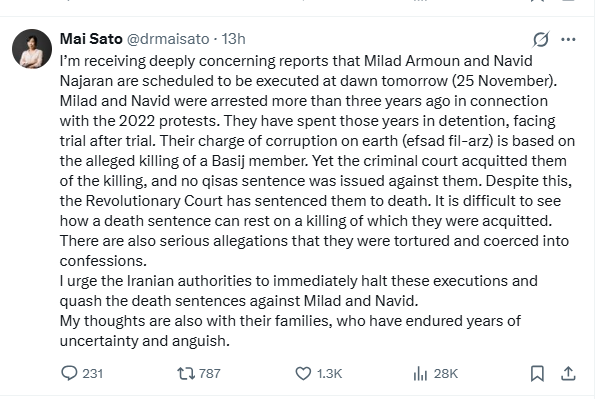
Emergency Situation: Milad Armoun (27, arrested on 3 November 2022 in Tehran) and Navid Najaran (34, arrested on 2 December 2022 in Ahvaz), two protesters from the 2022 nationwide protests in the case known as “Ekbatan,” face a serious and imminent risk of execution following the Supreme Court’s confirmation of their death sentences and their transfer to solitary confinement in Ghezel Hesar Prison on Saturday, 21 November 2026. These concerns persist on Wednesday, 25 November 2026 (the date reportedly set for their execution), as Mizan News Agency, affiliated with the judiciary, while denying claims that the Revolutionary Court’s final death sentence against the two protesters had been overturned, stated that reports regarding the timing of the execution are “inaccurate”—a situation that, due to a lack of official transparency and ongoing detention and solitary confinement, heightens fears of a sudden implementation of the sentence. Meanwhile, the UN Special Rapporteur on the situation of human rights in Iran, Madam Mai Sato, has also warned of deeply concerning reports regarding the situation of the two prisoners and called for an immediate halt to their executions and the quashing of their sentences.

 Background of the Ekbatan Case: The “Ekbatan” case stems from the death of Arman Alivardi, a 21-year-old Basij member, during protests and clashes in Tehran’s Ekbatan Town on 26 October 2022. Following this incident, state forces arrested more than 50 young residents of Ekbatan, and indictments were ultimately issued for 14 individuals; the case of the eight main defendants was brought forward on charges related to “complicity in murder” in the criminal court and “moharebeh” (enmity against God) or “corruption on earth” (efsad-e fel-arz) in the Revolutionary Court.
Judicial Proceedings and Violations of Fair Trial Guarantees: The legal proceedings in the case of Milad Armoun and Navid Najaran have been marked by a series of serious procedural and substantive flaws:
- Coerced confessions and evidentiary ambiguities: Human rights reports indicate that the defendants were subjected to torture and ill-treatment and forced into making coerced confessions that were later broadcast on state media; meanwhile, serious ambiguities remain regarding how the incident occurred, the lack of clarity over who inflicted the fatal blow, and the failure to present cited footage and evidence in court.
- Contradictory proceedings in the Criminal Court and Revolutionary Court: On Wednesday, 13 November 2024, Branch 13 of the Tehran Criminal Court One—by a majority vote of its advisory judges (mostasharan), while the presiding judge opposed the ruling and issued a minority opinion—sentenced Milad Armoun, Navid Najaran, and four other co-defendants to qisas (retribution-in-kind) death sentences on the charge of “complicity in premeditated murder,” a ruling that was overturned by branch No.9 of the Supreme Court on 13 September 2025. Upon retrial on 19 May 2026, the criminal court sentenced Milad Armoun to five years in prison and diyeh (blood money) on the charge of “complicity in causing non-fatal injuries” and acquitted Navid Najaran of the murder charge. Nevertheless, 25 May 2026, Branch 15 of the Tehran Revolutionary Court, presided over by Abolghasem Salavati, sentenced Milad Armoun and Navid Najaran, along with two co-defendants, to death—a ruling that Mizan News Agency has insisted remains in force, but which defense lawyers have strongly challenged, including on grounds of violating the prohibition against double jeopardy (ne bis in idem) and contradictions in the charges.
- Restrictions on legal counsel and flaws in notification and cassation: Defense lawyers have reported that throughout all stages of the trial and sentencing, they were barred from effective attendance and denied access to the case files and written verdicts, with sentences communicated orally instead—a practice that severely obstructed the right to a defense and lawful appeal.