Executive Summary at a Glance
- High-Level Coordination to Intensify Crackdowns: Meeting between Chief Justice Gholamhossein Mohseni-Ejei and Mojtaba Khamenei on October 24, 2026 (2 Aban 1405), emphasizing “swift and decisive processing” and “deterrent execution of sentences,” without any reference to fair trial guarantees or fundamental rights of defendants.
- Secret Mass Case of “Kordabad, Isfahan” (18 Death Sentences): Opening of a mass, non-transparent case involving approximately 70 defendants related to the January 2026 (Dey 1404) protests in Kordabad, Isfahan, resulting in 18 death sentences and long-term prison terms (5 to 25 years) for around 40 individuals under complete blackout and without publishing court verdicts.
- Imminent Execution Risk of a Child Offender: Imposition of a death sentence on Mohammad Soleimani in the Kordabad case, who, according to credible field reports, was under 18 years of age at the time of arrest.
- Non-Transparent Death Sentences in Kazerun Prison: Imposition of death sentences on 5 protest-related detainees from the January 2026 protests in Kazerun Prison (residents of Khesht, Moshtan, and Ghaleh-Seyed) amidst absolute news opacity, with only one surname (“Dehghani”) verified.
Introduction
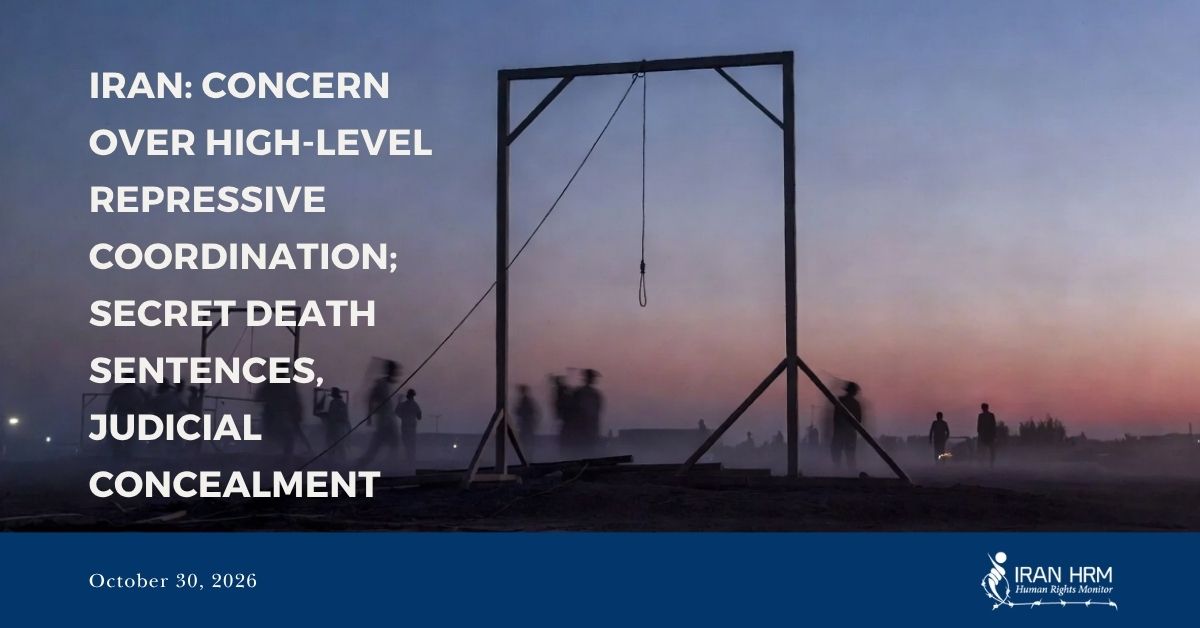
This legal report documents concerning trends in the trajectory of judicial and security policies within the Islamic Republic of Iran. Credible reports and field accounts indicate that while receiving high-level political directives to enforce “speed, decisiveness, and deterrence,” the judiciary has embarked on a dangerous path of “judicial concealment” and “structural opacity.”

Imposing severe death sentences in mass protest cases without publishing verdicts, without individualizing specific alleged criminal acts, and in the absence of public trials constitutes a clear violation of Iran’s international obligations under the International Covenant on Civil and Political Rights (ICCPR).
Legal Assessment of High-Level Judicial-Political Meeting: Escalating “Deterrence” Contrary to Fair Trial Standards
On October 24, 2026 (2 Aban 1405), Chief Justice Gholamhossein Mohseni-Ejei met with Mojtaba Khamenei to present an operational report and general policies of the judiciary. According to official reports (including Tasnim and IRNA news agencies), the main focus centered on “thorough, swift, and decisive case processing,” “timely and deterrent execution of sentences,” and “combating manifestations of insecurity and corruption.”
Legal Analysis and Conflicts with International Standards:
Impact of “Speed and Decisiveness” on Fair Trial Rights (Article 14, ICCPR):
While trial without undue delay is a component of fair proceedings, Article 14 of the ICCPR mandates that speed must not compromise fundamental defense rights. Given long-standing concerns regarding judicial independence, effective access to legal counsel, forced confessions, and defense restrictions in political/security cases, emphasizing “speed” and “decisiveness” without mentioning procedural guarantees directly conflicts with Article 14 obligations.
Misuse of “Deterrence” to Justify Executions:
Emphasizing “deterrent execution of sentences” within a punitive criminal policy serves directly as a cover for mass death sentences in political and protest cases. This stands in complete opposition to UN Human Rights Committee interpretations limiting capital punishment strictly to the “most serious crimes” subject to strict fair trial compliance.
Compromising the Principles on the Independence of the Judiciary:
Submitting strategic reports and receiving direct guidance from top political authorities undermines the institutional and operational independence of the judiciary, raising severe questions regarding its susceptibility to political and security directives.
The meeting highlights that:
- The Chief Justice directly reports on judicial operations to the Supreme Leader;
- Judicial priorities are determined at the leadership level;
- Major judicial policy frameworks are defined within political directives.
Key Omission of Human Rights Concepts:
Official announcements contained zero references to the “right to defense,” “prohibition of torture,” “court transparency,” “prisoners’ rights,” or “limiting capital punishment,” demonstrating a total prioritization of repressive efficiency over human rights compliance.
Hidden Cases, Mass Death Sentences, and Structural Judicial Silence
The most alarming aspect of the judiciary’s recent conduct is the creation of classified, high-profile cases and the lack of official disclosures regarding death sentences. This practice precludes independent human rights monitoring and entirely tramples upon the rights of defendants and their families.
A) The Secret Case of “Kordabad, Isfahan” (18 Death Sentences & Dozens of Heavy Sentences)
According to credible sources, following the January 2026 protests in Kordabad, Isfahan, a mass case was brought against approximately 70 individuals.
- Sentences Issued: 18 individuals sentenced to death, and approximately 40 others received prison terms ranging from 5 to 25 years.
- List of the 18 Individuals Sentenced to Death:
- Morteza Nasoohi Dehnavi (Father)
- Mojtaba Nasoohi Dehnavi (Son)
- Mohammad-Reza Yahyaei
- Abolfazl Zarei
- Ali-Akbar Kordabadi
- Mojtaba Kordabadi
- Sirous Ghorbani
- Jalil Shokrollahi
- Khalil Shokrollahi
- Pouya Khalili Mal-Khalifeh
- Mojtaba Ghorghani
- Vahid Amini
- Hadi Dehghani
- Ali Aghababaei
- Javad Haji-Alizadeh
- Mojtaba Hajian
- Mohsen Shahbazi
- Mohammad Soleimani
Severe Legal Violations in the Kordabad Case:
- Non-Publication of Verdicts and Vague Charges: Severe charges such as “Moharebeh” (enmity against God), “Baghi” (armed rebellion), “Efsad-fil-Arz” (corruption on Earth), and “destruction of public property” were raised without specifying individual criminal conduct. Notably, no murder charges exist in announced charges.
- Execution Risk of a Child Offender (Mohammad Soleimani): Mohammad Soleimani was under 18 years old at the time of arrest. Sentencing him to death constitutes a direct violation of the Convention on the Rights of the Child (CRC) and Article 6 of the ICCPR.
- Concealment of Proceedings: Retaining agencies, Revolutionary Court branches, judges’ identities, appeal status, and legal counsel access remain completely hidden from the public and families.
B) Non-Transparent Death Sentences in Kazerun Prison (5 Convictions)
Credible field reports from Kazerun Prison (under Warden Saham Rahmani and Internal Director Arabzadeh) indicate death sentences issued for five protest detainees from the January 2026 protests (residents of Khesht, Moshtan, and Ghaleh-Seyed).
- Structural Opacity and Legal Deprivation: Judicial authorities refuse to formally disclose official charges, court branches, names, or legal statuses.
- Incomplete Identification: Among the 5 death-row prisoners, only one surname (“Dehghani”) has been verified; the remaining four identities remain unconfirmed due to strict security blackouts.
- Denial of Fair Trial Standards: The possibility of the lack of choice counsel, secret sessions, and severed family communications place these 5 prisoners at imminent risk of secret execution.
Legal Assessment and Violations of International Obligations
- Right to Life and Prohibition of Arbitrary Deprivation of Life (Article 6, ICCPR):
Imposing capital punishment without strict adherence to fair trial guarantees, in closed proceedings, and based on vague charges constitutes Arbitrary Deprivation of Life.
- Prohibition of Executing Minors (Article 6 ICCPR & Article 37 CRC):
Sentencing Mohammad Soleimani to death for an offense allegedly committed while under 18 violates binding international treaty obligations.
- Judicial Opacity and Risk of Legal Disappearance (Articles 9 & 14, ICCPR):
Continued classification of files, refusal to publish written verdicts, failure to declare full identities, and concealing trial data deprive individuals of essential legal protections. This creates a state of “Legal Disappearance”—where an individual’s judicial identity, case status, and defense rights are completely erased from public, legal, and international oversight, directly violating Articles 9 and 14 of the ICCPR.
Actionable Demands and Recommendations to UN Mechanisms
Given the imminent threat of secret executions, UN human rights mechanisms are requested to take urgent action:
- To the Special Rapporteur on Iran & Special Rapporteur on Extrajudicial Executions:
- Urgent Intervention & Transparency: Demand formal, transparent accounting from Iranian authorities regarding the Kordabad case (18 death sentences) and the 5 death sentences in Kazerun Prison.
- Immediate Stay for Child Offender: Issue an urgent appeal to halt and quash the death sentence of Mohammad Soleimani.
- To the Working Group on Arbitrary Detention (WGAD) & OHCHR:
- Demand Judicial Transparency: Pressure Iranian authorities to publish complete written judgments, review closed trials, and guarantee full access to independent chosen counsel.
- Ensure Judicial Independence: Demand an end to political and security interventions in judicial proceedings in accordance with the UN Basic Principles on the Independence of the Judiciary.