Executive Summary
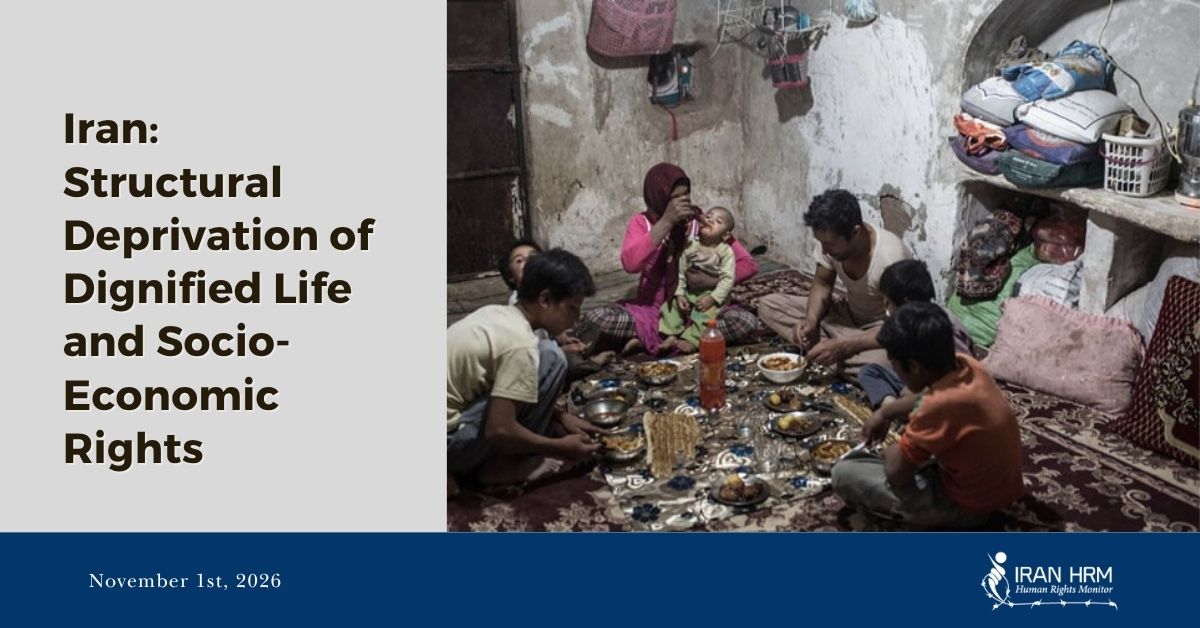
This report examines and evaluates the human rights implications of the current economic situation in the Islamic Republic of Iran. Statistical documentation and official field reports in the first half of 2026 indicate that the adoption of contractionary economic policies, the abrupt elimination of subsidies for basic goods and medicines, structural imbalances, and the failure to prioritize public welfare have led to an unprecedented collapse in societal purchasing power and the emergence of a profound humanitarian crisis.

The misery index reaching a historic high of 97.7%, point-to-point inflation ranging from 83.8% to 88.6%, food inflation soaring up to 128.1%, the exclusion of 1.5 million individuals from formal employment, and a multi-fold increase in the cost of critical medications for rare and chronic diseases provide serious evidence of the deterioration of living conditions and the diminished access of broad segments of the population to work, food, housing, and medical services. This situation raises serious concerns regarding the implementation of the obligations of the Islamic Republic of Iran under Articles 6, 11, and 12 of the International Covenant on Economic, Social and Cultural Rights (ICESCR), as well as obligations related to the protection of the right to life and human dignity enshrined in Article 6 of the International Covenant on Civil and Political Rights (ICCPR). The continuation of this trend can amount to a structural deprivation of the conditions necessary for a life of dignity and human worth.
Introduction and International Legal Framework
The right to life in international standards is not merely limited to “biological survival.” According to General Comment No. 36 of the United Nations Human Rights Committee (concerning Article 6 of the ICCPR), the right to life entails the enjoyment of a “life with dignity.”
Under this interpretation, even in times of economic crisis or resource constraints, states are obligated to guarantee the core minimum of economic and social rights, notably access to food, health, and medicine.
Furthermore, pursuant to Articles 6, 11, and 12 of the International Covenant on Economic, Social and Cultural Rights (ICESCR)—to which the State of Iran is a party without any reservations—the State is bound by the principle of non-retrogression in fulfilling welfare, guaranteeing the “right to an adequate standard of living,” the “right to adequate food and freedom from hunger,” and the “right to the enjoyment of the highest attainable standard of physical and mental health.”
The findings of this report indicate that a combination of policies, economic decisions, and governance practices in the Islamic Republic of Iran has resulted in the continuous erosion of citizens’ access to the essential components of a dignified life, raising serious concerns regarding the State’s international obligations in the sphere of economic, social, and cultural rights.
Section I: Serious Challenges in Securing the “Right to Adequate Food” and Food Security (Article 11 of the ICESCR)
- Surge in Food Inflation and the Shrinking of the Public Table
- According to data from the Statistical Center of Iran, point-to-point food inflation reached 128.1% in July 2026. Oils and fats recorded the highest increases at 261.5%, followed by milk, cheese, and eggs at 147.1%, red and white meat at 145.2%, and bread and cereals at 116.7%.
- The cost of food provisions for a single individual reached 8.6 million Tomans (45.58 $ current official rate) in October 2026—an amount that has pushed the aggregate cost of feeding a four-person family far beyond the purchasing power of the vast majority of wage earners, workers, and pensioners.
Note to the reader: Based on a resolution by the Supreme Labor Council the minimum monthly wage for workers in year 2026-2027 is 88.12 dollars and the minimum monthly payment to the pensioners is 89.04 $
This situation reflects a severe decline in economic access to adequate food and conflicts with the requirements of Article 11 of the ICESCR concerning the right to an adequate standard of living and food security.
- Elimination of Subsidies and Heightened Food Insecurity
- A 150% increase in flour prices following the elimination of industrial wheat subsidies has led to a 2.5-fold rise in the price of industrial bread (surging from 23,800 Tomans to 60,000 Tomans, and in some instances up to 90,000 Tomans).
- A 25% increase in the price of chicken (reaching up to 335,000 Tomans per kilogram) and a sharp spike in red meat prices to approximately 2 million Tomans have severely restricted access to protein sources for impoverished classes.
According to the interpretive guidelines of the Committee on Economic, Social and Cultural Rights, States are obligated to ensure economic and physical access to adequate food for all individuals. When broad segments of society are forced to eliminate or curtail the consumption of essential items, serious concerns arise regarding the realization of the right to food and compliance with Article 11 of the Covenant.
- Inadequacy of Social Support Schemes
- Measures such as a 500,000-Toman increase in electronic welfare food cards (Kala-barg) for limited groups bear no proportionality to the scale of inflation and purchasing power collapse, necessitating a fundamental revision based on the State’s obligations regarding the equitable distribution of resources.
Section II: Severe Impediments to the Realization of the “Right to Health” and the Pharmaceutical Crisis (Article 12 of the ICESCR)
- Exorbitant Costs and Scarcity of Critical Medications
- The implementation of policies eliminating preferential foreign exchange rates without establishing an effective protective umbrella has resulted in a 7- to 10-fold jump—and in certain cases up to a 900% increase—in the prices of medications for chronic and rare diseases.
- According to official reports, the cost of a single course of chemotherapy for cancer patients has surged from 7 million Tomans in recent years to approximately 70 million Tomans (a 10-fold increase), while the prices of specific life-saving drugs have escalated from 1 million to 30 million Tomans.
- Field reports indicate acute shortages of critical medical supplies, including insulin and diagnostic laboratory kits, in the market. The continuation of these shortages directly imperils patients’ access to necessary medical treatment.
- Negligible Share of Health in Gross Domestic Product (GDP)
- Public health expenditure in Iran accounts for merely 4.9% of GDP. According to data from The Global Economy, this ranks Iran 112th out of 184 countries, illustrating a profound discrepancy with global health benchmarks and international standards.
- Monopolization of the Pharmaceutical Market and Discrimination in Public Resource Allocation
The structure of pharmaceutical production and importation in Iran remains under the exclusive control of quasi-governmental and state-affiliated entities, notably companies such as “Barakat”, affiliated with the “Execution of Imam Khomeini’s Order” (Setad). Capital accumulation and monopolization within this sector, coupled with the protracted non-allocation of official foreign exchange for essential medicines over consecutive months (while exceeding $2 billion allocated for the importation of luxury automobiles), exemplify systemic mismanagement and institutional conflicts of interest. This disparity directly deprives the most vulnerable strata of society of medical treatment, placing the right to health (Article 12 of the ICESCR) in grave jeopardy.
Article 12 of the ICESCR obligates State Parties to guarantee the highest attainable standard of physical and mental health. Effective and affordable access to essential medicines constitutes a core component of this right. The exponential rise in medical treatment and pharmaceutical costs, combined with severe supply shortages, raises significant concerns regarding compliance with obligations under the right to health and its minimum core content.
Section III: Labor Market Crisis, Informal Employment, and the Erosion of Labor Standards (Articles 6 and 7 of the ICESCR)
- Massive Exit of the Workforce from Formal Employment
- In the first six months of 2026, at least 1.5 million individuals were displaced from formal employment, while 250,000 workers suffered job losses.
- Official reports from the Statistical Center of Iran indicate a net contraction of 450,000 employed individuals and a 10.1% decline in Gross Domestic Product (GDP) in the spring of 2026. The industrial and mining sectors experienced the most severe setback, contracting by 14.17%.
- Expansion of Precarious Work and Blank-Signed Contracts (Gharardad-ha-ye Sefid-Emza)
- The exclusion of workers from formal employment deprives them of social security coverage, pension schemes, and statutory benefits. The widespread prevalence of blank-signed contracts presents critical obstacles to the realization of “just and favorable conditions of work” as mandated by Article 7 of the ICESCR.
- Historic Surge in the Misery Index
- The convergence of an official unemployment rate of 9.1% with point-to-point inflation exceeding 88% has driven the misery index to a historic high of 97.7%, exerting profound adverse impacts on the psychological and socio-economic stability of households.
The right to work does not merely denote holding employment; it requires the provision of genuine employment opportunities, job security, and equitable working conditions. The systematic expansion of employment insecurity and the mass displacement of workers from formal employment generate substantial concerns regarding the enforcement of Articles 6 and 7 of the ICESCR.
Section IV: Widespread Livelihood Protests and Structural Suppression of Labor and Trade Union Rights (Articles 8 of the ICESCR and 21 of the ICCPR)
Field Report on Gatherings within a 72-Hour Span
- Saturday, October 24, 2026 :
- Gas Industry Personnel: Employees of the Bidboland Gas Booster Stations in Ahvaz, Hosseinieh, Piazabad, and Kuhdasht staged protest gatherings following months of unanswered follow-ups regarding their demands.
- Municipal Workers: A group of municipal workers in Ilam gathered in front of the governorate building to protest their employment status and livelihood conditions.
- Sunday, October 25, 2026 :
- Social Security Organization Retirees: Protest gatherings were held in Tehran, Shoosh, Rasht, and Ahvaz, featuring slogans protesting poverty and mismanagement.
- Security Obstruction against the Nationwide Gathering of Steel Retirees: Steel retirees intended to travel to Tehran from across the country; however, security agencies (the Ministry of Intelligence) deployed intimidation, threats, and deterrence to prevent buses from departing their cities of origin. Nevertheless, a number of retirees managed to reach the capital and gathered in front of the Ministry of Cooperatives, Labour, and Social Welfare.
- Strikes and Service Sector Protests: School transport and public transit drivers in Karaj gathered to protest severe diesel fuel shortages, while
- Bakers in Iranshahr simultaneously went on strike.
- Monday, October 26, 2026 :
- Nationwide Gathering of Telecommunications Retirees: Simultaneous gatherings were held in dozens of cities, including Isfahan, Tehran, Tabriz, Ilam, Borujerd, Bijar, Kermanshah, Khorramabad, and Sanandaj. In Tehran (around Sardar-e Jangal district), these protests received widespread support from passing citizens.
Legal Analysis of the Protests (Conclusion)
The occurrence of dozens of nationwide gatherings and strikes across entirely diverse livelihood and occupational sectors (including telecommunications, social security, and steel retirees, bakers, public transport drivers, gas station workers, and municipal personnel) within a limited 3-day window (October 24–26, 2026) demonstrates several fundamental legal realities:
- Structural Scope and Pervasiveness of the Livelihood Crisis: This volume of simultaneous protests across dozens of cities (including Tehran, Isfahan, Tabriz, Ahvaz, Rasht, Sanandaj, Ilam, Khorramabad, and Karaj) proves that the prevailing economic deprivation is neither localized nor episodic; rather, it has transformed into an “all-encompassing and structural livelihood crisis” affecting the entirety of the labor force and pension-recipient strata.
- Complete Erosion of Resilience and Protective Mechanisms: The sequential protests conducted by retirees and workers following months of fruitless follow-ups reflect the total inadequacy of official channels for addressing livelihood demands and the insufficiency of wages and pensions to secure the minimum requirements of life (Article 11 of the ICESCR).
- Security Obstruction and Intimidation against the Right to Peaceful Assembly: The intervention of security apparatuses (including measures by the Ministry of Intelligence to intimidate, threaten, and obstruct the transit of steel retirees’ buses from various cities to the capital) constitutes a manifest violation of the right to peaceful assembly (Article 21 of the ICCPR) and the right to freedom of association and trade union activities (Article 8 of the ICESCR). A police-security response to foundational livelihood demands represents a blatant repudiation of the State’s international obligations to respect citizens’ fundamental rights.
Conclusion
The findings of this report indicate that the ongoing economic crisis in the Islamic Republic of Iran is not merely a financial or managerial challenge; rather, it has reached a juncture where its impacts directly undermine the enjoyment of fundamental human rights by millions of citizens. Unprecedented inflation, severe purchasing power decline, the expansion of food insecurity, the crisis in accessing medicine and medical treatment, the contraction of formal employment, and the proliferation of precarious labor contracts have collectively generated conditions that deprive broad segments of society of the minimum prerequisites for a life of human dignity.
The body of evidence presented in this report demonstrates that the aforementioned deprivations are no longer sporadic or temporary phenomena; rather, they have manifested as a structural and persistent pattern across the spheres of employment, health, nutrition, and social protection. The continuation of this situation, particularly in the absence of adequate remedial and protective mechanisms, generates grave concerns regarding the State’s compliance with its obligations under Articles 6, 7, 11, and 12 of the International Covenant on Economic, Social and Cultural Rights.
Furthermore, the concurrence of the livelihood crisis with restrictions imposed on civic and trade union protests and assemblies has left many citizens not only deprived of effective access to their economic and social rights but also has stripped them of the ability to peacefully demand and pursue those rights. Such conditions drastically elevate the risk of deepening cycles of poverty, inequality, and social exclusion on a massive scale.
Accordingly, the existing evidence reveals that a significant portion of Iran’s population faces a growing trend of structural deprivation from the essential components of a “dignified life with human worth”—a situation that necessitates the immediate attention of international human rights bodies and the adoption of effective corrective measures by responsible authorities.