A Comprehensive Analytical and Documented Legal Report on the Awarding of the Global Magnitsky Prize to Iran’s Boxing Champion, the Urgent Imperative to Quash his Death Sentence, and the Necessity of Transitioning from Verbal Condemnations to Targeted Sanctions
Introduction and Exclusive News: The Resounding Name of a Champion on the International Stage
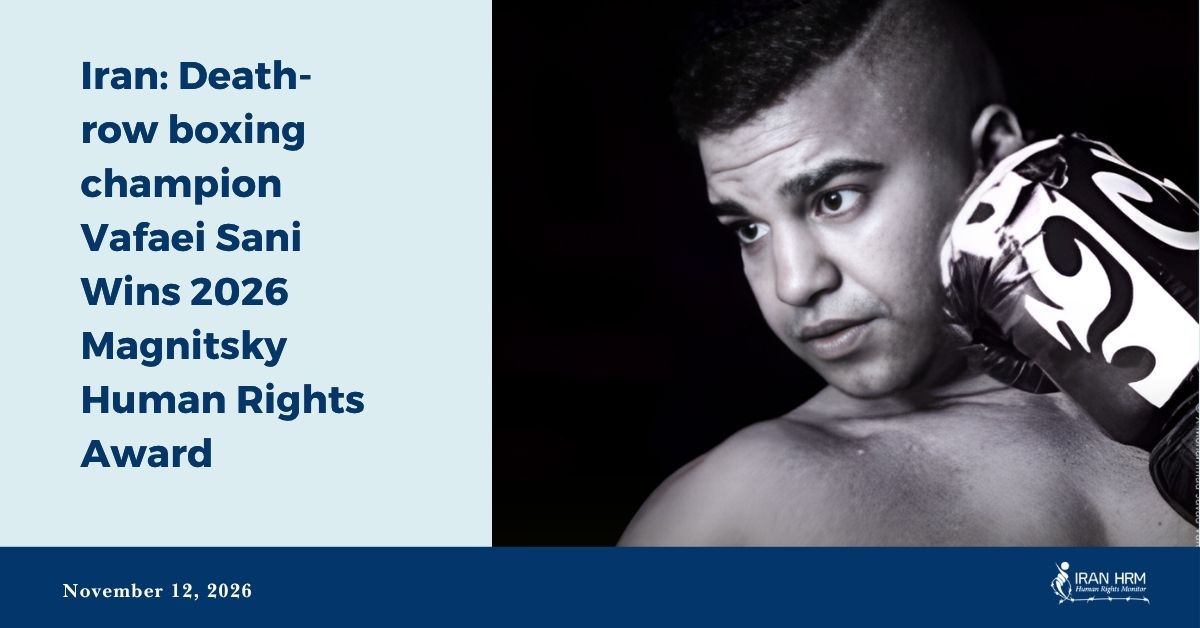
In a prominent human rights event, the Magnitsky Human Rights Award foundation announced Mohammad Javad Vafaei Sani, a 31-year-old Iranian boxing champion and martial arts coach, as the recipient of the 2026 award in the category of “Outstanding Human Rights Activist.” This international award, established in 2015 to honor courageous individuals standing against repression and tyranny, is scheduled to be presented on Thursday, November 12, 2026 (Aban 21, 1405), during an official ceremony in London by Bob Blackman, a Member of the British House of Commons and Chairman of the 1922 Committee.

In its X (formerly Twitter) post on November 9, the foundation stated:
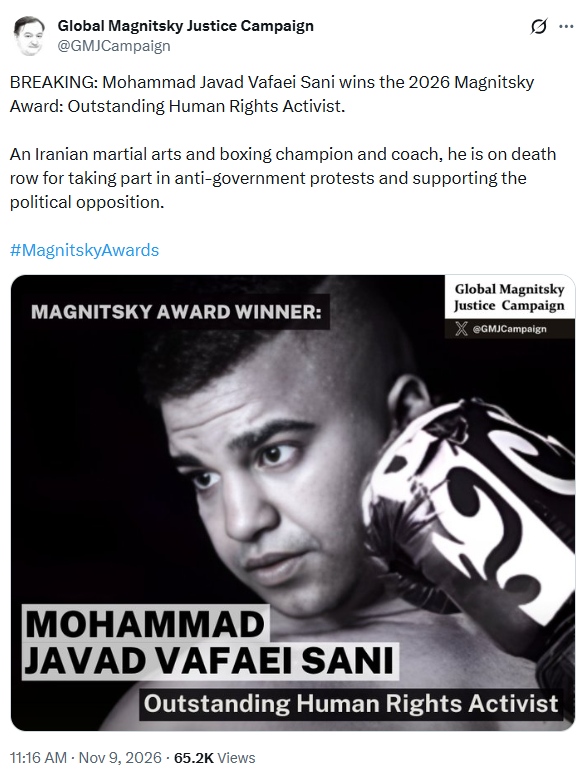 The conferral of this award upon Mohammad Javad Vafaei Sani carries profound significance, as he is not a professional human rights defender, but an athlete and boxing coach facing execution due to his case’s intersection with popular protests and political charges—proceedings persistently marred by grave fair-trial concerns. This selection demonstrates that his case has transformed in the eyes of the international community into a symbol of political repression, the employment of capital punishment against dissidents and critics, and the ongoing violation of due process standards in the Islamic Republic of Iran.
Mohammad Javad Vafaei Sani, a political prisoner incarcerated in Vakilabad Prison in Mashhad, receives this global accolade while facing a death sentence handed down by the judiciary of the Islamic Republic for the third time. Bestowing this international title upon him not only pays tribute to the resilience and steadfastness of a political prisoner against repression but also reflects the international community’s escalating alarm over the Islamic Republic’s deployment of capital punishment in political cases, reinforcing the surging demand for the immediate quashing of his death sentence.
From the Boxing Ring to Death Row: Case Background and Fabricated Charges
Mohammad Javad Vafaei Sani, a national boxing championship silver medalist, was arrested in March 2020 (Esfand 1398) amidst an intensified security climate and widespread suppression following the November 2019 (Aban 1398) nationwide protests.
Throughout more than five years of imprisonment, he has endured severe physical and psychological torture, prolonged solitary confinement, and persistent threats of execution.
The judiciary sentenced this athletic champion to death for “supporting the People’s Mojahedin Organization of Iran (PMOI/MEK),” and under fabricated charges such as “corruption on earth” (Efsad-fil-Arz), and “moharebeh” (enmity against God). Although the Supreme Court twice overturned his death sentence, Branch 4 of the Revolutionary Court of Mashhad issued a death sentence for a third time in September 2024, which was subsequently upheld by the Supreme Court in October 2025.
Vafaei Sani’s case epitomizes the systemic pattern of repression in Iran, where freedom of expression (Article 19 of the ICCPR), the right to peaceful assembly (Article 21 of the ICCPR), and the right to a fair trial (Article 14 of the ICCPR) are thoroughly trampled, and confessions extracted under torture (violating Article 7 of the ICCPR) serve as the foundation for issuing the gravest sentences. Beyond breaching Articles 7, 14, 19, and 21 of the International Covenant on Civil and Political Rights, Mohammad Javad Vafaei Sani’s case raises critical concerns regarding the violation of Article 6 of the Covenant (the right to life), given that capital punishment has been imposed for conduct falling glaringly short of the international standard for “most serious crimes.”
The Voice of Resilience from the Political Ward of Vakilabad Prison, Mashhad
In a poignant message from Vakilabad Prison in Mashhad following the issuance of his third death sentence, Vafaei Sani reaffirmed his faith, his ideals of freedom, and his political convictions. Emphasizing his unwavering loyalty to the Iranian people’s aspiration for freedom and his explicit support for the People’s Mojahedin Organization of Iran (PMOI/MEK), he wrote:
“We, the deprived of our homeland’s most sublime human heritage who have suffered oppression for a prolonged period, now have no choice other than to rise up in defense of our people, our future, and our freedom. We will not surrender, and we have proven that we possess the most formidable weapon possible: our faith and righteousness…”
This message embodies the indomitable spirit of a political prisoner who, despite standing on the precipice of execution, remains steadfast in safeguarding human dignity and defending the rights of his compatriots.
Global Solidarity: Sports and Parliamentary Statements Demanding the Immediate Quashing of the Death Sentence
The issuance and upholding of the death sentence against this boxing champion have provoked widespread outrage and condemnation across the international community:
- Statement by 19 Prominent Global Sports Figures: Renowned athletes and Olympic and world medalists—including Martina Navratilova (tennis legend), Nancy Hogshead (three-time Olympic gold medalist), Sharon Davies (Olympic medalist), and Riley Gaines—issued a joint statement sharply condemning the death sentence handed down to Mohammad Javad Vafaei Sani, demanding its immediate and unconditional quashing. Recalling the tragic executions of athletes such as Habib Khabiri (captain of the national football team), Forouzan Abdi (captain of the national women’s volleyball team executed during the 1988 massacre), and Navid Afkari (the executed wrestling champion), the signatories urged immediate action by the United Nations and international sports federations to save his life.
- Call by the British Committee for Freedom in Iran: Issuing a press release and warning against the imminent threat to the life of Mohammad Javad Vafaei Sani and 17 other political prisoners, the Committee emphasized that verbal condemnations of the Iranian regime are insufficient and that practical measures must be taken to halt all executions completely.
From the “Magnitsky Award” to “Global Magnitsky Sanctions”: The Imperative to Stop Executions and Hold Perpetrators Accountable
The conferral of the Magnitsky Award upon Mohammad Javad Vafaei Sani occurs as the judiciary of the Islamic Republic has imposed capital punishment against him for a third time, despite the Supreme Court having twice overturned his death sentence. The repetition of death sentences following repeated legal flaws raises grave concerns regarding judicial independence, the principle of legal certainty, and the instrumentalization of the death penalty in political cases.
This convergence is not merely a symbolic event; rather, it highlights the profound gap between the international community’s assessment of his human rights situation and the Islamic Republic judiciary’s treatment of this political prisoner.
In addition to this recognized international award, the name “Magnitsky” is linked to a framework of human rights sanction mechanisms in the United States, the European Union, the United Kingdom, Canada, and Australia. These sanctions regimes enable the imposition of targeted sanctions against individuals implicated in serious human rights violations—including torture, arbitrary detention, denial of fair trial rights, arbitrary executions, and other gross violations of fundamental rights. Such measures typically comprise asset freezes, travel bans, and financial and banking restrictions.
Bestowing this award upon Mohammad Javad Vafaei Sani must not be confined to a purely symbolic gesture. The ongoing issuance and upholding of death sentences against him, notwithstanding widespread international anxiety over judicial proceedings and reports of torture and coerced confessions, underscore the pressing necessity of holding the perpetrators of these violations accountable.
Accordingly, the international community, United Nations special mechanisms, and states equipped with Magnitsky sanctions regimes are urged to:
- Demand the immediate and permanent quashing of Mohammad Javad Vafaei Sani’s death sentence, alongside his unconditional release and that of all political prisoners.
- Investigate the role of Judge Mansouri (Head of Branch 4 of the Revolutionary Court of Mashhad) and other judicial authorities, interrogators, security agents, and officials involved in issuing, upholding, or enforcing judgments derived from proceedings that violate international standards, and, upon establishing accountability, subject them to targeted human rights sanctions under global Magnitsky regimes.
- Request the Special Rapporteur on the situation of human rights in the Islamic Republic of Iran, the Special Rapporteur on extrajudicial, summary, or arbitrary executions, and the Special Rapporteur on torture to urgently pursue Mohammad Javad Vafaei Sani’s case as an emblem of grave concerns surrounding capital punishment, torture, and the absence of due process.
- Elevate the cessation of executions, the guarantee of fair trials, and the accountability of perpetrators of serious human rights violations as a clear and continuous demand in bilateral and multilateral engagements with the Islamic Republic of Iran.
Conclusion
The awarding of the 2026 Magnitsky Human Rights Award to Mohammad Javad Vafaei Sani marks a pivotal step in amplifying the voices of political prisoners facing execution in Iran. The international community, sports federations, and international bodies must urgently deploy all legal and executive instruments at their disposal to secure the immediate quashing of this national champion’s death sentence and preserve his life.
The conferral of the 2026 Magnitsky Human Rights Award upon Mohammad Javad Vafaei Sani is not merely recognition of a political prisoner; it serves as an alert to the global community regarding the peril of capital punishment facing an individual whose case is intertwined with critical human rights apprehensions. At a juncture where the Islamic Republic has applied the death penalty against him for the third time, silence or purely symbolic reactions risk tacitly condoning the imminent threat of irreversible deprivation of the right to life.
The responsibility of the international community now extends beyond mere condemnation; it requires mobilizing every existing mechanism to prevent this execution and hold its perpetrators accountable.