
Executive Summary

Femicide in Iran is no longer a collection of isolated murders or domestic disputes. An examination of documented cases recorded in 2026 reveals that women and girls are subjected to lethal violence within a backdrop of domestic abuse, child marriage, legal discrimination, and structural barriers that render escaping violent relationships difficult or impossible.
This report argues that femicide in Iran cannot be reduced merely to the individual actions of perpetrators. The Islamic Republic of Iran bears responsibility for creating and perpetuating conditions that facilitate femicide through the maintenance of discriminatory laws, the persistent allowance of child marriage, the absence of a comprehensive law to prevent violence against women, a shortage of protective mechanisms, and a failure to prevent recognized forms of violence against women.
An examination of documented instances shows that many victims faced violence, threats, coercion, or continuous control prior to their murder, yet no effective protective mechanisms existed for them. This situation raises serious concerns regarding the Islamic Republic of Iran’s adherence to its international human rights obligations. Under the International Covenant on Civil and Political Rights (ICCPR) and the International Covenant on Economic, Social and Cultural and Political Rights (ICESCR), the Islamic Republic of Iran is obligated to guarantee women’s right to life, protect them from foreseeable violence, and adopt effective legal, judicial, and administrative measures to prevent, protect against, and ensure accountability for gender-based violence.
Introduction
Violence against women is one of the most widespread and persistent human rights violations globally. In its most severe form, this violence culminates in femicide—the killing of women and girls in a context of gender discrimination, gender-based violence, control, domination, or structural deprivation.
According to United Nations standards, femicide is not merely ordinary murder. When women are killed because of their gender or within the framework of unequal power relations, domestic violence, forced marriage, child marriage, or patriarchal control, the issue transcends ordinary criminal law and transforms into a human rights crisis.
In recent years, numerous cases of the murder of women and girls in Iran have shocked public opinion. A common characteristic of many of these cases is that the victims faced a cycle of violence, threats, forced marriage, child marriage, or restrictions stemming from legal discrimination prior to their death.
Dimensions of the Femicide Crisis in Iran
An examination of documented cases from the beginning of 2026 through the end of October indicates that at least 92 women and girls were victims of murder in Iran, with at least 13 of them being under the age of 18.
In October 2026 alone, at least 24 murder cases involving 26 female and child victims were reflected in media and human rights sources—a statistic averaging approximately one victim per day.
A significant portion of these murders were perpetrated by husbands, former husbands, fathers, brothers, or other close relatives of the victims. This pattern aligns with global findings, where international organizations have repeatedly warned that the most dangerous place for many women is the family environment and their closest relationships.
Nevertheless, existing statistics likely reflect only a fraction of reality. The lack of a transparent system for recording femicide, the non-publication of official data, and restricted independent access to information have left the true dimensions of this crisis obscured.
Victims of Femicide: From Child Marriage to Murder Following Divorce Requests
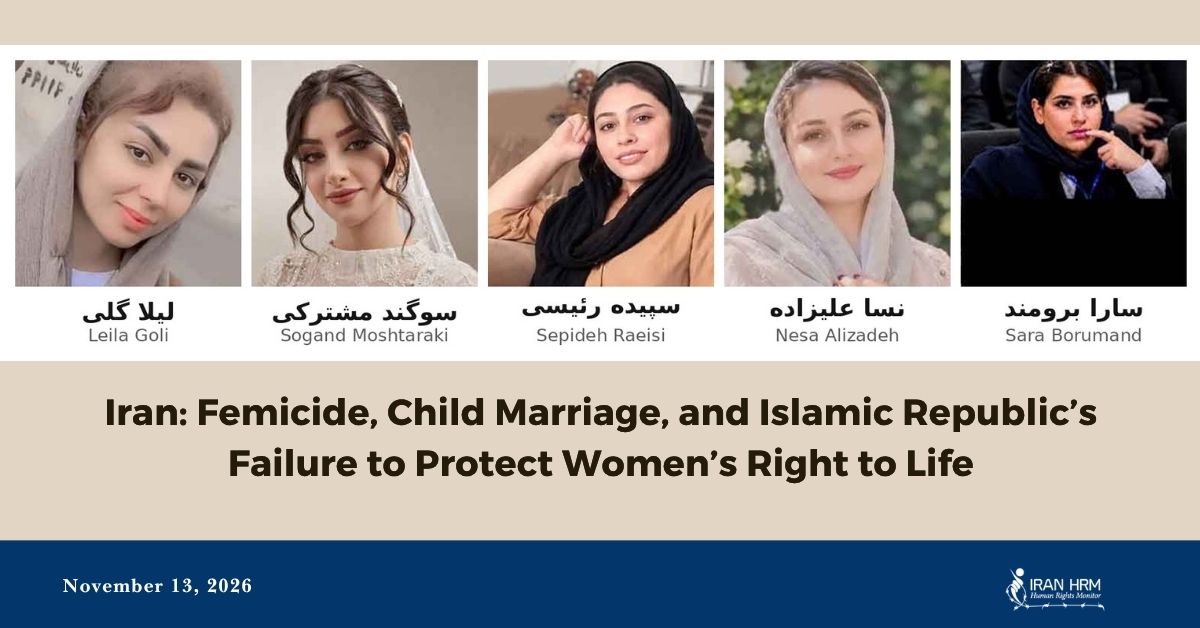
- Sara Boroumand: According to Etemad Online, 27-year-old Sara Boroumand, a mother of two, disappeared in November 2026 while returning home. Her body was discovered in a well 12 days later, illustrating women’s vulnerability to violence and the lack of effective protective mechanisms.
- Nesa Alizadeh: According to Asr-e Iran, 16-year-old high school student Nesa Alizadeh from Khoy was murdered by her father after her family opposed her marriage. Her father cited “preserving family honor” as his motivation. Her case is one of the most glaring examples of domestic violence against adolescent girls and the enforcement of control over personal autonomy.
- Sogand Moshtarki: According to Rokna, 14-year-old Sogand Moshtarki had given birth just ten days before her murder. She was killed with machete blows following an argument with her husband. Sogand was a victim of both femicide and child marriage, demonstrating how early marriage strips girls of the ability to defend themselves or escape violent relationships.
- Sepideh Raeisi: According to Khabar Online, 21-year-old Sepideh Raeisi—a mother of a three-year-old child who was also four months pregnant—was shot and killed by her husband on November 7, 2026, in Zag village, Simkan district, Jahrom County, Fars Province. Rokna reported that she was shot after asking for a divorce, and her mother was also attacked and wounded. According to sources close to her family, Sepideh married off at age 13, had repeatedly faced domestic violence, threats, and intimidation.
- Leila Goli: According to Rokna, the body of 30-year-old Leila Goli, a mother of two children aged 10 and 13, was found with signs of physical trauma under Vahdat Bridge in Shahin Dezh. Reportedly married off by force to an adult man at age ten, she endured years of abuse and was threatened with murder by her former husband after requesting a divorce, ultimately being killed by him.
Child Marriage: A Pathway to Femicide
A key finding in examining femicide cases in Iran is the prominent presence of child marriage victims among the slain women. Sogand Moshtarki, Sepideh Raeisi, and Leila Goli are among those who faced severe violence after being forcibly or prematurely thrust into marital life.
Under Article 1041 of the Civil Code of Iran, the marriage of girls under the age of 13 is permissible with the permission of the paternal guardian and court expediency. This provision remains a primary catalyst for early marriage and heightened vulnerability to domestic violence. Child marriage typically entails dropping out of school, economic deprivation, dependence on spouses, restricted personal autonomy, and an increased risk of lethal violence.
Discriminatory Laws and Structural Impunity
Femicide in Iran cannot be analyzed without evaluating the existing legal framework:
- Article 301 of the Islamic Penal Code: Relative Impunity of Fathers for Filial Homicide
Under Article 301 of the Islamic Penal Code, if a father or paternal grandfather murders his child, he is exempt from the punishment of qisas (retribution in kind). In such cases, the perpetrator faces only ta’zir (discretionary) punishments and the payment of diya (blood money).
For years, this legal exception has been one of the primary focal points of criticism by jurists, child rights activists, and human rights organizations, as it deviates the criminal justice system from the principle of equality in protecting the right to life and differentiates between murder victims based on the familial relationship between the perpetrator and the victim. Consequently, children—and particularly girls who are subjected to domestic violence—do not enjoy the same legal protection as other murder victims.
Cases such as the murder of Romina Ashrafi once again drew public attention to the consequences of this article. In that case, despite committing intentional murder, the victim’s father (the murderer) was exempted from qisas, an issue that sparked widespread criticism both inside and outside Iran.
From a human rights perspective, the issue is not merely the type of punishment, but rather the legal and social message embedded within this article. When the law makes an exception for certain perpetrators of lethal domestic violence, it raises serious concerns that the legal value and criminal protection afforded to the lives of children and girls within the family environment are diminished, creating a form of relative impunity for perpetrators. For this reason, Article 301 has been criticized by human rights institutions as one of the structural factors contributing to the perpetuation of domestic violence and so-called “honor” killings.
This provision is also deemed to be in conflict with the state’s obligation to effectively protect the right to life and guarantee equal protection before the law, as enshrined in Articles 6, 2, and 3 of the International Covenant on Civil and Political Rights (ICCPR).
Note: In May 2020 (Ordibehesht 1399), 14-year-old Romina Ashrafi from Talesh was returned to her family by judicial and law enforcement authorities despite expressing fear for her life after running away due to her father’s opposition to her marriage. Shortly afterward, she was beheaded by her father with a sickle. According to some sources, her father murdered her with a sickle after consulting his son-in-law, who was an attorney-at-law, and with the knowledge that under the Islamic Penal Code, a father (as a blood avenger/guardian of blood) is exempt from qisas. Invoking Article 301 of the Islamic Penal Code, the judiciary exempted her father from qisas and sentenced him to only nine years of discretionary imprisonment.
- Article 382 of the Islamic Penal Code: Inequality of Women’s and Men’s Lives in the Criminal Justice System
Under Article 382 of the Islamic Penal Code, in cases where a man intentionally murders a woman, the enforcement of the sentence of qisas (retribution) is contingent upon the female victim’s awliya al-dam (heirs of the blood) paying half of a complete man’s diya (blood money) to the killer or his heirs prior to the execution of the sentence. Consequently, the victim’s family is forced to pay a sum of money to the murderer in order to access one of the severest criminal penalties—an obligation that does not exist in cases involving the murder of men.
From a human rights perspective, the issue is not merely a financial dispute or a matter related to diya. This article is formulated on the presumption that the legal value of a woman’s and a man’s life is not considered equal, and this very inequality permeates the criminal proceedings and the administration of justice. As a result, the family of a murdered woman faces an additional financial barrier to achieve a legal outcome that is attainable without such a condition in the murder case of a man.
For years, jurists and human rights organizations have criticized this article as an example of legal discrimination against women, because it practically conditions the criminal protection of women’s right to life on requirements different from those for men, and deems it incompatible with the principles of equality before the law and non-discrimination enshrined in Articles 2 and 3 of the International Covenant on Civil and Political Rights (ICCPR) and the International Covenant on Economic, Social and Cultural Rights (ICESCR).
Even in cases where the perpetrator is ultimately punished, the existence of such a provision demonstrates that the legal system of the Islamic Republic continues to differentiate between the lives of women and men—a distinction that not only impacts the course of justice but also carries profound social consequences regarding the valuation of women’s lives and human dignity.
Absence of a Comprehensive Law Against Violence Against Women
In addition to the existing discriminatory laws, the absence of a comprehensive and effective legal framework to prevent violence against women and protect women at risk constitutes one of the most significant gaps in Iran’s legal and protection systems.
One of the clearest manifestations of the Islamic Republic of Iran’s systemic failure to establish legal mechanisms to address violence against women is the prolonged and ultimately unsuccessful legislative process surrounding a bill intended to protect women from violence. First introduced more than a decade ago, the bill passed through successive stages of review involving the government, the judiciary and parliament, while its provisions and title were repeatedly revised, including under the title “Bill on the Protection, Dignity and Security of Women against Violence.” Despite repeated official promises that it would be adopted, the process failed to result in the enactment and implementation of comprehensive and effective legislation. According to Amnesty International’s report on the human rights situation in Iran in 2025, in May 2025 the government withdrew a bill that had originally been introduced more than a decade earlier to address violence against women and had been repeatedly diluted and renamed. This prolonged history demonstrates that the absence of effective legal protection for women is not merely the result of technical legislative deficiencies or administrative delays but reflects years of institutional inaction and failure to establish a legal framework capable of preventing violence and protecting women at risk.
The shortage of shelters and safe houses, the absence of emergency mechanisms for risk assessment and the protection of women, the lack of effective protection orders to remove perpetrators of violence from contact with their victims, and the difficulties women face in accessing judicial, legal, financial and social support leave many women effectively unprotected against violence. In such circumstances, a woman subjected to threats, physical assault or repeated violence by her husband or another family member may have neither immediate access to a safe place where she can escape the abusive environment nor the ability to obtain legal measures preventing the perpetrator from continuing to contact, threaten or assault her.
Economic dependence, concerns about the fate of her children, obstacles to pursuing legal proceedings, and the absence of effective support following the filing of a complaint may further compel her to remain in an unsafe environment or return to it. As a result, violence may continue without effective intervention, escalate in severity, and increase the risk of more serious forms of violence, ultimately including the killing of women.
Accordingly, the absence of an effective protection system not only undermines opportunities for preventive intervention but also deprives women who were already at risk before the killing of a meaningful opportunity to be protected and potentially saved.
Responsibility of the Islamic Republic of Iran
The central question of this report is not why certain men commit the murder of women. The central question is whether the Islamic Republic of Iran has fulfilled its obligations to protect women’s lives, prevent violence, and establish effective protective mechanisms.
Under international human rights standards, states are not merely obligated to refrain from committing human rights violations themselves; they are also obligated to adopt effective measures to prevent, protect against, investigate, and ensure accountability for violence against women.
In the reviewed cases, numerous signs of structural failure in fulfilling these obligations are observed:
- The persistence of child marriage;
- The lack of effective protection for women at risk of violence;
- Legal vacuums;
- The continuation of certain discriminatory provisions;
- And the absence of effective mechanisms for intervention prior to the occurrence of a tragedy.
Under the principle of due diligence, state responsibility is not limited solely to refraining from the direct commission of human rights violations; rather, it also encompasses adopting reasonable and effective measures to prevent violence perpetrated by private individuals, protecting individuals who are at risk, and conducting effective investigations and holding perpetrators accountable. In instances where state authorities knew, or ought to have known given the circumstances, of the existence of a real and immediate risk to a woman’s life yet failed to take reasonable and available measures to protect her, their omission can engage the international responsibility of the state.
Legal Evaluation
The situation examined in this report implicates a range of international obligations of the Islamic Republic of Iran:
- Article 6 of the ICCPR: Inherent right to life.
- Articles 2(1) and 3 of the ICCPR: Guarantee of non-discrimination and gender equality.
- Article 26 of the ICCPR: Equality before the law and equal protection.
- Articles 2(2) and 3 of the ICESCR: Non-discrimination and equal enjoyment of rights.
- International Due Diligence standards concerning violence against women.
Available evidence demonstrates that femicide in Iran is not merely the result of the individual behavior of perpetrators, but rather occurs within a context of discriminatory laws, the persistence of child marriage, inadequate protective mechanisms, and the lack of effective protection for women at risk.
Consequently, the Islamic Republic of Iran must be held accountable not only for the prosecution and punishment of perpetrators, but also for its inadequate measures to prevent lethal violence against women.
Conclusion
Femicide in Iran cannot be regarded merely as a collection of domestic murders or individual actions of perpetrators. The examined cases demonstrate that a number of victims faced continuous violence, threats, child marriage, coercion, and restrictions stemming from legal discrimination prior to their murder.
The persistence of discriminatory laws, the legal permissibility of child marriage, the absence of a comprehensive law against violence against women, and the inadequacy of protective mechanisms have created an environment in which women at risk of violence encounter serious barriers in accessing protection and escaping violent relationships.
The Islamic Republic of Iran, as a state party committed to international human rights covenants, is obligated to protect women’s right to life, take effective measures against foreseeable risks, reform discriminatory laws and practices, and conduct independent and effective investigations in cases of murder. Failure to fulfill these obligations—particularly in instances where the risk to victims was foreseeable and effective intervention was possible—can engage the international responsibility of the state.
Therefore, combating femicide requires holding perpetrators accountable while simultaneously reforming the legal and structural frameworks that fail to effectively protect women against lethal violence.
Consequently, the core issue is not merely the responsibility of the murderers, but rather the responsibility of the structures that have failed to effectively protect women’s right to life.