1. Introduction: Scope of Security and Judicial Measures
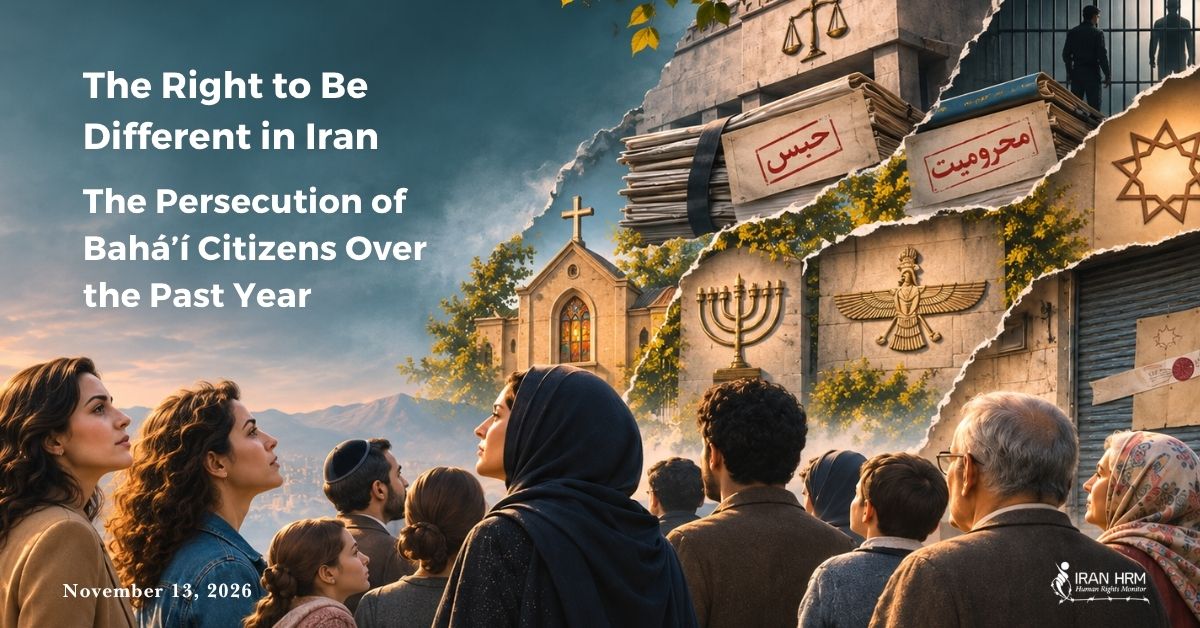
Human rights violations in Iran are not confined to protesters and political opponents. Citizens whose religious beliefs differ from those endorsed by the authorities also face arrest, prosecution, exclusion from education and employment, and interference with their private lives. The treatment of Bahá’í citizens provides a documented example of these practices.

Data compiled from March through October 2026 identify at least 118 Bahá’í citizens—60 women and 58 men—in 11 Iranian provinces who were subjected to various security and judicial measures. The aggregate figures have not yet been fully reconstructed through independent case-by-case verification and represent only part of the incidents documented in 2026.
| Indicator | Recorded figures |
| Identified individuals | 118 |
| Initial arrests | 32 |
| Individuals brought before a court | 27 |
| Individuals sentenced to imprisonment or whose sentences were upheld | 30 |
| Aggregate prison sentences | 155 years, 10 months and 9 days |
| Transferred to prison to serve sentences | 17 |
| Deprivation of social rights | 20 individuals; 149 years and 1 day in total |
| Recorded home searches | 38 |
| Individuals subject to property-confiscation orders | 4 |
| Individuals excluded from further education | 2 |
These categories overlap, and the sum of prison sentences imposed does not necessarily equal the period of imprisonment legally enforceable.
The largest numbers of identified individuals were recorded in Fars and Yazd (25 each), Mazandaran (23), Isfahan (14) and Tehran (10). Other incidents were reported in Alborz, Kerman, Razavi Khorasan, South Khorasan, Semnan, and Sistan and Baluchestan.
2. Judicial Prosecution: From Religiously Related Charges to Heavy Prison Sentences
One significant case concerns 26 Bahá’í citizens in Shiraz who were summoned to court again after nearly a decade of proceedings. Their case began in 2016–2017. In 2022–2023, they received combined sentences of 85 years’ imprisonment, 24 years’ internal exile and 52 years of travel bans. After the Supreme Court overturned the convictions, Branch One of the Fars Provincial Court of Appeal acquitted all 26 in December 2022–January 2023.
Nevertheless, a request by the head of the Fars Province judiciary to invoke Article 477 of the Code of Criminal Procedure reopened the case. A new hearing was scheduled for 11 October 2026 before Branch One of the Shiraz Revolutionary Court, presided over by Judge Mahmoud Sadati. The outcome of that hearing is not established in the available records.
In Mazandaran, 12 Bahá’í residents of Qaem Shahr were sentenced on 20 August 2026 by Branch One of the Sari Revolutionary Court, presided over by Ammar Ramezani. Raquel Ataian received four years’ imprisonment and a ten-year deprivation of social rights. Eleven others, including Keyumars Akbari, Sohrab Loghaei, Zahra Golabian, Banafseh Asadian, Fouad Loghaei and Anahita Koushkbaghi, each received two years and 15 days’ imprisonment and six years’ deprivation of social rights. The combined social-rights restrictions amounted to 76 years.
In Tehran, Branch 26 of the Revolutionary Court, presided over by Iman Afshari, imposed an aggregate 31-year prison sentence on Afshin Heyratian. If the judgment becomes final, the most severe sentence—12 years—would be enforceable under the rules governing multiple offences. Branch 15 of the Tehran Revolutionary Court, presided over by Abolqasem Salavati, sentenced Hengameh Sharifinia, Fouad Abdolghaffari and Fahim Agahi to 15, ten and ten years’ imprisonment, respectively. Their sentences were accompanied by restrictions on social activity, travel bans and property confiscation.
In Yazd, Moein Mohammadi-Dehj received a combined sentence of 16 years, seven months and 18 days’ imprisonment, a ten-year deprivation of social rights, and permanent disqualification from public and government employment. The reported most severe prison term applicable to his case is 12 years, six months and one day.
Charges appearing in several cases include “propaganda against the system,” “assembly and collusion,” and “deviant educational and proselytising activities contrary to Islamic law.” Where security offences are used to penalise peaceful religious activity, this conflicts with Iran’s obligations to protect freedom of religion or belief.
3. Arrests, Enforcement of Sentences and Detainees’ Whereabouts
On 22 August 2026, Arsalan Yazdani, a Bahá’í artist, was arrested to serve a five-year prison term. Ministry of Intelligence agents also searched his home and seized his mobile phone, laptop and personal belongings. In November–December 2023, he had received a combined six-year sentence on charges reportedly including “membership in the Bahá’í community” and “propaganda against the system.”
On 31 August 2026, Babak Zeinli, Sahba Taef, Fouad Taefi, Shervin Shabrokh and Ali Bagherkashi were detained after reporting to the Shahriar Revolutionary Court to begin one-year prison terms. Early accounts differed as to whether they were transferred to Greater Tehran Prison or subsequently to Qezel Hesar Prison. Their precise place of detention was unclear when those accounts were published.
In Sari, Soraya Manouchehrzadeh, Shima Sanaei, Fakhereh Zahedi, Negar Badiei and Maral Roshani were arrested on 22 August 2026 and taken to the Intelligence Department detention facility known as “Keshouei.” The release on bail of three women was recorded in September; the subsequent status of the other two was not established in the reviewed material.
In a statement dated 29 July 2026, UN experts expressed alarm over reports of arbitrary detention, enforced disappearance, torture and coerced confessions involving Bahá’ís. They specifically raised concerns about Payam Vali, Roya Sabet, Artin Ghazanfari, Shakila Ghasemi, Peyvand Naeimi and Borna Naeimi. Allegations concerning the last two include severe physical and psychological abuse and mock executions intended to extract confessions. These are allegations conveyed to UN experts and require independent investigation; they are not presented here as final judicial findings.
4. Property Seizures, Economic Restrictions and Exclusion from Education
In Tehran, Shideh Tavakoli reportedly faced orders confiscating two properties valued at 18.7 billion tomans and certain personal assets, alongside an aggregate 11-year prison sentence and a fine of 330 million tomans. She was also permanently barred from employment in government and public services.
In Isfahan, on 24 August 2026, security agents searched the homes of Amin Tabyani-Fard, Baharieh Asgari-Nasab and Nima Tabyani-Fard. The family’s musical-instrument workshop was emptied and its production tools and equipment seized; their music shop was sealed under a judicial order. The available documents do not establish a final order confiscating the workshop equipment.
The seizure of a vehicle and assets belonging to Keyhan Atefi and Fereshteh Atefi in Isfahan was also documented, together with seizures of electronic equipment, cash and personal belongings in other cases.
In Yazd, on 28 March 2026, Intelligence Department officers dispersed a private gathering of approximately 50 Bahá’í citizens and seized attendees’ mobile phones. Around 12 participants were summoned for questioning in June–July. In August–September, agents searched Majid Ghaneh’s home while young Bahá’ís were attending a reading gathering and confiscated their phones.
On 27 September 2026, the tenth anniversary of the killing of Farhang Amiri, approximately 40 security officers searched his family home in Yazd. Homes of other relatives and a family farm were also searched.
In education, Kamyar Maleki, an architecture student at Islamic Azad University in Birjand, was prevented from continuing his studies on the stated ground that he had “not met general eligibility requirements.” Kamand Rouhi, an architecture student in Yazd, was likewise excluded from her studies; reports identified her religious beliefs as the reason. The formal university notices and any administrative appeal outcomes were unavailable in the reviewed documents.
5. United Nations Positions and the Iranian Government’s Response
Mai Sato, the UN Special Rapporteur on the situation of human rights in Iran, warned in statements reported in September–October 2026 of structural discrimination against ethnic and religious minorities. The accounts of her remarks identified restrictions on Bahá’ís’ access to university education, government employment, economic activity and property rights, as well as the prosecution of Christian converts for religious activities.
In communication IRN 4/2026 of 13 April 2026, several UN special procedures raised allegations of arbitrary detention, enforced disappearance, torture and coerced confessions affecting seven Bahá’í citizens. In communication IRN 14/2024 of 31 July 2024, UN experts conveyed concerns to the Iranian authorities about 47 Bahá’í women reportedly targeted through arrests, summonses, home searches and property seizures.
In its concluding observations of November 2023, the UN Human Rights Committee expressed concern over continuing discrimination and rights violations affecting Bahá’ís, including arrests, imprisonment, confiscation of property and denial of access to higher education, and called for effective protection of religious minorities.
Through Human Rights Council resolution 58/21 of 3 April 2025, the mandate of the Independent International Fact-Finding Mission on Iran was expanded to examine structural drivers of human rights violations, including discrimination based on religion or belief. At the Council’s September 2026 session, the Mission’s chair, Sara Hossain, presented findings concerning the suppression of protests, arbitrary detentions, torture, coerced confessions and violations of fair-trial guarantees. These findings do not directly establish the facts of every Bahá’í case discussed here; the expanded mandate, however, encompasses examination of religious discrimination and preservation of relevant evidence.
In its responses to UN mechanisms, the Iranian government has maintained that citizens enjoy legal rights regardless of religious affiliation and that prosecutions concern criminal conduct rather than religious belief alone. In a response dated 28 October 2024 to UN experts’ correspondence, it invoked legal guarantees concerning equality, property, employment, education and due process, and rejected allegations of discrimination solely on religious grounds.
Nevertheless, the reviewed cases involve religiously related allegations and the application of security provisions, including Article 500 bis of the Islamic Penal Code, alongside prison terms and restrictions on social rights. Case-specific official responses and accessible full judgments were unavailable for a number of these proceedings.
6. Conclusion
Cases documented across several Iranian provinces show Bahá’í citizens facing arrest, prosecution, economic restrictions, home searches and exclusion from educational and social opportunities. The recurrence of these measures, considered alongside the UN Human Rights Committee’s findings, raises serious concerns about discrimination on grounds of religion or belief. Establishing centralised coordination across all cases would require further institutional evidence.
Under its international human rights obligations, Iran must protect freedom of religion or belief, equality before the law, fair-trial rights and non-discriminatory access to education and employment. Enjoyment of these rights must not depend on adherence to the authorities’ official beliefs or on a person’s political position.