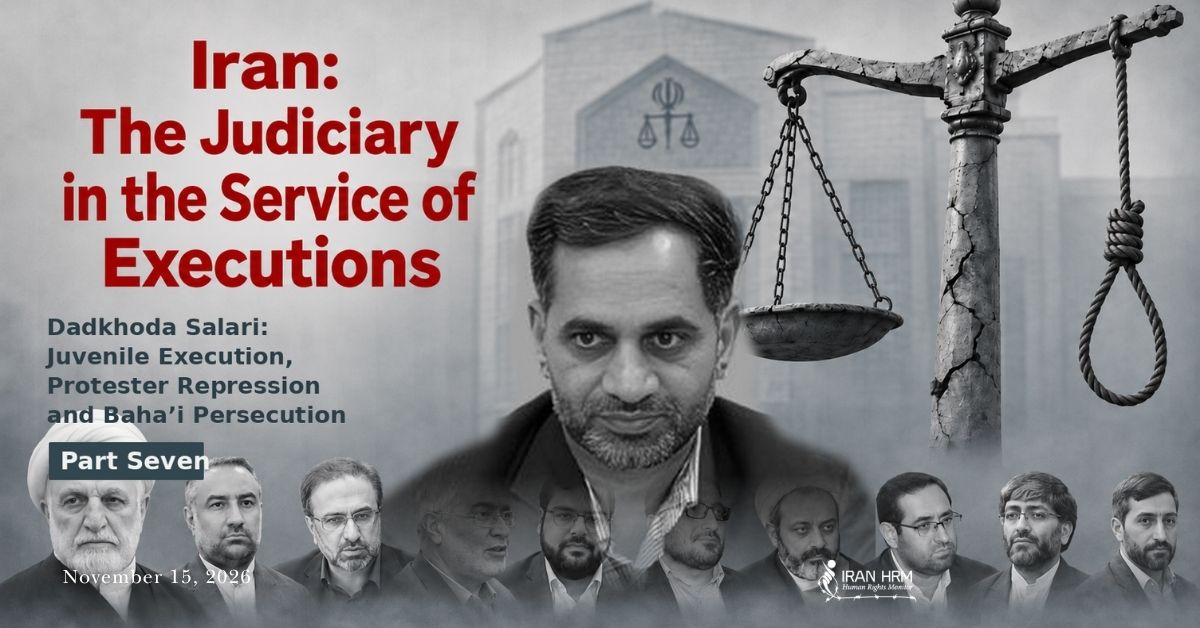
Iran: The Judiciary in the Service of Executions – Part 7
In Iran, the judiciary is one of the principal instruments used by the ruling regime to suppress political dissent, intimidate society and contain popular protests. The policy of harsh punishment against opponents is pursued through Revolutionary Courts, prosecutors’ offices and sentence enforcement authorities, under the direction and with the support of senior regime and judicial officials, including Gholamhossein Mohseni Ejei. Judges and prosecutors who issue or oversee the implementation of lengthy prison sentences and death penalties form part of this wider judicial apparatus.

Dadkhoda Salari Manzari, the newly appointed head of the judiciary in Kerman Province, is one such official. His career of more than three decades has been associated with death sentences, the prosecution of protesters, the arrest of online activists and judicial measures against members of the Baha’i community. His appointment in October 2026 raises renewed questions about accountability for actions taken during his previous judicial appointments.
Judicial Career and Appointment as Head of Kerman’s Judiciary
Dadkhoda Salari Manzari was born in 1966 in Jiroft, Kerman Province. He began his judicial career in 1991 at the Revolutionary Prosecutor’s Office in Bam. He subsequently served as prosecutor in Bam, judge at the Revolutionary Court in Sirjan, and head of the Revolutionary Courts in Kahnuj and Jiroft.
After presiding over Branches Three and One of the Revolutionary Court in Kerman, he served as head of the Revolutionary Court between 2006 and 2014. On 19 November 2014, he was appointed Public and Revolutionary Prosecutor of Kerman Province’s capital, a position he held until 17 October 2022.
Salari subsequently became Deputy Head of the Provincial Judiciary for Judicial Affairs, Planning and Information Technology. On 7 September 2024, he was appointed Director-General of the Provincial Inspectorate. On 20 October 2026, Gholamhossein Mohseni Ejei, head of Iran’s judiciary, appointed him Chief Justice of Kerman Province.
Death Sentences Issued by the Kerman Revolutionary Court
During Salari’s leadership of the Kerman Revolutionary Court, he was involved in proceedings and public announcements concerning cases that resulted in death sentences.
On 18 August 2010, he announced that the Supreme Court had upheld eight death sentences in two drug-related cases: six in a case involving ten defendants and two in a separate case. The dates on which all these sentences may have been carried out remain unclear. On 29 December 2010, while serving as head of Branch One of the Kerman Revolutionary Court, he also announced further death sentences, life imprisonment and lengthy custodial sentences in several cases.
On 18 May 2014, ten prisoners were executed in Kerman Central Prison. On 26 August 2014, four men — Hossein Shahriari, Abbas Pouryazdanpanah, Hamid Mir and Mohammad Hosseini — were executed alongside a woman whose name was not disclosed at Shahab Prison in Kerman.
On 31 August 2014, Branch Four of the Kerman Revolutionary Court sentenced eight defendants in a drug-related case to a combined total of thirteen death sentences. Gholam Shiehaki Atraqi and Hamzeh Abureza Atraqi each received three death sentences, Nourbakhsh Abuzar Atraqi received two, and five other defendants, including Manizheh Khuzestani Atraqi, each received one. These sentences were issued while Salari headed the Revolutionary Court, although there is no documented evidence that he personally delivered the rulings.
Executions continued after Salari became provincial prosecutor. Seven prisoners were executed on 1 January 2015, two on 15 February 2015 and at least twelve on 6 December 2018. Abdolghani Ghalandarzehi, Yaghoub Ghalandarzehi, Jalil Khodabakhsh and Yousef Jalaleddin were among those executed in 2018. On 9 August 2021, Nabi Noutizehi and Ebrahim Ghanbarzehi were also executed on drug-related charges.
These executions took place during Salari’s judicial appointments, but not every sentence can be attributed directly to him without access to the relevant judgments. Nevertheless, his positions as head of the Revolutionary Court and subsequently as provincial prosecutor warrant examination of his judicial and supervisory responsibilities.
Execution of Arman Bahr Asmani: Violation of Children’s Rights
One of the significant cases during Salari’s tenure as prosecutor was the execution of Arman Bahr Asmani, who was 16 years old at the time of his alleged offence.

According to the verified case information, his execution was carried out on 16 January 2017 at Jiroft Prison. Attempts to obtain the consent of the victim’s family did not prevent the execution.
Article 37 of the Convention on the Rights of the Child and Article 6 of the International Covenant on Civil and Political Rights prohibit the death penalty for offences committed by persons under the age of 18. Iran is a party to both treaties, and the application of qisas (retributive punishment) does not exempt the state from these obligations.
Salari was serving as Public and Revolutionary Prosecutor of Kerman Province’s capital at the time. However, the available documents do not establish his direct involvement in issuing or ordering the execution. Determining his individual responsibility requires examination of the judicial records and the authority exercised by the provincial prosecutor’s office in the Jiroft case.
Repression of the December 2017–January 2018 Protests and Arrests of Online Activists
During the nationwide protests of December 2017 and January 2018, Salari, as Kerman’s prosecutor, publicly addressed the arrest of protesters and the prosecution of online activists.
On 9 January 2018, speaking at a meeting of provincial judicial officials and prosecutors, he announced the arrest of 27 individuals whom he described as the “main and central elements” of the protests.
Salari also reported the arrest of eight administrators of social media channels across several districts. According to his account, intelligence, security and law enforcement agencies had monitored Telegram channels and identified individuals who had circulated calls for demonstrations.
He stated that the authorities would deal with the main individuals involved “firmly and without leniency”.
Salari portrayed online communication as evidence of advance planning by opponents, stating that when one Telegram channel was targeted, another appeared to circulate calls for protests. He also announced that the prosecutor’s office maintained a round-the-clock online monitoring unit and had prioritised investigations into protesters.
On 15 February 2018, Salari reported that nine individuals arrested during the protests remained in detention. He said they faced charges of “acting against the country’s internal security”, while others had been released on judicial bail or other conditions and indictments had been issued against several defendants.
The identities of all those detained, their access to legal counsel and the final outcomes of their proceedings have not been publicly established. Salari’s statements demonstrate that Kerman’s prosecutor’s office treated online communication and the organisation of protests as matters for security-related prosecution.
November 2019 Protests and Allegations Against Salari
During the November 2019 protests, which followed an increase in petrol prices, security and law enforcement agencies also pursued protesters in Kerman Province.
On 28 December 2019, Kerman’s police commander announced the arrest of thirteen vehicle owners and drivers whose vehicles had reportedly been involved in demonstrations and roadblocks on 16 November. They had been identified through vehicle registration plates. Salari was provincial prosecutor at the time, although there is no direct evidence that he personally ordered these arrests.
Salari is also named in the international human rights documentation database Faces of Crime. In a profile last updated on 6 October 2021, the organisation identified him as Kerman’s Public and Revolutionary Prosecutor and a member of the Provincial Security Council, attributing to him responsibility for widespread arrests of protesters and orders to use lethal weapons. The organisation also reported that at least two protesters were killed in Kerman Province.
These allegations raise questions about Salari’s possible involvement in decisions concerning the use of lethal force. They remain findings attributed to a human rights documentation organisation, however, and do not constitute a final judicial determination of his individual criminal responsibility.
Salari was also listed as number 87, under his title as Kerman’s Public and Revolutionary Prosecutor, among the officials examined by the International People’s Tribunal on Iran’s November 2019 Protests, commonly known as the Aban Tribunal. Established to examine the repression of those protests, the tribunal was an independent people’s tribunal, not a judicial body of the United Nations or the International Criminal Court.
These records underscore the need for independent investigation into Salari’s role in the arrests of protesters and security-related decisions in the province.
Judicial Prosecution and Restrictions on the Rights of Baha’i Citizens
During Salari’s judicial appointments, members of the Baha’i community in Kerman faced arrests, security-related prosecutions and restrictions on their economic and religious activities.
On 12 October 2013, while Salari headed the Kerman Revolutionary Court, judicial officials announced the identification and arrest of a group of 66 individuals. Three were described as organisers and the remaining 63 as members.
Salari alleged that the group operated a clandestine organisation with foreign connections. The announced allegations included activities against national security, contact with foreign entities and recruitment of young people. The Ministry of Intelligence was involved in identifying and arresting those concerned. The complete indictment, identities of all detainees and outcomes of the proceedings were not publicly disclosed.
On 25 December 2017, seventeen shops belonging to Baha’i citizens in Kerman remained sealed, having been unable to operate for approximately 32 months. The closures had initially been linked to the owners observing a Baha’i religious occasion. Appeals to the Administrative Justice Court had not resulted in the reopening of the businesses by that date.
On 15 March 2018, the Baha’i cemetery in Kerman, known as Golestan Javid, was sealed by order of judicial authorities. Officials prevented families from entering the cemetery and carrying out burial ceremonies, restricting access to graves and the observance of religious mourning practices.
In December 2020, Vahda Siyalani, a Baha’i resident of Kerman, was arrested to serve a seven-month prison sentence on charges relating to the promotion of the Baha’i faith.
These measures occurred within the judicial jurisdictions in which Salari held senior positions. The original sealing orders and the identities of the officials who signed them remain unavailable. The restrictions affected the community’s freedom of religion, employment and individual rights.
Salari’s Statements Reported by Reuters and Agence France-Presse
On 14 December 2013, Reuters reported that Salari, then head of the Kerman Revolutionary Court, had announced the arrest of an individual accused of spying for Britain’s foreign intelligence service, MI6.
Salari alleged that the accused had met British intelligence officials on eleven occasions and had confessed to the allegations. Reuters stated that it had been unable to independently verify these claims.
Agence France-Presse also reported Salari’s statements that day, including allegations of face-to-face contacts with British intelligence officers and the commencement of legal proceedings. The accused person’s identity was not disclosed.
These reports were not human rights condemnations of Salari. They documented his public statements in a security case in which allegations of a confession were presented without independent public verification.
Judicial Responsibility and International Human Rights Standards
Salari’s responsibility in individual cases must be assessed according to his position and legal powers. At the Revolutionary Court, his functions involved judicial proceedings and court administration. As prosecutor, they included criminal prosecution, supervision of investigations and responsibilities relating to sentence enforcement. His current office carries broader administrative and supervisory authority.
These functions are distinct, and executions or arrests in Kerman cannot automatically be attributed to his personal decisions. His official statements and documented actions nevertheless provide a basis for examining individual responsibility.
Article 6 of the International Covenant on Civil and Political Rights restricts the death penalty to the “most serious crimes”. According to the UN Human Rights Committee’s interpretation, drug offences that do not directly and intentionally result in death do not meet this threshold.
Articles 9 and 14 protect personal liberty and the right to a fair trial, while Articles 18, 19 and 21 protect freedom of religion, expression and peaceful assembly.
The absence of public access to many judgments, arrest orders and execution records makes it difficult to establish the precise responsibilities of judicial officials or independently assess compliance with these obligations.
Promotion and Accountability
Following eight years as prosecutor, Salari was appointed to senior positions in the provincial judiciary, the Inspectorate and ultimately the post of Chief Justice of Kerman Province.
The publicly available material examined did not identify the outcome of any specific independent investigation or disciplinary proceedings concerning his personal responsibility in cases involving executions, the detention of protesters or restrictions on citizens’ rights. This does not establish that no proceedings have taken place, but it limits public scrutiny and