Executive Summary

The official announcement that surveillance cameras may be installed in classrooms in schools across Iran marks the latest development in a series of government policies and measures that, in recent years, have increasingly subjected the country’s education system to security, surveillance and ideological considerations. Although the authorities of the Islamic Republic have justified this measure on grounds such as enhancing security, addressing complaints and preventing misconduct, an examination of concurrent developments in the education sector indicates that this decision cannot be assessed as an isolated or merely administrative measure.
In recent years, a range of policies—including the formal involvement of law enforcement agencies in the education sector, the organized expansion of clerics’ presence in schools, the implementation of the Amin Program, the recruitment of thousands of seminary students into the education system, extensive changes in school management, and now the authorization of video surveillance in classrooms—have collectively contributed to an increasingly pronounced process of securitization and ideologization of Iran’s education system.
This report argues that these developments, particularly in the aftermath of the nationwide protests of 2022 and ahead of the anniversary of the January 2026 nationwide protests, should be examined as part of a broader process of the “securitization and ideologization of education”. This process may affect children’s fundamental rights, including the right to education, freedom of thought, freedom of expression, the right to privacy, and the independence of educational environments.
Introduction
Education is not merely a process of knowledge transmission. Under international law, schools are among the most important social institutions for the development of children’s personalities, the cultivation of critical thinking, the enhancement of intellectual and social capacities, and the preparation of individuals for free participation in society.
In recent years, alongside political and social developments in Iran, the education system has undergone significant changes. Some of these changes have taken place within a broader framework of increased surveillance, expanded intervention by security and law enforcement agencies, and a strengthened role for religious institutions in schools.
The official announcement that surveillance cameras may be installed in classrooms represents the latest link in this chain of developments. Considered collectively, these measures present a picture of the objectives and functions of the education system that differ significantly from the one conveyed by examining each measure in isolation.
This report examines the securitization and ideologization of education as two related but distinct processes. Securitization refers to the expansion of surveillance, law enforcement and control mechanisms within educational environments, as well as the increased role of security and law enforcement agencies in managing and directing students’ conduct. Ideologization, by contrast, refers to the strengthening of institutions and programs operating within the education system with the aim of transmitting, consolidating and reproducing the worldview and values endorsed by the State. Alongside political and managerial changes within the school system, these two processes may simultaneously affect the autonomy of educational environments, students’ freedom of thought and expression, and the fundamental objectives of public education. Accordingly, assessing these policies requires both an examination of each process individually and due consideration of their cumulative and mutually reinforcing effects on children’s rights.
Surveillance Cameras in Classrooms: The Latest Link in an Expanding Chain of Surveillance
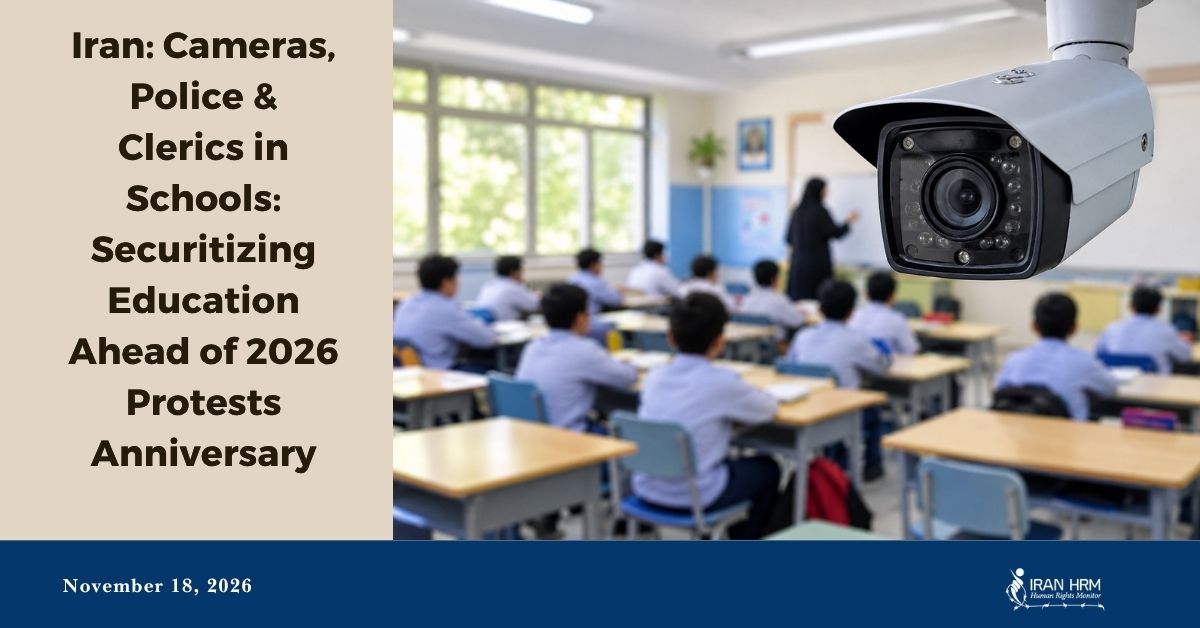
Under the new school regulations, provision has been made for the installation of surveillance cameras in classrooms. Education officials have stated that the use of such equipment could assist in addressing complaints, investigating cases of corporal punishment, resolving disputes and enhancing school security.
However, video surveillance in classrooms is fundamentally different from surveillance in corridors, schoolyards or at school entrances. The classroom is an environment in which students exchange views, express opinions, learn, participate and develop their intellectual identities. Introducing surveillance cameras into such an environment raises serious concerns regarding privacy, freedom of expression and the autonomy of the educational process.
These concerns are heightened by the absence of clear explanations in the published regulations regarding the retention period for recorded footage, access to the data, the authorities responsible for storing the information, the rights of parents and students, or independent oversight mechanisms governing the use of such data.
The Formal Entry of the Police into the Education System
In recent years, the Islamic Republic of Iran has pursued a policy under which cooperation between law enforcement agencies and the education system has extended beyond limited and ad hoc measures, becoming part of the formal framework for policymaking and educational activities. The signing of a cooperation memorandum between the Ministry of Education and the Law Enforcement Command of the Islamic Republic of Iran (FARAJA) in April 2025 was one of the most significant indications of this development.
Under the provisions of the memorandum of understanding between the Ministry of Education and FARAJA, the scope of cooperation between the two institutions is not limited to ensuring security in the areas surrounding schools. The memorandum provides for the design and implementation of cultural and educational activities aimed at promoting social discipline among students; cooperation in the production of educational materials; the organization of educational workshops for students, parents and educational staff; cooperation in implementing the Student Social Care System (NAMAD); and the use of the Ministry of Education’s educational, pedagogical and media resources, including the SHAD student education network.
Furthermore, the section setting out FARAJA’s commitments emphasizes its participation in organizing educational and cultural programs for school principals, teachers and students; cooperation in the training and capacity-building of educational staff and students; and participation in developing educational content and warnings concerning social harms, risks and the online environment.
This is despite the fact that the spokesperson for the Ministry of Education, in explaining the memorandum, stated that police cooperation would relate primarily to the areas surrounding schools and would not entail the presence of law enforcement personnel inside school premises. Nevertheless, the provisions of the memorandum indicate that FARAJA’s envisaged role extends beyond perimeter security to encompass aspects of educational, cultural and pedagogical activities, as well as student social care. From this perspective, the issue is not merely the physical presence of police officers in schools, but rather the institutional expansion of the law enforcement apparatus’s role in processes relating to students’ education and upbringing.
This development has taken place against the backdrop of the nationwide protests of 2022, during which schools became important centers of civil protest and students played an active role in demonstrations in many cities across Iran. In the aftermath of those protests, schools and universities have increasingly become focal points of the authorities’ policies of control and surveillance.
From the perspective of children’s rights and the right to education, the institutional involvement of the police in schools cannot be regarded merely as an administrative or educational measure. Rather, it signals the gradual transfer of a security-oriented logic into an environment whose essential purpose should be grounded in learning, intellectual development, the cultivation of individual abilities, and the promotion of trust and student participation. When law enforcement agencies become established actors in educational processes, there is a risk that schools will increasingly function not as spaces for learning and free development, but as environments for the surveillance, control and management of students’ conduct.
This concern takes on particular significance ahead of the anniversary of the January 2026 nationwide protests. The expansion of the police’s role in schools, alongside the development of other surveillance mechanisms, including classroom cameras, extensive managerial changes and the increased presence of ideological institutions in education, points to an intensification of State control over educational environments.
Expansion of Clerical Presence in Schools
One of the most significant developments in Iran’s education system in recent years has been the institutionalization of clerical presence in schools through formal and structured mechanisms.
The “Amin” (Trustworthy) Program, implemented in cooperation with the Ministry of Education and the Islamic seminaries, is not merely an extracurricular religious initiative; rather, it forms part of the country’s official educational and upbringing policy. The program’s documents and regulations emphasize strengthening students’ “religious and revolutionary identity,” promoting the values officially endorsed by the state, and expanding structured links between schools, families and mosques.
Under this framework, clerics assigned to schools do not merely serve as religious advisers or organizers of religious ceremonies. They also participate in educational, cultural and social activities and, in some cases, in processes relating to the guidance and supervision of students. This indicates that the presence of religious institutions in schools has moved beyond voluntary or ancillary activities and has become part of the formal structure of educational policymaking.
From the perspective of international human rights law, the central issue is not the presence or absence of clerics as such, but whether public education under these circumstances can preserve its pluralistic, inclusive and freedom-of-thought-based character. Article 29 of the Convention on the Rights of the Child (CRC), together with the interpretations of United Nations human rights bodies, emphasizes that education must be directed towards the full and free development of the child’s personality and mental abilities, as well as respect for diversity of thought and belief. In this context, the expanding institutional presence of ideological bodies within schools may raise concerns regarding the independence of public education and children’s right to an educational environment grounded in diversity and freedom of thought.
Recruitment of Islamic Seminary Students into the Education System
Beyond the presence of clerics through cultural and educational programs, the Islamic Republic has, in recent years, also pursued a policy of recruiting seminary students on a wider scale into the formal structure of the Ministry of Education.
Ministry of Education officials have announced that approximately 3,500 seminary students have entered the education system through the Ministry’s recruitment and employment processes, describing this initiative as a measure to strengthen students’ religious beliefs and value systems.
The significance of this issue lies not merely in the number of personnel recruited, but in the underlying rationale of the policy. Official statements by government authorities indicate that the recruitment of seminary students has been supported not as a temporary measure to address staffing shortages, but as part of the ideological approach underpinning the education system. Statements by Ministry of Education officials concerning this policy, particularly their emphasis on strengthening students’ religious beliefs and expanding religious upbringing and instruction in religious rulings in schools, suggest that this approach goes beyond addressing staffing needs. Rather, it is being pursued within the framework of a deliberate policy aimed at reinforcing and reproducing the values and ideological foundations endorsed by the Islamic Republic among school-age generations.
This policy is being implemented at a time when education experts have repeatedly raised concerns in recent years about teacher shortages, declining educational indicators, inequalities in access to education, and the need to improve professional teaching standards. Against this backdrop, prioritizing the recruitment of personnel on the basis of ideological affiliation or training, rather than exclusively on professional and educational qualifications, raises concerns that religious and political objectives may increasingly take precedence over professional standards in education.
From the perspective of the right to education, the primary concern is not whether a teacher has received seminary education, but whether the education system, in its recruitment processes, prioritizes professional competence, the impartiality of public education, intellectual diversity and the educational interests of students, or instead seeks to reproduce an officially prescribed and predetermined worldview. This question assumes particular importance in light of Article 13 of the International Covenant on Economic, Social and Cultural Rights (ICESCR) and Article 29 of the Convention on the Rights of the Child, both of which recognize education as a means of developing the human personality freely and promoting respect for fundamental freedoms, rather than as an instrument for enforcing intellectual conformity or ideological indoctrination.
Widespread Management Changes Following the Nationwide Protests
One of the most significant developments in Iran’s education system following the 2022 nationwide protests was the extensive restructuring of school management. Official authorities reported that approximately 20,000 school principals had been replaced across the country, a figure representing one of the largest management reshuffles in the history of Iran’s education system.
Although the Ministry of Education justified these changes as part of a process of “management transformation” and structural reform, the scale of these replacements prompted considerable reactions and criticism within the country’s media and political spheres. Some domestic media outlets and observers interpreted the process within the framework of the policy commonly referred to as “purification” (khāles-sāzi), a term used in recent years to describe the exclusion or removal of personnel considered by the authorities insufficiently aligned with the state’s official ideological and political orientations.
These concerns are not limited to domestic reporting and criticism. The Independent International Fact-Finding Mission on the Islamic Republic of Iran, in its report to the Human Rights Council (document A/HRC/55/67), referred to a pattern of suspension, dismissal, forced retirement and other forms of retaliation against teachers and academics. The Mission also stated that, according to credible information, government authorities had taken measures to retain and recruit educational personnel loyal to the Islamic Republic while excluding others, including individuals active in teachers’ trade unions and civil society organizations. The report further documented remarks by the Minister of Education concerning the replacement of nearly 20,000 school principals in the Iranian year 1402 (2023–2024). These findings, together with statements by members of parliament concerning the dismissal of school principals on political and ideological grounds and the process described as “purification,” reinforce concerns about the influence of political and ideological considerations on the independence of educational management and the composition of school personnel.
These developments must be examined within the broader context of the government’s response to the 2022 nationwide protests and their repercussions for educational environments. During those protests, school students and university students were among the groups that participated in demonstrations, while schools and universities were also subjected to security interventions and measures. The report of the Independent International Fact-Finding Mission on the Islamic Republic of Iran documented cases of the arrest and suspension of, and other forms of action against, school and university students. It also referred to retaliatory measures against teachers and academics and to efforts by government authorities to retain and recruit educational personnel loyal to the Islamic Republic.
Against this backdrop, extensive management changes in schools and the expansion of cooperation between law enforcement and ideological institutions and the education system cannot be examined solely as administrative reforms or executive decisions detached from the country’s political and social developments. The concurrence of these developments underscores the need for closer scrutiny of the relationship between educational policies and the government’s approaches to control in the post-protest period. As the anniversary of January 2026 nationwide protests approaches, examining these trends assumes particular importance, as the issue extends beyond the management of schools to encompass how the education system engages with a generation that has played a role in the protest movements of recent years.
From a human rights perspective, the issue is not simply the replacement of school principals. Rather, the fundamental question is whether such developments contribute to strengthening the independence of educational environments or, conversely, expose schools to increasing levels of political and ideological control. When these changes are considered alongside the installation of cameras in classrooms, the institutional presence of police, and the expansion of ideological programs, they point to an increasingly concentrated state focus on controlling and managing the educational environment in the aftermath of nationwide protests.
Legal Framework and Human Rights Assessment
The Islamic Republic of Iran is a State party to the International Covenant on Economic, Social and Cultural Rights (ICESCR) and the Convention on the Rights of the Child (CRC). Accordingly, it is obligated to ensure that education is provided in an environment grounded in human dignity, freedom of thought, diversity of perspectives and the free development of the child’s personality.
Iran is also a State party to the International Covenant on Civil and Political Rights (ICCPR) and, under its obligations thereunder, is required to respect and protect fundamental rights that are directly relevant to the educational environment and children’s everyday experiences. Article 17 of the Covenant protects individuals against arbitrary or unlawful interference with their privacy; Article 18 guarantees freedom of thought, conscience and religion; Article 19 protects freedom of expression and the right to seek, receive and impart information and ideas; and Article 24 affirms children’s right to special measures of protection appropriate to their status as minors. These obligations are particularly relevant when assessing the implications of video surveillance, the involvement of law enforcement and ideological institutions in educational settings, and the potential restrictions on students’ freedom of expression and thought.
Nevertheless, the developments examined in this report, including the introduction of surveillance cameras into classrooms, the expansion of structured cooperation between the Ministry of Education and the Law Enforcement Command of the Islamic Republic of Iran (FARAJA), the expansion of the Amin Program, the placement of clerics in schools, the recruitment of seminary students into the formal education system, and extensive management changes following the nationwide protests, collectively point to an increasing involvement of security and ideological institutions in the educational environment. The concern lies not in any one of these measures in isolation, but in their cumulative impact on the nature of education and the everyday experiences of millions of children across Iran.
The Right to Education: Does the School Remain an Educational Institution?
Under Article 13 of the International Covenant on Economic, Social and Cultural Rights, education must be directed towards the full development of the human personality, the strengthening of respect for fundamental freedoms, and the preparation of individuals for effective participation in a free society.
However, the trends examined in this report raise concerns that the priorities of the education system are gradually shifting away from education aimed at the free development of the child’s personality towards the cultivation of students who are, above all, aligned with the ideological and value-based frameworks endorsed by the state. In this context, the expansion of video surveillance, the institutional presence of police in schools, the placement of clerics in educational settings, the implementation of programs such as the Amin Program, and the recruitment of seminary students into the education system can be assessed not as isolated measures, but as components of a broader policy aimed at monitoring, guiding and shaping the intellectual and social identities of future generations. This trajectory creates the risk that, rather than serving as spaces for fostering independent thinking, diversity of perspectives and children’s free participation, schools may increasingly become instruments for reproducing the state’s official worldview and controlling dissenting views.
Under such circumstances, it is students who bear the primary cost: children who, instead of experiencing an environment grounded in creativity, dialogue, critical inquiry and free learning, may grow up in settings where conformity with official norms and avoiding the expression of differing views become unwritten requirements.
Freedom of Expression, Thought and Conscience: The Emergence of a Culture of Self-Censorship
Articles 13 and 14 of the Convention on the Rights of the Child protect children’s right to express their views, develop independent beliefs, and enjoy freedom of thought and conscience.
The principal concern raised in this report is not that students are explicitly prohibited from expressing their opinions, but that the combined effect of surveillance and ideological policies may create an environment in which children begin to consider the potential consequences of expressing any particular view before doing so.
A child who knows that their classroom is under video surveillance, that the police have assumed a role within the educational structure, that clerics have become part of the system of education and upbringing, and that the educational environment is increasingly subject to the management of ideological and security institutions may gradually refrain from raising sensitive questions, expressing differing opinions or participating freely in educational discussions.
The consequences of such an environment extend beyond restrictions on freedom of expression. They include the emergence of a culture of self-censorship during childhood, at a stage when individuals’ intellectual and social identities are still developing.
Furthermore, Article 12 of the Convention on the Rights of the Child affirms the child’s right to express their views freely in all matters affecting them and requires that those views be given due weight in accordance with the child’s age and maturity. This right is equally relevant to decisions concerning the educational environment. Policies such as the installation of surveillance cameras in classrooms, which directly affect students’ everyday living and learning environments, should not be implemented without taking into account their right to participate in decision-making and express their views. Disregarding students’ voices in decisions affecting their privacy, sense of security and freedom within the school environment may be incompatible with the principles of participation and respect for children’s rights.
The Right to Privacy: Normalizing Surveillance from Childhood
Article 16 of the Convention on the Rights of the Child protects children against arbitrary or unlawful interference with their privacy.
In this regard, General Comment No. 25 (2021) of the UN Committee on the Rights of the Child, on children’s rights in relation to the digital environment, establishes specific standards for protecting children’s privacy against digital surveillance. Under paragraph 75 of this General Comment, any digital surveillance of children, together with the automated processing of their personal data, must respect the child’s right to privacy and must not be conducted routinely, universally or without the child’s knowledge or, in the case of very young children, that of their parents or caregivers. The paragraph also emphasizes the need to ensure the right to object to such surveillance and to employ the least intrusive means available to achieve the intended purpose.
Furthermore, paragraphs 69 and 70 of the same General Comment stipulate that any interference with children’s privacy must be lawful, proportionate to a legitimate aim, based on the principle of data minimization, and accompanied by safeguards including transparency, independent oversight and access to remedies. Accordingly, making provision for the installation of cameras in classrooms without establishing clear rules governing notification, access to footage, data processing and retention, the proportionality of surveillance to its stated purpose, and the possibility of challenging such surveillance raises serious concerns regarding Iran’s compliance with its international obligations concerning children’s rights.
The introduction of surveillance cameras into classrooms is not merely a technical issue. The classroom is one of the most important spaces in a child’s everyday life: a place where children learn, ask questions, make mistakes, develop and form their identities.
While officials have cited the surveillance-related benefits of these devices, no clear information has been made publicly available regarding the scope of their use, data retention, the individuals authorized to access the footage, the length of time for which information is retained, or the existence of independent oversight mechanisms governing these processes.
Under such circumstances, there is a risk that continuous surveillance will become a normalized feature of childhood. The implications of this trend extend beyond the mere recording of students’ images. It conveys the message that learning, dialogue, asking questions and even the formation of individual identity must take place within an environment that is constantly monitored. In the long term, the normalization of surveillance may undermine intellectual independence, reinforce self-censorship and diminish children’s willingness to participate freely in social and civic life. From this perspective, the issue extends beyond privacy to encompass the deeper impact of continuous surveillance on the development of children’s personalities, self-confidence and understanding of freedom and participation in society.
The Aims of Education: From Fostering Independent Citizens to Producing Compliant Ones?
Article 29 of the Convention on the Rights of the Child establishes education as a means of developing the child’s personality, talents and mental abilities to their fullest potential.
In its General Comment No. 1 (2001) on the aims of education, the Committee on the Rights of the Child emphasized that Article 29 of the Convention is not limited to ensuring children’s access to education. Rather, the nature, content and orientation of the educational process must also be consistent with the principles of human dignity and the fundamental rights of the child. According to this General Comment, education must contribute to the holistic development of the child’s personality and talents, strengthen respect for human rights and fundamental freedoms, and prepare the child for responsible life in a free society founded on understanding, tolerance, equality and respect for cultural and ideological differences. From this perspective, any systematic orientation of public education that prioritizes intellectual conformity and acceptance of an officially prescribed worldview over the development of independent thinking and the ability to participate freely raises serious questions regarding its compatibility with the aims of education established under the Convention on the Rights of the Child.
By contrast, the combination of policies examined in this report raises a fundamental question: what kind of citizens is Iran’s education system seeking to cultivate?
Is its objective to foster individuals who are independent, capable of critical thinking and questioning, and able to participate freely in society? Or is the educational structure gradually moving towards cultivating individuals who, from an early age, become accustomed to continuous surveillance, behavioral control and compliance with official ideological frameworks?
This is not merely a theoretical question. The answer may have long-term implications for society, civic participation, fundamental freedoms and the future of generations to come in Iran.
Conclusion
The provision allowing the installation of cameras in classrooms should not be viewed merely as an operational, technical or administrative decision within Iran’s education system. An examination of this policy alongside other developments in recent years indicates that it forms part of a broader trajectory in which the boundaries between education, security surveillance and ideological direction have gradually become blurred.
The formal entry of the Law Enforcement Command of the Islamic Republic of Iran (FARAJA) into the field of education; the expansion of the institutional presence of clerics in schools through the Amin Program; the recruitment of thousands of seminary students into the education system; extensive management changes, described by some domestic observers as “purification” (khāles-sāzi); and, most recently, the introduction of provisions allowing video surveillance in classrooms collectively point to a transformation in the nature and function of the education system. This transformation extends beyond school administration and concerns the shaping of the intellectual, social and political identities of the next generation.
The principal concern of this report is not the installation of a camera in a classroom or the presence of a cleric in a school as such. Rather, it is that the cumulative impact of these policies may transform schools from spaces for learning, critical inquiry, exposure to intellectual diversity and the free development of the child’s personality into environments in which surveillance, behavioral control and the transmission of the state’s officially endorsed values become dominant features of the educational process.
Under such circumstances, the risk extends beyond restrictions on children’s privacy. What is at stake is the very concept of education as an environment for fostering independent citizens equipped with critical thinking skills, the capacity for civic participation and freedom of thought. When children grow up from their earliest years of schooling in an environment where continuous surveillance, the presence of security institutions and ideological direction have been normalized, there is a risk that self-censorship, enforced conformity and acceptance of permanent surveillance will become normalized features of educational experience.
As the anniversary of the January 2026 nationwide protests approaches, these developments warrant particular attention from international human rights mechanisms, including the Special Rapporteur on the right to education, the Committee on the Rights of the Child, the Special Rapporteur on the promotion and protection of the right to freedom of opinion and expression, and the Special Rapporteur on the situation of human rights in the Islamic Republic of Iran. The issue at stake is not merely a new educational policy, but a broader trajectory that may have profound and long-lasting consequences for the development of the personality, identity, intellectual independence and social participation of Iran’s future generations.