Supreme Court Rejects Appeal
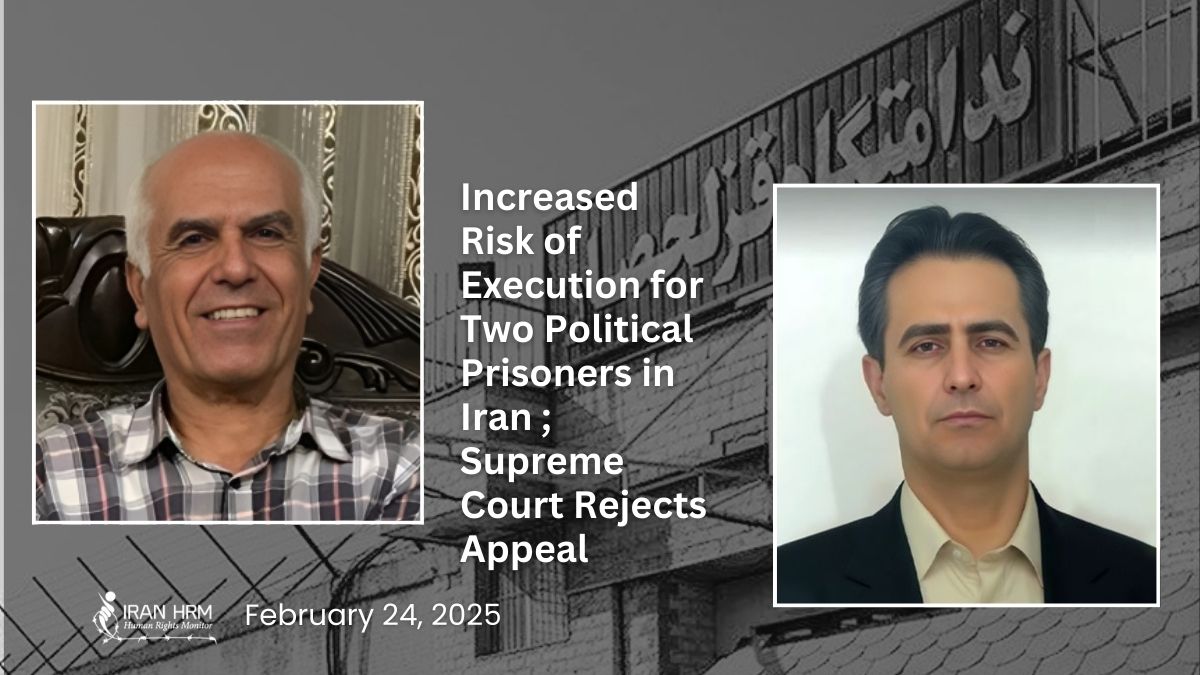
Two political prisoners, Behrouz Ehsani and Mehdi Hassani, who were sentenced to death in September 2024 by Branch 26 of the Tehran Revolutionary Court under Judge Iman Afshari, are now facing an increased risk of execution. On January 8, 2025, the Supreme Court upheld their death sentences without undergoing the appeals court process.

In a recent development on Sunday, February 25, 2025, the Supreme Court’s Branch 39 rejected Behrouz Ehsani’s request for retrial. Earlier, Mehdi Hassani’s daughter had also announced on social media that her father’s retrial request had been denied.
Transfer to Qezel-Hesar Prison for Execution
Previously, on Sunday, January 27, 2025, Behrouz Ehsani and Mehdi Hassani, whose death sentences had been confirmed and their cases forwarded for execution, were transferred from Evin Prison to Qezel-Hesar Prison. This sudden transfer was confirmed by various news sources, stating that both prisoners were summoned from different wards of Evin Prison and moved to Qezel-Hesar.
Life and Case of Behrouz Ehsani Eslamloo
Behrouz Ehsani Eslamloo, 70, was born in Urmia and resides in Tehran. He holds a high school diploma, is self-employed, married, and has two children. He is also the caretaker of his elderly mother.
He was arrested at his home in November 2022 during the nationwide protests and was taken to Ward 209 of Evin Prison. After three and a half months of interrogation and torture, he was transferred to Ward 4 of Evin Prison.
After 22 months in legal limbo, in September 2024, the Tehran Revolutionary Court sentenced him to death along with Mehdi Hassani. His charges include “rebellion, waging war against the state, corruption on earth, membership in the People’s Mojahedin Organization, gathering classified information, and conspiring against national security.”
Life and Case of Mehdi Hassani
Mehdi Hassani, 48, was born in Shahr-e Rey, is married, and has three children. He was arrested on September 10, 2022, in Zanjan and taken to Ward 209 of Evin Prison. During his detention, he was subjected to physical and psychological torture before being transferred to Ward 8 of Evin Prison.
His charges are similar to those of Behrouz Ehsani, including “rebellion, waging war against the state, corruption on earth, membership in the People’s Mojahedin Organization, gathering classified information, and conspiring against national security.”
With their retrial requests rejected and their transfer to Qezel-Hesar Prison, the risk of their execution has significantly increased.