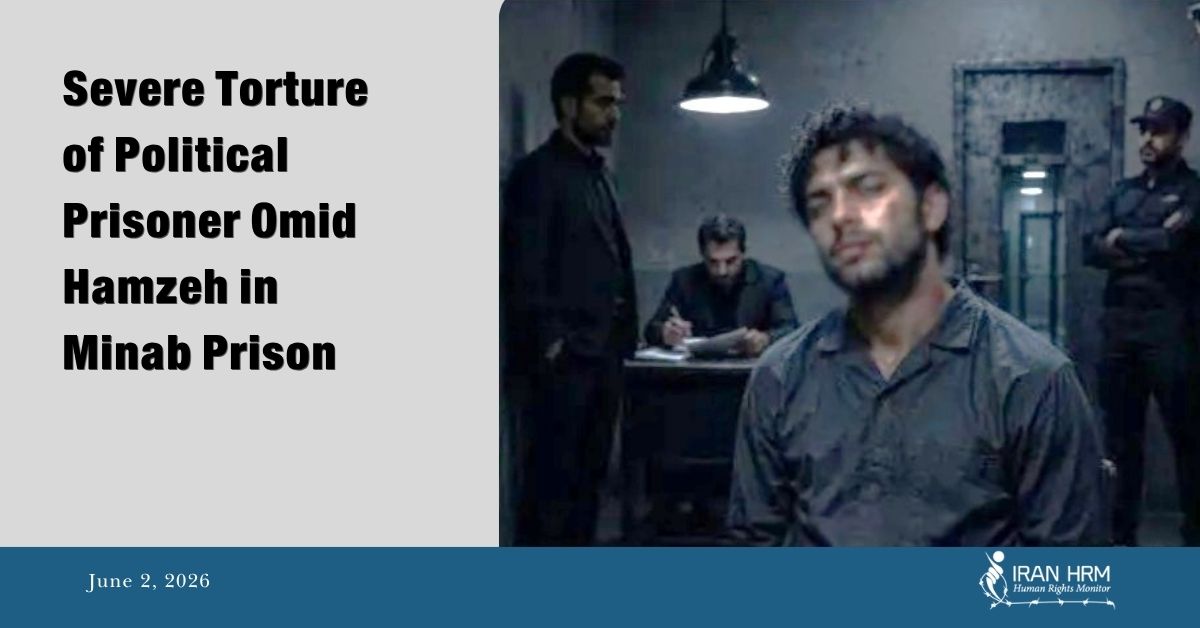
Documented and deeply concerning reports recently leaked from the corridors of security wards in Hormozgan Province reveal a severe humanitarian crisis. According to verified accounts, political prisoner Omid Hamzeh has been subjected to horrific physical torture in a premeditated operation orchestrated under the direct orders of security apparatuses and executed by the hands of Minab Prison authorities. Civil rights activists view this persistent, overt violence as a systematic tool designed to crush the detainee’s resistance and coerce him into accepting the interrogators’ fabricated scenarios. The fundamental question remains: why does this method of gradual elimination and assault on the life of political prisoner Omid Hamzeh continue to lack a deterrent and material response to halt this machinery of repression, unfolding under the diplomatic silence of international bodies that claim to champion human rights?

The case of this prisoner has been shrouded in absolute censorship and blackout; consequently, precise information regarding the exact date, manner, and underlying pretext of the arrest of this political prisoner remains entirely unavailable.
State of Limbo: The Judicial System’s Psychological Leverage Against Omid Hamzeh
Substantiated evidence demonstrates that political prisoner Omid Hamzeh has now been held in a state of absolute suspension and prolonged administrative limbo inside the ward for more than two months. Denying him access to a fair legal process and repeatedly extending his detention under severe security conditions are designed as part of an exhausting attrition strategy.
The regime’s judiciary systematically refuses to provide any transparent response or formal reading of charges to the family of this detainee, leaving them in a state of absolute agonizing uncertainty regarding their child’s fate. This prolonged duration of arbitrary limbo constitutes engineered white torture aimed directly at destabilizing the prisoner’s psychological stability long before the case ever reaches a revolutionary court.
The Anatomy of a Crime: Deconstructing Physical Injuries in Minab Prison
According to data transmitted from Minab Prison, detention center guards and torturers, backed by their institutional security immunity, have launched a severe assault against political prisoner Omid Hamzeh. Informed sources have documented the injuries resulting from this systematic violence as follows:
- Severe dislocation of the shoulder caused by acute mechanical traction and violent blows.
- Acute and critical injuries inflicted upon the vertebrae and muscles of the neck area.
- Deep lacerations on parts of the detainee’s lips and face.
The magnitude of these injuries unequivocally proves that security agents observed absolutely no boundaries in their conduct toward this protester. The absolute absence of independent oversight bodies across Iranian detention facilities has granted torturers the opportunity to play with the dignity and health of detainees, relying entirely on their absolute exemption from accountability.
Reviewing a Routine: The Function of Forced Confessions in Revolutionary Courts
Four decades of documented experience demonstrate that in political cases, torture and unbearable physical pressures are utilized exclusively to compensate for a lack of legal evidence and to fabricate judicial files. Interrogators employ violent methods, prolonged solitary confinement, and continuous psychological threats in an attempt to coerce political prisoner Omid Hamzeh, or any other dissenter, into admitting to crimes they never committed.
These forced confessions, extracted under intolerable duress, are subsequently weaponized in Revolutionary Courts as definitive evidence of guilt to issue the heaviest judicial sentences, including death. In a structural environment where the right to access independent counsel of one’s choice is systematically denied and judicial independence is entirely non-existent, this unprincipled routine is continuously reproduced and urgently demands a decisive international intervention.
Denial of Medical Care: The Tool of Silent Execution Behind High Walls
Reports concerning the health status of political prisoner Omid Hamzeh following the recent rounds of torture are assessed to be deeply critical. Despite this, Minab Prison authorities have actively blocked any transfer to equipped medical facilities or access to an independent physician.
Deliberately depriving wounded detainees of proper medical care serves as the regime’s complementary mechanism to exert maximum pressure and force the prisoner to their knees. This strategy, which has historically claimed the lives of numerous detainees, constitutes a silent execution carried out under the pretext of security concerns, placing the life of political prisoner Omid Hamzeh in grave, irreversible danger.
Legal Assessment: Violation of the Fundamental Clauses of International Law
The cumulative actions perpetrated against this detainee in Minab Prison represent an explicit violation of international treaties to which the Iranian government is a state party:
- Violation of the Absolute Prohibition of Torture (Article 5 of the Universal Declaration of Human Rights): The severe beatings and infliction of physical trauma on the shoulder and neck of Omid Hamzeh constitute definitive instances of cruel, inhuman treatment and physical torture.
- Violation of the Right to Personal Security (Article 3 of the Universal Declaration of Human Rights): The execution of structural violence within the place of detention completely invalidates the detainee’s right to security and the protection of life.
- Violation of Fair Trial Standards (Article 10 of the Universal Declaration of Human Rights): Prolonged detention in a state of limbo and the absence of judicial transparency openly violate the bedrock principles of a fair and just trial.
- Violation of the United Nations Standard Minimum Rules for the Treatment of Prisoners (The Nelson Mandela Rules): Denying immediate medical treatment following severe torture constitutes a direct violation of the legal obligations tied to the custody of detainees.
International Inaction or a Firm Stand on Human Values?
The alarming case of political prisoner Omid Hamzeh mirrors the harrowing reality of hundreds of voiceless protesters held across the regime’s hidden detention centers.
Today, international law advocates must be asked: if global institutions, instead of relying on ceremonial statements, had conditioned their economic and diplomatic relations with Tehran on an immediate halt to torture and the release of dissenters, would the regime still find its hands so freely open to orchestrate bloodshed and torture? If the answer is no, why does the containment of these anti-human practices against political prisoner Omid Hamzeh and other political prisoners held by the Islamic Republic remain abandoned without tangible, material action that goes beyond paper condemnations? This international inaction must not be allowed to serve as a green light for the regime’s machinery of repression. The time for decisive action and genuine accountability is right now.