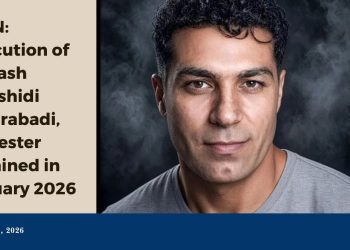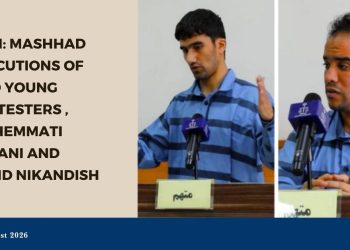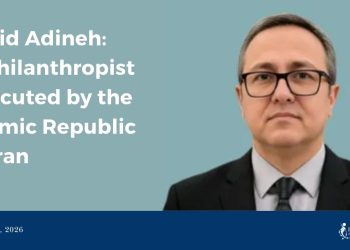
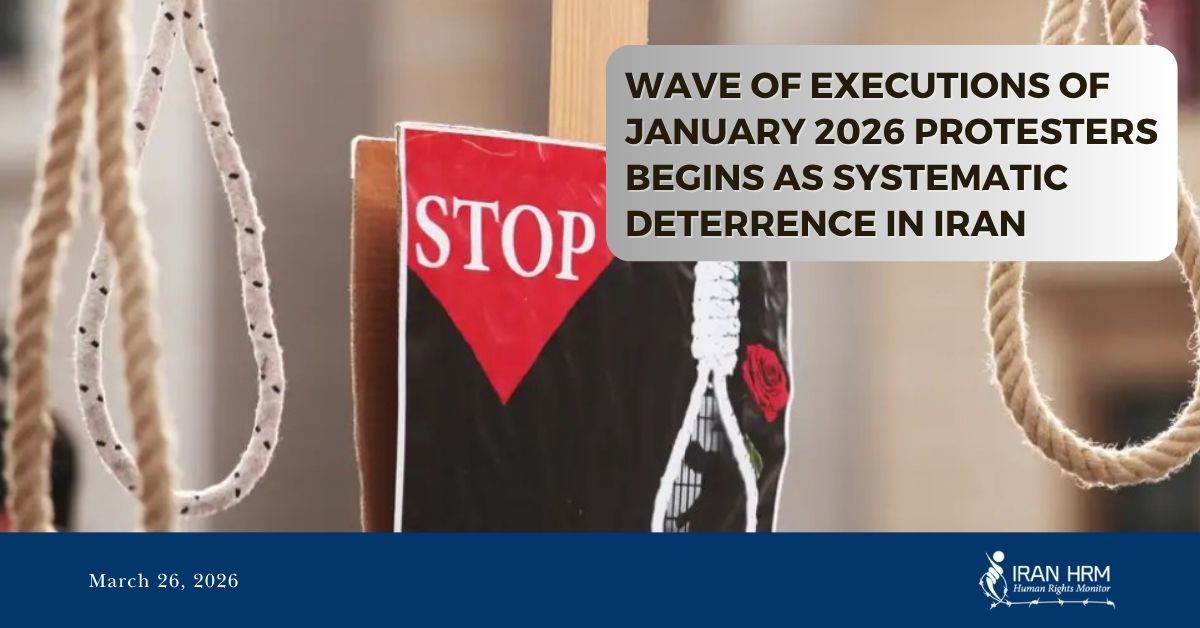
On March 23, 2026 (3 Farvardin 1405), only three days into the Iranian New Year, Hamzeh Khalili, the First Deputy Chief of the Judiciary of the Islamic Republic (per ILNA news report), unveiled the operational phase of executing protesters’ sentences. He stated: “The cases of the enemy’s terrorist agents and the January rioters have been processed. Some cases have led to final verdicts and are being carried out, and several have been executed over the past few days… No leniency will be granted to those convicted in these cases.” He further threatened that individuals “spreading lies and fake news” to cause public concern would be identified and face severe consequences with no possibility of clemency.

Public Executions: Engineering Fear to Prevent Uprisings
The First Deputy’s remarks refer to three public executions carried out in the city of Qom on March 18, 2026 (28 Esfand 1404). On that day, three detainees from the January 2026 uprising—Saleh Mohammadi, Saeed Davoodi, and Mahdi Ghassemi—were hanged on attributed charges including “Moharebeh” (enmity against God).
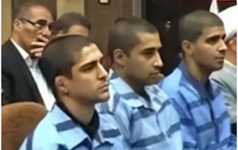
The interrogation and judicial proceedings for these individuals were conducted with extraordinary speed. Saleh Mohammadi, 19, a national freestyle wrestling champion who won a medal at an international competition in Russia in 2024, explicitly stated in court that his confessions were obtained under duress and torture. Nevertheless, in blatant violation of Article 7 (Prohibition of Torture) and Article 14 (Right to a Fair Trial) of the International Covenant on Civil and Political Rights (ICCPR), the court rejected the torture claim and utilized his forced confessions as the primary evidence for issuing a state-sponsored murder decree.
The public emphasis by judicial officials on “speed of execution” and “lack of leniency” must sound an alarm for the international community regarding the mass execution of detainees. Given that an estimated 50,000 individuals were arrested during the January 2026 uprising, this approach is a dire warning of an impending human catastrophe and another political massacre by the Islamic Republic.
The Insatiable Killing Machine and the Criminalization of Technology
The Islamic Republic’s machinery of repression has not stopped at executions. Following the First Deputy’s threats against information dissemination, state media (including Mehr and ILNA) reported on March 24, 2026, the arrest of 30 individuals in the provinces of Hamadan, Lorestan, and Kerman.
The Ministry of Intelligence, in an official statement, linked these arrests to “sending coordinates to the enemy” and possessing “Starlink equipment.” This action is a clear instance of the “Criminalization of Technology and Information,” aimed at creating the necessary legal pretext to issue heavy sentences against citizens simply seeking access to the free internet. Additionally, according to Iran Human Rights Monitor sources (IranHRM) 23 more individuals have been arrested in Markazi Province and two in Golestan Province under similar charges.
The experience of the 2019, 2022, and 2026 uprisings demonstrates that such broad, vague charges are merely a cover to legitimize political and physical purges of opponents and the arbitrary deprivation of life.
Warning from Ms. Mai Sato, UN Special Rapporteur on Human Rights in Iran
In a message published on X, Ms. Mai Sato emphasized that she has received “deeply concerning” information regarding the execution of individuals who participated in nationwide protests; an issue that “could indicate a direct link between the death penalty and political repression.”
Legal Analysis and International Responsibility
The sequence of public executions in Qom and forced confessions under torture signifies the establishment of a “systematic repression machine.” Its objective is not the administration of justice, but rather deterrence through terror to prevent future popular uprisings. By employing war-time rhetoric, the Islamic Republic has effectively dissolved the rule of law and replaced due process with “absolute repression.”
We call upon the UN Fact-Finding Mission to urgently prioritize the investigation of recent executions and the status of the 50,000 detainees from the January uprising. International silence or weak diplomatic responses to this new wave of executions amounts to ignoring the political massacre of the 2026 uprising and granting immunity to the perpetrators of these crimes to begin further mass killings.
The international community is duty-bound to activate the “Universal Jurisdiction” mechanism to initiate criminal prosecution of high-ranking judicial and security officials. Any delay will only embolden the Islamic Republic’s killing machine to physically eliminate thousands more detainees under the shroud of the internet blackout.