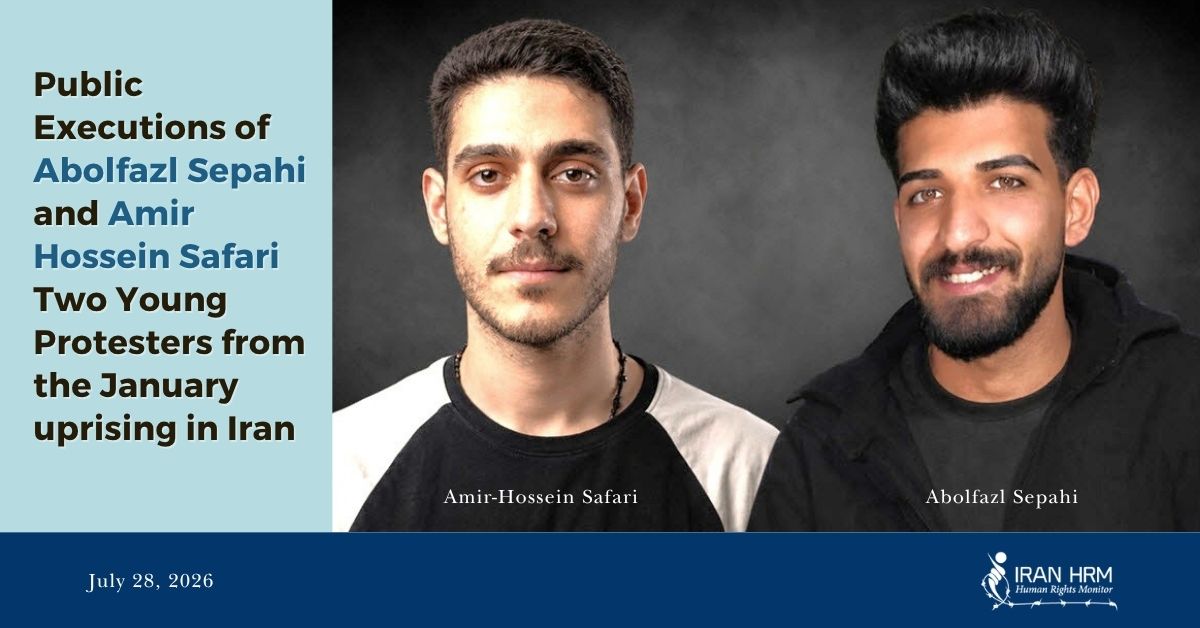
The official news agency IRNA, announced today: “The death sentences of Abolfazl Sepahi Badjani and Amir Hossein Safari Hosseinabadi, two of the perpetrators of the heinous crime at Shahid Alikhani Square in Isfahan during last year’s January coup, have been carried out.”

On July 19, 2026, two other individuals out of the 12 sentenced to death in the “Isfahan Alikhani Square Case” were hanged. At that time, all human rights organizations, including Iran Human Rights Monitor, sounded the alarm for the international community (Urgent International Action Needed to Immediately Halt the Execution Sentences of 12 Protesters in the Isfahan Alikhani Square Case – Iran Human Rights Monitor) and demanded international intervention to stop executions in Iran, particularly political executions, and specifically the executions of the remaining 10 defendants in this case.
However, the international community’s inaction and deafening silence—failing even to support the appeal of the Special Rapporteur on the situation of human rights in Iran to halt these executions—emboldened the Islamic Republic. Today, Iran’s judiciary hanged Amir Hossein Safari Hosseinabadi and Abolfazl Sepahi Badjani in public in Isfahan, at Alikhani Square.
Ms. Sato’s X Post – July 27, 2026:
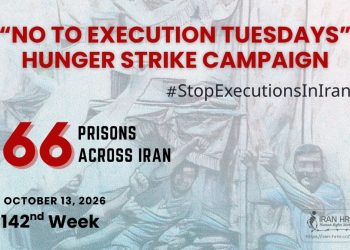
“UN experts condemned the death sentences issued for 12 young men due to their participation in the January 2026 protests and demanded an immediate halt to the executions. The experts stated that the group and closed-door trials of these defendants violate fair trial standards, expressing grave concern over arbitrary arrests, enforced disappearances, ill-treatment, and the use of forced confessions broadcast on television. These experts warned that following the execution of two defendants, 10 others remain at imminent risk of execution. The case of Shervin Bagherian Jebelli, who was 18 years old at the time of arrest, is a grave example of due process violations. They also stated that at least 24 people have been executed in connection with the January protests since the beginning of 2026, emphasizing that the death penalty is being utilized to instill fear and terror in society and to suppress dissent. According to the experts, ‘Under current laws, participating in any protest criticizing the government without the risk of retaliation, harassment, and prosecution is practically impossible. The cycle of protests and executions will only be broken when civic space is opened and freedom of peaceful assembly and freedom of expression are guaranteed.’ Referring to the fact that despite repressions, prisoners continue their resistance through the ‘No to Execution Tuesdays’ campaign and strikes in Qezel Hesar Prison, they called on Islamic Republic authorities to immediately stop carrying out death sentences and adhere to their international human rights and due process obligations.”
Iranian Society No Longer Tolerates Executions; Where Does the International Community Stand in This Equation?
At the time of the execution of these two individuals, according to obtained video footage, chants of “Dishonorable! Dishonorable!” (Bi-sharaf! Bi-sharaf!) can be heard as citizens protest the executions. Clashes broke out between people and special unit forces present at the scene. Reports indicate that after dispersing the gathering, security forces pursued citizens in the surrounding alleys of Alikhani Square in Isfahan. According to these reports, the atmosphere in the region remains heavily militarized and tense, with the pursuit of protesters continuing in nearby streets.
More Arrests, More Unfair Trials, and More Executions
How is it that the world takes action and is willing to pay any price to secure the flow of oil in the Persian Gulf, yet to prevent crimes against humanity—thousands killed by the state in the January 2026 (1404) uprising, countless executions before it, and now countless executions after it, 50 political executions since the outbreak of war, hundreds of ordinary executions, and now two public executions in the 21st century—it is unwilling to pay any cost, nor take any practical action? Where are human rights headed?
- Close Iran’s embassies in your countries.
- Make all economic, political, and diplomatic relations with Iran strictly contingent upon an immediate halt to executions.
- Isolate Iran for its human rights violations and make it understand that the era of cost-free executions, torture, and forced confessions is over.
The question is not whether stopping executions in Iran is possible or not. The question is not whether the Iranian people themselves have paid the price for this halt—they have paid this cost far beyond the capacity of any nation, with their beautiful lives devoted to freedom, and currently, 1,500 prisoners on death row are on their 16th consecutive day of a hunger strike in Qezel Hesar Prison, the question is whether such will exists in today’s “civilized” world or not.
Stop Crimes Against Humanity; Let the Public Execution of Abolfazl Sepahi and Amir Hossein Safari Be the Last Executions in Iran Under the Rule of the So-Called Islamic Republic.