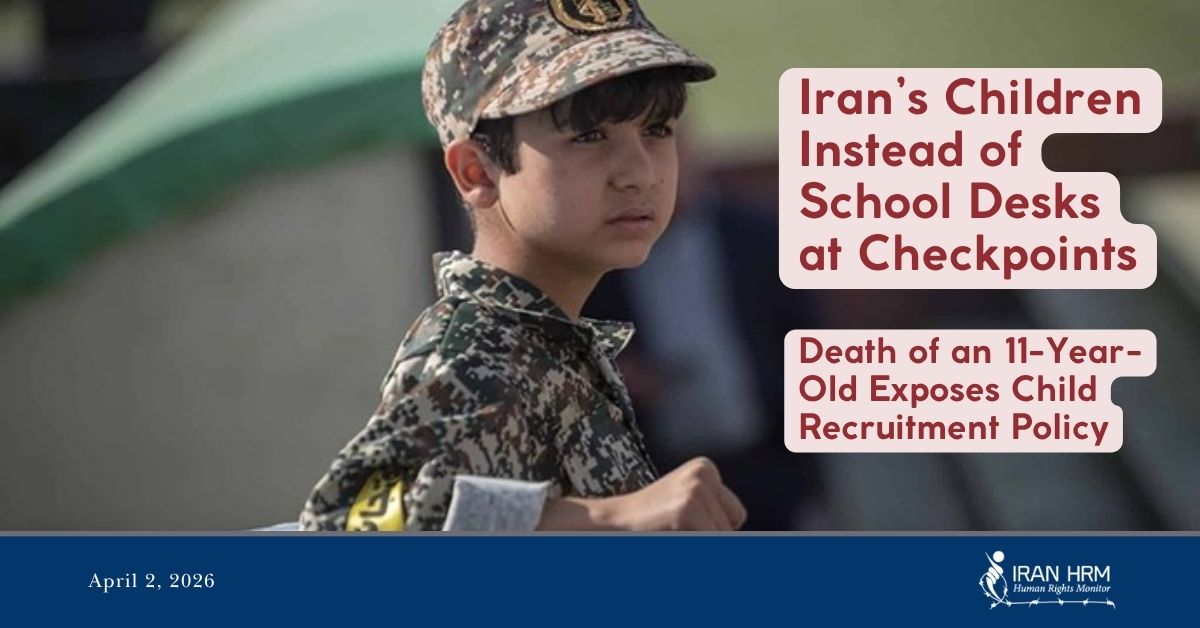
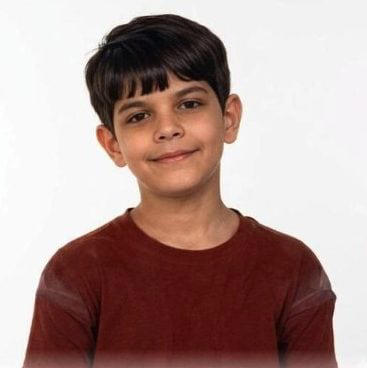
An 11-year-old boy who should have been sitting at a school desk was instead stationed at a checkpoint in Tehran, where he lost his life. Alireza Jafari, a fifth-grade student, was present alongside his father at a checkpoint on Artesh Highway when a drone strike targeted the location, killing him. His family later described his presence there as part of “defending Iran.”

Factual Account
On March 10, 2026, a checkpoint on Artesh Highway in Tehran was struck by a drone attack. Alireza Jafari and his father were killed in the incident.
State-affiliated Basij organizations, including the Basij Teachers Organization, confirmed that the child was killed “while on duty,” indicating that he had been engaged in security-related activities at the checkpoint.
At an age when he should have been attending school, Alireza was instead positioned at a site that had effectively become a military target.
Family Testimony
Alireza’s mother, Sadaf Monfared, told the state-affiliated Hamshahri newspaper that a “shortage of personnel” led to her husband bringing their son to the checkpoint.
Her account reflects operational pressures within security structures, where a lack of personnel has resulted in the presence of children in high-risk security environments.
Timeline; Death Following Official Policy
Alireza’s death occurred only days after officials publicly announced the reduction of the minimum participation age in security activities.
Rahim Nadali, cultural deputy of the IRGC in Tehran, stated on March 26, 2026, in an interview with state television:
“We set the minimum age at 12 and above; now 12- and 13-year-olds want to be present in these activities.”
This statement confirms that the presence of minors at checkpoints is not incidental, but part of an officially acknowledged policy.
Organized Recruitment Campaign
Recruitment has been conducted openly and in a structured manner. Registration booths have been set up in mosques and major public squares, where individuals, including adolescents, are encouraged to enroll in security-related roles.
Official posters under the “Homeland Defenders” campaign explicitly call for the registration of civilian volunteers and outline roles such as “intelligence patrols,” “operational patrols,” and “checkpoint inspections.”
These materials prominently feature teenagers and emphasize youth participation, indicating that the involvement of minors is actively promoted within a public recruitment framework.
 Official Narrative; Justifying Youth Involvement
Hossein Salami, commander of the IRGC, emphasized the need to ideologically guide younger generations, referring to the creation of an “ethical compass” within the education system.
On January 10, 2025, he stated:
“People constantly demand decisive action.”
These statements reflect an effort to align social mobilization, including youth participation, with broader security objectives.
Militarization of Public Space
Ahmadreza Radan, Iran’s police chief, stated on March 25, 2026:
“All matters are viewed as wartime.”
He further emphasized that forces are ready to use weapons, underscoring the level of risk present in public security zones such as checkpoints.
Under such conditions, checkpoints have become high-risk environments, even for trained personnel; for children, the danger is significantly greater.
Legal Analysis; From Civilian Child to Exposed Participant
The deployment of children at checkpoints effectively shifts their status from protected civilians to individuals exposed to direct risk within a security environment.
Under Article 38 of the Convention on the Rights of the Child, the recruitment or use of individuals under the age of 15 in activities related to armed conflict is prohibited. In addition, the Rome Statute of the International Criminal Court defines the use of children under 15 in hostilities as a war crime.
In this context, the presence of children at checkpoints constitutes a clear violation of international obligations concerning the protection of child rights.
Conclusion; A Death Reflecting a Policy
In this context, the death of Alireza Jafari can no longer be viewed as an isolated incident, but rather as an indication of a developing pattern in which children are increasingly drawn into security structures and exposed to direct harm. The continuation of this policy raises the likelihood of similar incidents.
This situation underscores the urgent need for attention from international bodies, including the United Nations and UNICEF as the use of children in checkpoints and security-related roles must be examined and addressed as a serious violation of child rights.