Prisons turned to slaughter houses of human rights
By Maryam Fakhar

As authorities demand accelerated executions and death sentences, I encountered news that was unbelievable in the realm of human rights and humanity. We have frequently heard the Head of the Judiciary, Mohseni-Eje’i, call for the acceleration of the issuance and implementation of death sentences following the December 2025/January 2026 uprising and during the recent war. However, hearing a demand for nighttime and public executions from the Deputy of the “Institute for the Intellectual Development of Children and Young Adults” (Kanoon), Farhad Fallah, reveals the true depth of the ongoing human tragedy at the hands of the Islamic Republic regime.
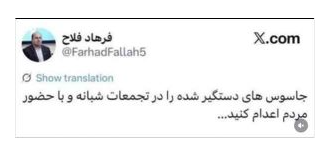
“Execute the arrested spies in nighttime gatherings with public presence”
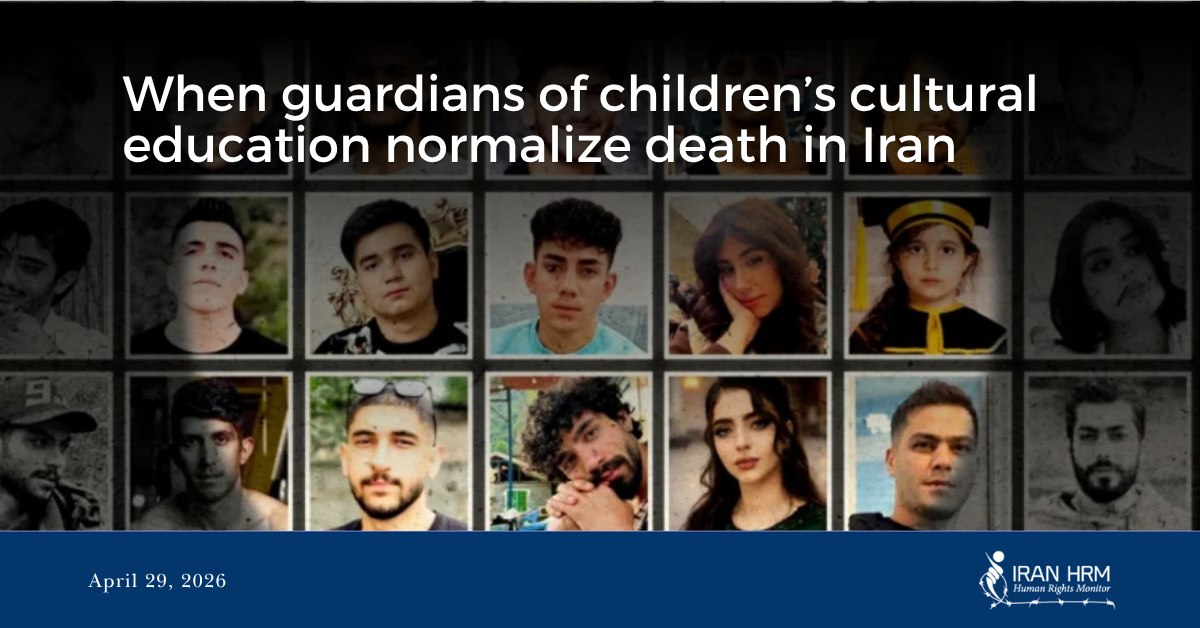
“Execute the arrested spies in nighttime gatherings with the presence of the people.” This anti-human demand for public execution was raised on the X network by Farhad Fallah, the Deputy of the Institute for the Intellectual Development of Children and Young Adults. The prescription of such violence by an individual whose affiliated institution is responsible for cultural education for children perfectly demonstrates how suppression, execution, and, in a word, crimes against humanity have become institutionalized within this government. Not only is it institutionalized, but the Islamic Republic seeks to transform these elements into a culture within society to eradicate any human sentiment, deeming any effort to keep it alive a crime and warning of its consequences. The prescription of such violence by an individual whose affiliated institution is responsible for cultural education for children is, beyond a political stance, indicative of a “systematic de-childing” of social ethics. The regime is effectively seeking to hollow out empathy from society and replace it with a “culture of hate and death,” where any human action is criminalized. However, the true danger of these statements is understood only when we decode who the regime labels as a “spy” or “terrorist.”
 Redefining the Vocabulary of Repression: Who is a “Spy”?
A review of state media headlines regarding the executed strips bare the reality of this cultural official’s tweet. Political prisoners (members of the People’s Mojahedin Organization of Iran), including “Hamed Validi and Mohammad Masoumshahi” (labeled as Mossad spies), and individuals such as Abolhassan Montazer, Vahid Bani-Amerian, Babak Alipour, Pouya Ghobadi, Akbar Daneshvarkar, and Mohammad Taghavi, were all hanged under the fixed headline of “terrorists and acting against national security.” Furthermore, “Erfan Kiani” (a protester from Isfahan) was executed under the bizarre title of “Mossad’s brawler”; “Amir-Ali Mir-Jafari” on charges of “leading for Mossad in the January 8 and 9 protests”; “Ali Fahim” labeled as “enemy elements in terrorist riots”; and “Mohammad-Amin Biglari and Shahin Vahedparast” under the title of “enemy agents intending to attack a military site.” Amer Ramesh, a Baluch youth who was about 18 at the time of his arrest, was also accused of being a terrorist element. Although only two of those executed since the beginning of the year 1405 (2026) faced “espionage” charges, the regime and Mohseni-Eje’i personally have created a security umbrella to legitimize the slaughter of former political prisoners and December 2025/January 2026 protesters by conflating the concepts of “spy,” “terrorist,” and “enemy agent.” In this context, the X post by the deputy of the children’s institute is not merely an opinion, but the theorizing and preparation of the public atmosphere for the street executions of these very protesters under the code name “spy.” The government, by conflating “spy,” “terrorist,” and “enemy agent,” has created a security umbrella to legitimize slaughter. Labels like “Mossad’s brawler” for protesters are not merely legal charges, but tools to strip the accused of the “right to defense” and transform a “protester” into a “war enemy” in public opinion.
What is happening behind prison walls ?
Alongside efforts to draw the attention of the world and international human rights bodies to the state of executions in Iran and the exploitation of the war pretext to accelerate death sentences and their implementation, attention must also be drawn to the other side of the coin: the condition of prisons in Iran, where a person’s human identity is stripped away, and humanity and human rights hold no meaning.
Death Sentence for Mohammad Abbasi and Long Imprisonment for His Daughter
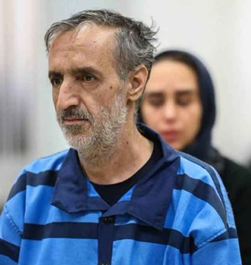
The regime’s Supreme Court has upheld the death sentence of Mohammad Abbasi, one of the detainees of the Malard protests, as well as a 25-year prison sentence for his daughter, Fatemeh Abbasi. These two political prisoners are currently held in Karaj’s Ghezel Hesar and Tehran’s Evin prisons, respectively. Mohammad Abbasi and his daughter were subjected to severe pressure and torture during interrogation. Since their arrest, they have been denied access to a lawyer during all stages of proceedings, including interrogation, investigation, court, and the Supreme Court review. Mohammad Abbasi, 55, and his daughter Fatemeh Abbasi, 34, were arrested during the protests of December 2025/ January 2026. Branch 15 of the Tehran Revolutionary Court, presided over by Abolqasem Salavati, had sentenced Mohammad Abbasi to death on charges of “Moharebeh (enmity against God) through intentional murder” and his daughter to 25 years in prison for “complicity in the crime.” The police forces (Faraja), in collaboration with judicial bodies, claimed that Mohammad Abbasi killed a law enforcement officer in Malard on January 7, 2026, during the protests. However, a review of the evidence presented in court reveals serious contradictions, including the presentation of two different images of two separate individuals, both introduced as Mohammad Abbasi. Furthermore, despite claiming to have reviewed all surveillance cameras in the vicinity of the incident, no clear image showing the presence of Mohammad Abbasi or his daughter at the scene of the clash leading to the officer’s death was presented. Regarding Fatemeh Abbasi, her exact role in this case remains unclear. According to the published report from the court session, the only evidence against this father and daughter was their entry into an alley where the police officer died—an act regarded as “participation in murder” and “complicity in crime” without any supplementary evidence.
A Report on the Condition of Ilya Ben Rashid in Isfahan’s Dastgerd Prison
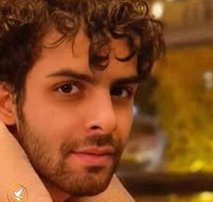
Ilya Ben Rashid, 22, a resident of Shahin Shahr, Isfahan, is among those detained in connection with the nationwide protests of December 2025/ January 2026 in Shahin Shahr, on January 22, 2026. After nearly 100 days, he remains in detention and is held in Isfahan’s Dastgerd Prison. In early April of this year, his court session was held via video conference in Branch 5 of the Isfahan Revolutionary Court. During this session, he faced charges including “Moharebeh” through participation in the destruction of public property, “assembly and collusion against national security,” and “propaganda activities against the system,” against which he defended himself. Ilya Ben Rashid had previously lost his parents and lived with his grandparents before his arrest. Due to the advanced age of his family members, pursuing the legal process of his case has been accompanied by difficulties. Furthermore, he has been denied access to a chosen lawyer so far.
Mohammadreza Hissinia’i: Transferred to Solitary Confinement on the Eve of Trial

Mohammadreza Hissinia’i, born in 1996 and a resident of Kerman, previously lost his parents and was arrested on January 14, 2026, by approximately 30 armed agents at his private home in Kerman. The agents entered the house without presenting a judicial warrant and pressured family members by creating an atmosphere of intimidation and threat. During this raid, his 85-year-old grandmother was subjected to abusive behavior, and Hosseinai himself was arrested with physical violence and transferred to an unknown location. This 29-year-old citizen has now been suddenly transferred to a solitary confinement cell as the date of his trial approaches.
Transfer of Three Baha’i Women to Kerman Prison; One is Pregnant
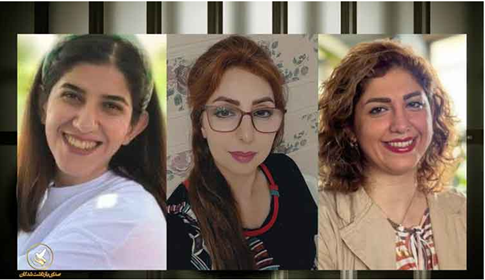 On Saturday, April 25, 2026, three Baha’i citizens from Rafsanjan—Boshra Mostafavi, Nahid (Elena) Naeimi, and Didar Ahmadi—were transferred to Kerman Prison to serve their sentences after being summoned to the sentence implementation unit. The sentence issued for each is four months of discretionary imprisonment. This occurs even though Branch 3 of the Rafsanjan Criminal Court had previously acquitted these three citizens citing a lack of sufficient evidence. However, this verdict was overturned during the appeal phase following an objection by the prosecutor of Rafsanjan, and ultimately, each was sentenced to imprisonment by Branch 7 of the Kerman Provincial Court of Appeal. During the proceedings, the presiding judge explicitly based his judgment on the defendants’ religious beliefs and declared that they must “pay the price for being Baha’is”—an issue that clearly contradicts the principles of fair trial and judicial impartiality. It has also been reported that one of these women was pregnant at the time of transfer to prison, a matter that doubles concern regarding her health and detention conditions.
The Islamic Republic’s Insatiable Appetite for Execution
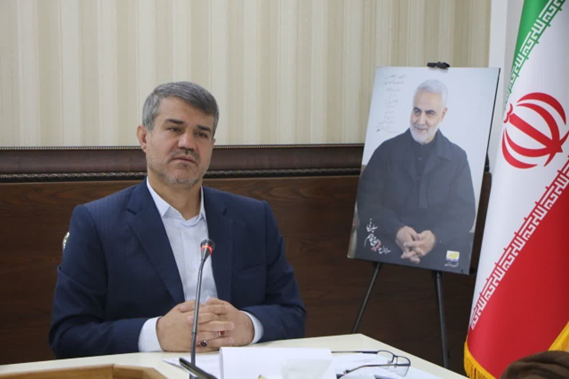
According to a report by the Daneshjoo News Agency dated April 27, 2026, the General and Revolutionary Prosecutor of Kerman, Mehdi Bakhshi, announced the arrest of at least 101 individuals in Kerman County alone, continuing security policies and the intensification of suppression. Announcing this news, the Prosecutor claimed that the detainees face charges such as “espionage,” “communication with Israel,” “carrying weapons,” and “membership in Takfiri groups”—charges which, according to Ejei’s directives, do not require lengthy court proceedings but must promptly lead to death sentences, even by having judicial advisors visit prisons to take the final defense of prisoners right there. Despite the scale of these arrests, authorities have not published any information regarding the identities, manner of arrest, location of detention, or legal status of these individuals, which constitutes the institutionalized violation of fundamental rights, including the right to a lawyer and a fair trial, and serves as an instance of enforced disappearance.
The Responsibility of the International Community
When the Holocaust occurred, the international community blamed itself for lacking mechanisms to prevent such massacres, war crimes, and crimes against humanity, and insistently pursued the creation of such mechanisms. However, we witness that the international community and international human rights bodies lack the courage to utilize these mechanisms against the Islamic Republic—a failure that undermines all the efforts of these bodies over these years and erodes public trust globally.
We once again insistently demand practical action to stop the massacres and flagrant human rights violations in Iran. All countries are obligated to condition their economic and diplomatic relations with this regime on the cessation of executions, the end of suppression, and the release of political prisoners.