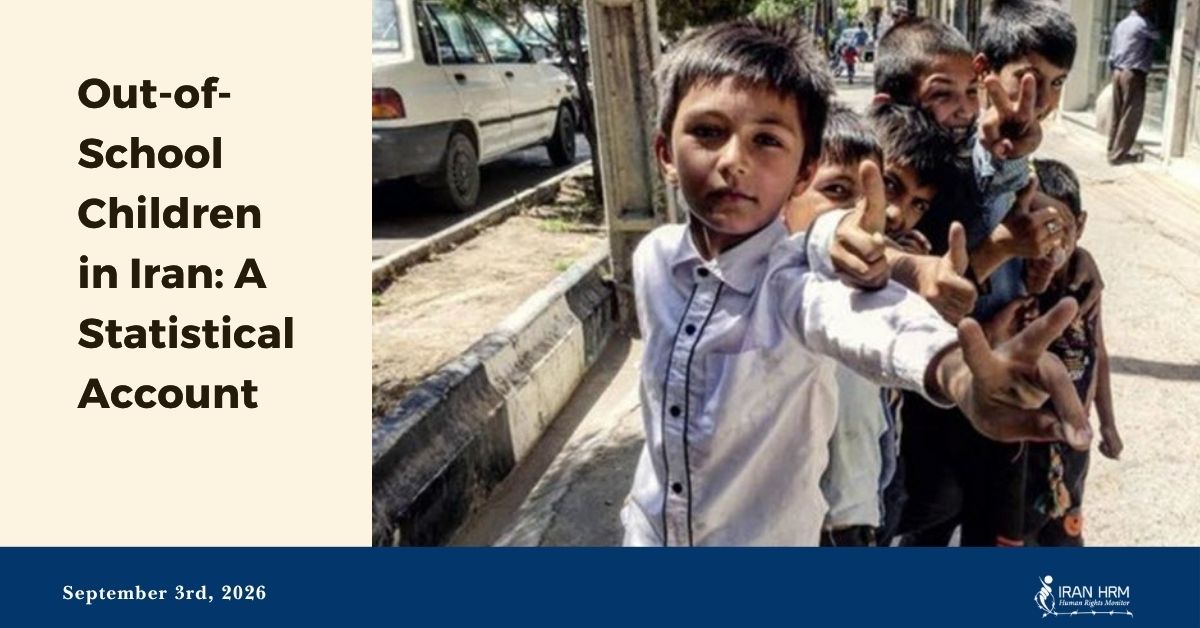
As the 2026–2027 academic year approaches, official reports and statistics published by Iranian educational authorities highlight serious concerns regarding children’s continuous access to education and the rise in out-of-school children. Although authorities report the enrollment of more than one million students in the first grade of primary school, official data and domestic media reports indicate that a significant proportion of children either do not enter the educational system from the outset or drop out of the learning cycle in subsequent years.

Rezvan Hakimzadeh, Deputy for Primary Education at the Ministry of Education, announced that out of 1,154,000 children eligible for first-grade enrollment, more than one million have finalized their registration; however, the status of a portion of eligible children remains undetermined. This situation indicates that the educational gap begins at the very point of entry into school.
While statistics report millions of enrollments in the first grade, realities reveal deep structural gaps—ranging from children who are denied the opportunity to register from the beginning to students who drop out during middle grades.
According to official statistics recorded in the “Shahid Mahmoudvand” system, a total of 141,837 out-of-school students aged 6 to 11 have been identified, including 78,670 boys and 63,167 girls. According to the Deputy for Primary Education, boys account for approximately 55.5%, and girls account for 44.5% of this total.
In analyzing this statistical difference, Ministry of Education officials and experts have pointed to differing drivers for boys and girls leaving school. Based on reports published in domestic media citing educational officials, the higher proportion of boys dropping out at the primary and lower secondary levels is frequently linked to economic poverty, contributing to household livelihoods, and early entry into the labor market (child labor). Conversely, while the proportion of girls is recorded as lower in primary school statistics, official sources emphasize that as students progress to higher grades, the dropout rate among girls increases more sharply due to cultural barriers, geographical distance to boarding schools, and the occurrence of early marriage.
Furthermore, educational authorities have stated that the highest number of out-of-school children is concentrated in the first grade of primary school, with approximately 38.8% of all out-of-school children being at the official school-entry age. This statistic demonstrates that a major portion of the current crisis forms even before formal education begins.
In addition to national statistics, domestic reports present an alarming picture of conditions within individual schools. For example, an educational inspector reported from a field assessment of a 400-student school in Tehran that 70 students had dropped out—a figure representing approximately 18% of that school’s student body. In other words, out of every six students who should be present in the classroom, one is missing.
Official data on geographical distribution further reveals that the out-of-school crisis possesses deep structural and regional dimensions. Based on statistics published by the Majlis Research Center and reports from official news agencies, marginal and underprivileged provinces account for the largest share of out-of-school children. Sistan and Baluchestan Province ranks highest, accounting for 15% of all out-of-school children in the country, followed by Khuzestan, West Azerbaijan, Razavi Khorasan, and Kerman provinces. This geographical concentration demonstrates a direct link between regional deprivation, inequality in the distribution of educational infrastructure, and the increasing rate of children leaving the educational cycle.
Educational authorities and domestic media have also reported an increase in dropouts in the seventh and eighth grades. Although precise national figures for this specific phenomenon have not been published, the analytical focus on this age group reflects a crisis occurring during the transition from childhood to adolescence.
Leaving school at this age increases the likelihood of early entry into the labor market, limits future educational and professional opportunities, and perpetuates the intergenerational cycle of poverty. Although the cited reports do not provide direct statistical data on the eventual fate of these students, educational authorities themselves have identified economic poverty, social hardship, and cultural factors as primary reasons for children remaining out of school.
Another key obstacle to children’s school registration and continued education, acknowledged by educational officials and state institutions, is the issue of “children lacking official identity documents and birth certificates.” According to statements by Ministry of Education officials and reports from official news agencies, thousands of children annually in border and marginal areas—including children born to unregistered marriages or residing in areas without access to civil registry services—are prevented from finalizing school enrollment or face severe legal and administrative disruptions in their education due to the lack of official identification documents.
Further dimensions of this crisis are evident in official statements by state authorities. The Minister of Education reported that more than 15,000 children with special needs (exceptional students) are currently out of school. This figure underscores severe challenges regarding equal and inclusive educational access for children with disabilities or special educational needs.
In addition, Ministry of Education officials have cited numerous intersecting drivers as causes for children remaining out of school, including financial poverty, improper guardianship or lack of guardianship, specific medical conditions, child labor, cultural barriers, distance between place of residence and school, and difficulties accessing educational services.
Among these factors, child marriage is notably documented. According to official statistics announced by the Deputy for Primary Education, at least 69 cases of child marriage have been recorded among primary school students.
Synthesizing these data points raises a fundamental question: if initial school intake remains in the millions, yet significant numbers of children fall out of the system from the very beginning of primary education and subsequently during middle grades (such as the seventh and eighth grades), how many of these children will ultimately succeed in completing their education?
The core issue is no longer merely initial “enrollment.” The central challenge lies in guaranteeing children’s continuous retention in school and creating conditions that enable them to complete their educational cycle. The gap between “school entry” and “school retention” has become one of the most critical structural challenges facing Iran’s educational system.
Human Rights Framework
The right to education is explicitly recognized under Article 26 of the Universal Declaration of Human Rights (UDHR), Article 13 of the International Covenant on Economic, Social and Cultural Rights (ICESCR), and Articles 28 and 29 of the Convention on the Rights of the Child (CRC).
Furthermore, given that more than 15,000 children with special needs remain out of school, this situation raises serious concerns regarding the implementation of obligations under Article 24 of the Convention on the Rights of Persons with Disabilities (CRPD), which mandates state parties to ensure an inclusive and non-discriminatory educational system.
In addition, the documentation of child marriages among primary school-aged children directly conflicts with standards articulated in the Convention on the Rights of the Child (Articles 19 and 34) and recommendations of the Committee on the Rights of the Child regarding the prohibition of underage marriage and the preservation of children’s right to continued education.
The issue of out-of-school children falls within the mandates of the UN Special Rapporteur on the Right to Education, the UN Special Rapporteur on the Situation of Human Rights in the Islamic Republic of Iran, the Committee on the Rights of the Child (CRC), the Committee on the Rights of Persons with Disabilities (CRPD), and the UN Special Rapporteur on Extreme Poverty and Human Rights.
Conclusion and Recommendations
Information published by Iranian authorities and domestic media demonstrates the continuation and, in certain areas, the intensification of the out-of-school children crisis. This crisis impacts not only children residing in underprivileged regions, but also children with disabilities, students at risk of poverty, child laborers, undocumented children, and girls exposed to early marriage.
A) Requests for Action by United Nations Mechanisms in Relation to the Islamic Republic of Iran:
Publish comprehensive, annual, transparent, and disaggregated data on out-of-school children based on province, gender, educational level, disability status, and possession of identity documentation.
- Publish comprehensive, annual, transparent, and disaggregated data on out-of-school children based on province, gender, educational level, disability status, and possession of identity documentation.
- Formulate and implement a time-bound action plan backed by adequate budgetary allocations to eliminate structural barriers to first-grade enrollment and prevent lower and upper secondary school dropouts.
- Urgently facilitate identity verification processes and the issuance of educational identification codes for all undocumented children to guarantee their right to education without administrative impediments.
- Establish the necessary infrastructure and conditions for inclusive education, adapting school facilities to ensure equal access for more than 15,000 children with special needs.
- Reform domestic legislation and adopt legal and socio-economic support measures to prohibit child marriage and alleviate livelihood pressures that force children out of the educational cycle.
B) Suggested Issues and Actions for the Special Rapporteur on the Right to Education and United Nations Mechanisms:
- Address the statistics and findings documented in this report in official communications and dialogues with state authorities of the Islamic Republic of Iran, requesting transparent accountability.
- Evaluate equal access to education for children with disabilities and undocumented children in periodic reviews conducted by specialized treaty bodies (including the CRC and CRPD).
- Integrate the impact of structural poverty and economic deprivation on the right to education within thematic reports concerning extreme poverty and human rights.
- Reflect Iran’s progress or regression in implementing international obligations related to the right to education in upcoming reports and sessions of the UN Human Rights Council.
- In future engagements with the Iranian government, demand a clear timeline for reducing out-of-school rates—particularly regarding children with disabilities, children in underprivileged regions, and undocumented children—and monitor progress in subsequent periodic reviews and reports.
Sources /
- Rokna News Agency: “15,000 Exceptional Students Left Out of Education / 70 Students in a 400-Student School in Tehran Dropped Out / First-Grade Registration for Hundreds of Children in Limbo / Dropouts Increase in Grades 7 and 8”
- Khabar Online: “141,000 Out-of-School Children Identified / Over 40,000 Students Returned to School”
https://www.khabaronline.ir/news/2268586/
- Tasnim News Agency: “Return of 46,000 Out-of-School Students to Schools”
https://tasnimnews.ir/fa/news/1405/04/01/3623541/
- SNN (Student News Network): “161,000 Primary School Out-of-School Children Identified”
https://snn.ir/fa/news/1362484/
- Eqtesad 24: “Shocking Statistics on Out-of-School Children / Priority for Boys’ Education and Child Marriage as Causes for Girls Dropping Out”
https://eghtesaad24.ir/fa/news/304849/
- IMNA News Agency: “Shocking Statistics of Out-of-School Children in Sistan and Baluchestan”
https://www.imna.ir/news/889033/
- Asr Iran: “Undocumented – Illiterate / Iranian Children Deprived of School Due to Lack of Birth Certificates”