Qezel Hesar Prison – March 29, 2026
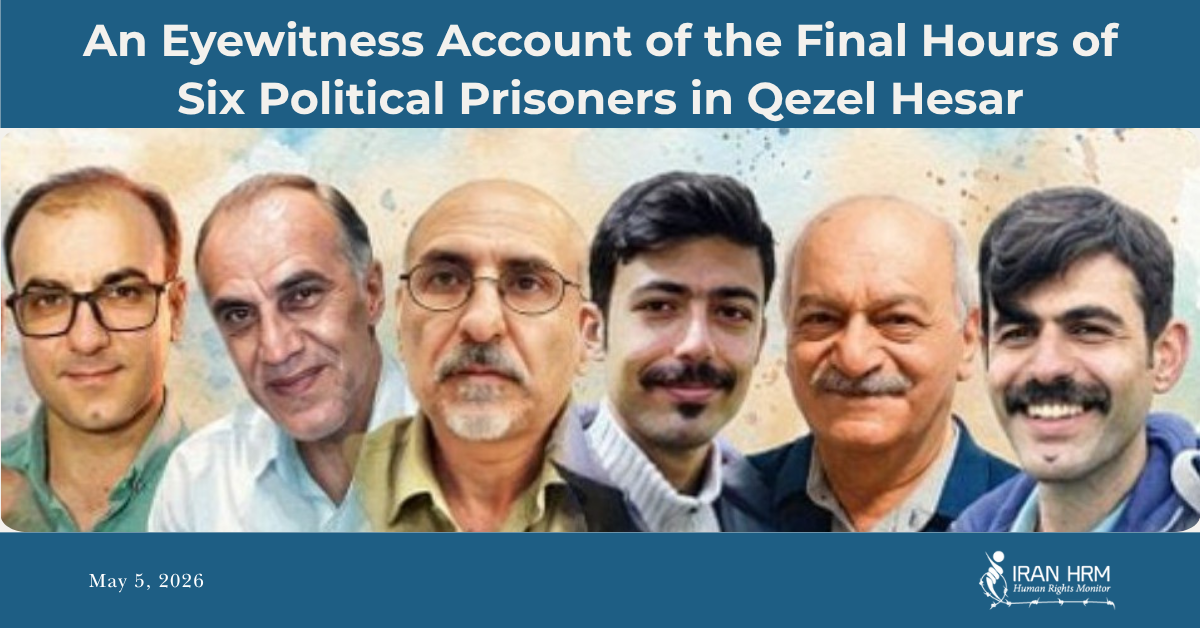
Some narratives set words on fire. What you are about to read is the jarring report of an eyewitness from the night of March 29, 2026, in Qezel Hesar Prison; a night in which the darkness of the agents’ masks paled in the face of the white light of faith and the smiles of six political prisoners. This report is not the story of an end, but an account of the “uprising” of human beings who mocked the fear of death to carve the meaning of freedom into history with their own flesh and blood.

How magnificent is the stature of those human beings who have ground the snout of death into the dirt!
Note to the Reader:
- For security reasons, the name and identity of the witness, as well as his voice recording, will not be made public and will remain protected.
- Terms marked with numerical superscripts are explained in the footnotes for cultural, historical, and religious context.
Eyewitness Report:
What a resurrection1 it was!
And how magnificent is the stature of those human beings who have brought even death to its knees!
The legions of Ibn Muljam2 and Harmalah3, masked in black and shouting, stormed into the “ward” late at night to slaughter the finest children of Iran—as if by wearing masks to prevent us from recognizing them, they would also remain safe from being recognized by history, the people, and God.
Their leader, Kamali (one of the criminals of the regime’s Prisons Organization), dressed in a suit with an ill-shaped physique and a nauseating hair dye plastered on his head, acted like “Pontius Pilate, the Roman governor who declared his innocence in the crucifixion of Jesus Christ.” In a disgusting manner, he kept saying: “We are nobody! If we don’t carry out these orders, how are we supposed to feed our wives and children??!”
Indeed, a resurrection it was!
At 9:30 PM, they raided us with masks, stun guns, handcuffs, chains, and batons. At the door was Shahrokh (Akbar Daneshvarkar); they swarmed him first, so hard that his clothes were torn and hung in tatters from his body. Yet, with mockery and laughter, he shouted: “Why are you so afraid?? We are the ones about to be executed; why are you afraid?” and he laughed aloud!
Babak the Tall (with a broken leg), who stood a head and shoulders above everyone else, asked with his usual soul-soothing smile: “Is everyone okay, guys?” While three men surrounded him, shackling him in handcuffs and chains, he used his torso to shove them aside so he could kiss and bid farewell to all the boys. They could not stop him.
The great man of slight build, Mohammad Taghavi, as they were leading him away in handcuffs for execution, reached out with his bound hands to help those like Vahid who had been struck by fists and batons and had fallen to the ground, lifting them up. When he reached me, we kissed, and he said: “Now we must sing an anthem.” I said: “Let us sing.”
He said: “I cannot concentrate and I cannot remember any anthem, but what anthem is more crushing than God is the Greatest?” And so:
” God is the Greatest! God is the Greatest!” The resonance of ” God is the Greatest ” shook the entirety of Ward 4, and it instinctively reminded me of the words of Zaynab al-Kubra4 who, upon witnessing the massacre of Imam Hussain’s companions, said: “I saw nothing but beauty.” 5 And from this resurrection that had been unleashed, I saw nothing but the grandeur, greatness, and beauty of the human stature!
Vahid Bani-Amerian seemed as if he had taken flight, falling to the ground from the hands of the guards of corruption and crime. Even as they struck his head and face with fists and batons, the cry of “God is the Greatest” never left his lips. While I was handcuffed from behind and he from the front, we came chest to chest; he took my face in his hands and we kissed. He said: “Forgive us. The call for the final journey has sounded; the time has come. The freedom of Iran and our people is worth all of this.”
At that moment, they were dragging him away. He let himself go, and the officers carried him out of the unit’s door while his feet did not even touch the ground. Raising two fingers in a V-shape, the sign of victory,the exited the unit and was boarded onto the transfer minibus.
Pouya Ghobadi reached me with a beaming face and a smile. He threw his arms, which were handcuffed in front, around my neck and kissed me. Noticing my tear-filled eyes, he widened his own inquisitively and asked with a smile: “Why?! Why the tears and weeping? Is it not our faith that ‘Among the believers are men who have been true to their covenant6? So what cause is there for regret or worry?”
And the ever-youthful elder, Mr. Montazar, who always said that one must go to execution with head held high, with dignity, and with certainty—he was truly so. With absolute calm, and while shackled by a single pair of handcuffs to another prisoner, he pulled him from side to side to bid farewell and kiss the others.
Yes! These are the children of our homeland, Iran, who have forsaken life, wealth, and family for the freedom of their people from tyranny and injustice, walking with pride toward the gallows. Meanwhile, vile individuals like Kamali and his ilk, through the blood of these historical legends, were despicably seeking overtime pay, feeding their families, or currying favor with their masters.
As it is written in the Ziarat Ashura7: “May the curse of God be upon those who paved the way and made the preparations for your slaughter.”
That same night in my solitary cell, as I reviewed the faces of each of these men and Vahid at the moment of their departure, I said to him: “If the realization of a free Iran is indeed a ‘Resurrection,’ then through your uprising for Iran’s freedom, you have removed the only remaining veil and distance (the fear of death) to reach that Resurrection.”
Peace be upon you for the patience and steadfastness you have endured.
Peace be upon you for what you patiently endured8.
A Word with the Reader: A Call for Action and Global Accountability
What is documented in this report is more than a personal’s mourning; it is a wake-up call for the world’s conscience. The magnificent standing of these six individuals against the noose is a stain of shame on the silence and inaction of the international community. For democratic governments and civil institutions that claim to protect human rights, these words must serve as a final warning: the passive observation of these systematic executions is complicity in crime. The world must not settle for issuing ineffective statements; the time has come for the perpetrators of these “state-sanctioned killings” to be held accountable before international law. Freedom is a collective responsibility, and the smiles of these legends on the gallows are a testament to the reality that a nation’s will for liberation cannot be harnessed by a hangman’s rope.
———————-
Footnotes:
- Resurrection (Qiyamat): In this context, the witness uses the term to describe a scene of immense chaos, gravity, and spiritual reckoning, similar to the Day of Judgment.
- Ibn Muljam: A historical figure in Islamic history notorious for the assassination of Ali ibn Abi Talib (the first Shia Imam). He is a quintessential symbol of treachery and the murder of a righteous leader.
- Harmalah: A figure infamous in the Battle of Karbala for killing the infant son of Hussain ibn Ali. He represents the peak of cruelty and heartlessness toward the innocent.
- Biblical Parallel: The use of Ibn Muljam and Harmalah here functions similarly to referencing Judas Iscariot (for betrayal) or Herod (for the slaughter of the innocents) to convey the depth of the villains’ depravity.
Note on Pilate: The witness explicitly references Pontius Pilate to highlight the “banality of evil”—the attempt by perpetrators to wash their hands of moral responsibility by claiming they are merely “following orders” to provide for their families.
- Zaynab al-Kobra: The granddaughter of the Prophet Muhammad and a central figure in Islamic history, known for her extraordinary resilience and eloquent defiance following the massacre of her family at the Battle of Karbala. She is a universal symbol of courage against tyranny.
- “I saw nothing but beauty” (Ma ra’aytu illa jamila): This famous declaration was Zaynab’s response to the tyrant Yazid when he mockingly asked her what she thought of God’s treatment of her family.
- Biblical Parallel: This resonates with the concept of “The Peace of God, which passeth all understanding” (Philippians 4:7) or the spirit of James 1:2-4, regarding finding joy and spiritual perfection even in the midst of trials and suffering. It reflects a state of “Exaltation” where the martyr sees spiritual victory rather than the physical suffering.
- “Among the believers are men who have been true to their covenant” (Min al-mu’minina rijalun sadaqu…): This is a fragment from the Quran (Surah Al-Ahzab 33:23), referring to those who remain steadfast in their promise to God even at the cost of their lives.
- Biblical Parallel: This closely mirrors the sentiment of Revelation 2:10: “Be thou faithful unto death, and I will give thee a crown of life.” It also echoes the theme of 2 Timothy 4:7: “I have fought a good fight, I have finished my course, I have kept the faith.” These verses emphasize the spiritual triumph of maintaining one’s integrity and “covenant” through the ultimate sacrifice.
- Ziarat Ashura: A sacred salutatory prayer in Shia Islam that honors the martyrs of Karbala. It contains strong condemnations of not just those who committed the killings, but those who laid the administrative and logistical groundwork for oppression.
- “Peace be upon you for what you patiently endured” (Salamun Alaykum Bima Sabartum): A phrase from the Quran (Surah Ar-Ra’d 13:24), representing the greeting given by angels to those entering Paradise due to their perseverance.
- Biblical Parallel: This echoes Matthew 5:10: “Blessed are they which are persecuted for righteousness’ sake: for theirs is the kingdom of heaven.” It also mirrors the commendation in Hebrews 10:36: “For ye have need of patience, that, after ye have done the will of God, ye might receive the promise.”