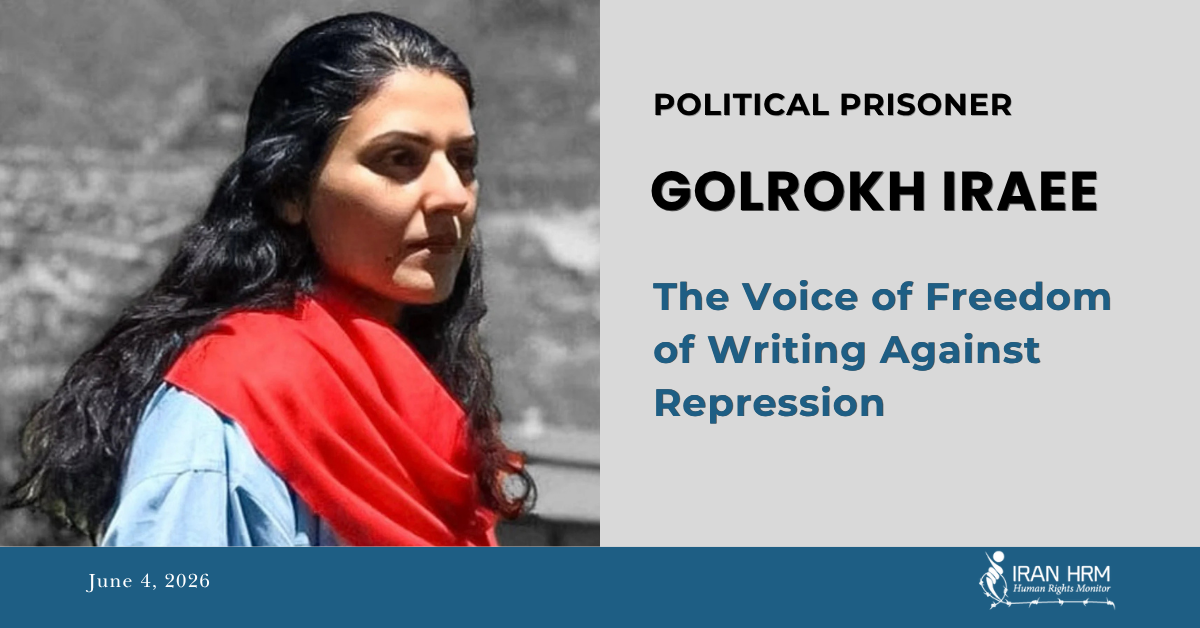
Political prisoner Golrokh Iraee is one of the most prominent figures of resistance for freedom of thought in Iran. Having spent years in prison due to her human rights activities and writing about oppression and inequality, she has provided a vivid depiction of repression, censorship, and the role of the pen in fighting injustice in a letter addressed to PEN America. This article introduces the life and struggles of political prisoner Golrokh Iraee and offers a reading of her message regarding the freedom to write.

Who is Political Prisoner Golrokh Iraee?
Political prisoner Golrokh Iraee is a writer and human rights activist born in 1980 in Amol. She has been arrested and imprisoned multiple times for writing about stoning, criticizing repressive structures, defending women’s rights, and protesting against executions.
The judicial case-fabrication against her began in 2014, when security agents used an unpublished short story she had written about stoning as a pretext to charge her with “insulting sanctities” and “propaganda against the state.”
From then until today, Golrokh Iraee has been arrested repeatedly, transferred to various prisons, and is currently held as a political prisoner in the women’s ward of Evin Prison.
The Letter of Political Prisoner Golrokh Iraee to PEN America
The letter written by political prisoner Golrokh Iraee from Evin Prison stands as one of the most important documents of resistance for freedom of expression in recent years. At the beginning of her letter, she speaks of “a world where truths are given no room to be revealed”—a world where writing about the suffering of the people is deemed “criminal,” and where writers face prosecution instead of praise.
In her letter, Golrokh Iraee emphasizes that writing about poverty, inequality, repression, and systematic killings, though highly costly, serves as a “window of hope” and a “catalyst for the conscious rage” of the people.
She views the pen as a tool that links the bitter existing reality to a bright future and shatters enforced silence.
In a crucial part of her letter, political prisoner Golrokh Iraee writes that she will continue to write even in prison, even under threat, and even at the risk of her life.
She considers this writing a continuation of a struggle that the people of the region—from the mountains and forests to the streets—have advanced with their “lives and blood.”
The Pen: The Shared Cry of Human Suffering
Furthermore, Golrokh Iraee calls the pen “the cry of a shared suffering”—a cry that knows no borders, race, or nationality.
She remembers the grief of mourning mothers, the children of Palestine, young girls who are victims of violence, and families seeking justice, defining the pen as the language of these agonizing struggles.
Concluding her letter to the writers and members of PEN America, Golrokh Iraee states that their efforts to expose the truth echo as “the voice of the voiceless,” and that liberation from suffocation will only be possible through a “collective movement.”
She ends her letter with the hope for the “establishment of justice and equality.”
Political Prisoner Golrokh Iraee: The Struggle Continues Even in Prison
Golrokh Iraee demonstrates that even from the heart of prison, one can write, protest, and be the voice of the people.
Her letter to PEN America is a testament to the fact that the pen, even under the harshest conditions, can keep the truth alive.
By emphasizing “we write even if our freedom is enchained,” she reminds us that the pen can break the silence and pave a path toward justice.
The Full Text of the Letter to PEN America:
From afar, I greet you who stand together to celebrate the “Freedom to Write.” I write from a world where truths are given no room to be revealed, and where shattering suffocation and subjugation is not a simple right, but a feat achieved only by confronting rulers whose interests rely on a fear that casts its shadow over speech and action.
Here, fearlessly writing about the suffering of a people rising up against tyranny is deemed criminal. “Those who reveal the ruin of pain to the eyes of the world with their pens” are left to waste away in silence; they are criminals and deserve to be prosecuted!
Writing about the suffering of the oppressed people, about poverty, inequality, repression, and systematic killings—which have always been a part of our lives—is not without anxiety. Yet, it is a window of hope for the motivation to struggle and a catalyst for the surging rage of a people who experience suffocation as their daily existence. History bears witness that the roar of their conscious and purposeful rage will be the only way to uproot tyranny.
The ruling reaction does not tolerate freedom of thought and boldness of expression when the “pen” assaults the erected gallows, narrates poverty and inequality, reflects empty tables, and heralds the uprising of the hungry.
Thus, they stood up to break the pen. The “pen” links the bitter existing reality to the bright horizon of tomorrow. It shatters the silence forced upon us by the relentless repression of more than a century of domination by both the “Sheikh and the Shah,” replacing it with social, political, and class consciousness—the very consciousness that liberates the deprived and the oppressed masses.
Golrokh Iraee : “We write even if our freedom is enchained.”
We write to confront the physical elimination of human beings, the disregard for thought, and the erasure of belief as well as political, ideological, and social rights. We write to counter the elimination of values and ideas that have always been forced into rejection and marginalization.
We write even if our freedom is enchained. Even if we are threatened, restricted, forced into exile, or made to sacrifice our lives. Throughout the years of the relentless domination of dictators, under the yoke of exploitation and reaction, we have sung and played our part in this struggle through poetry and slogans, with our lives and blood—atop mountains, from the heart of forests, and in the streets of our cities across a Middle East plundered by colonialism and invaded by reaction.
When the “pen” begins to write to speak of the people’s suffering, it is confined neither by borders, nor by race, nationality, gender, or color.
The “pen” becomes the cry of a shared suffering against tyranny, for us who stepped into the arena of an unequal battle…
The “pen” becomes a cry over breadless tables.
It becomes a cry on the tongues of the mothers of sorrow, as they shed tears while the bodies of those noble, executed souls are carried on the chariots of death toward unmarked graves.
It becomes a cry with the children of Palestine, as they carried the rage of occupation in the backpack of displacement, while their dreams turned to smoke and vanished into the air along with the ashes left from the olive trees burned by the malice of the oppressor.
It becomes a cry in that final, terrified look of the girls of Minab, amid the dust, blood, and disheveled hair matted against their frail necks.
It becomes a cry in the justice-seeking of Mahmonir Molaei-Rad, the mother of Kiyan Pirfalak, as she recalls an endless grief through the childhood games of Kiyan—her child killed in the Izeh protests—and writes that injustice is not permanent and the oppressor will face the retribution of their actions.
The “pen” becomes a cry against every suffering and every tyranny in every corner of the world; if it turns otherwise or out of expediency, it has abandoned its mission.
And you, my dear ones, whose hearts beat to expose the truth and whose concern is to write about reality without anxiety; you who cherish the “pen” and the struggle for equality and liberation—your conscious and responsible effort for the oppressed people fighting for their “rights” will be the reflection of the voice of the voiceless.
We shall be liberated from suffocation, and we know this will not be possible except through a collective movement.
For the establishment of justice and equality—until the liberation of humanity from the suffocation and subjugation of rulers.
Golrokh Iraee
May 2026 (Ordibehesht 1405)
Women’s Ward, Evin Prison