Victimized Children; Poverty, Deprivation, and Structural Discrimination
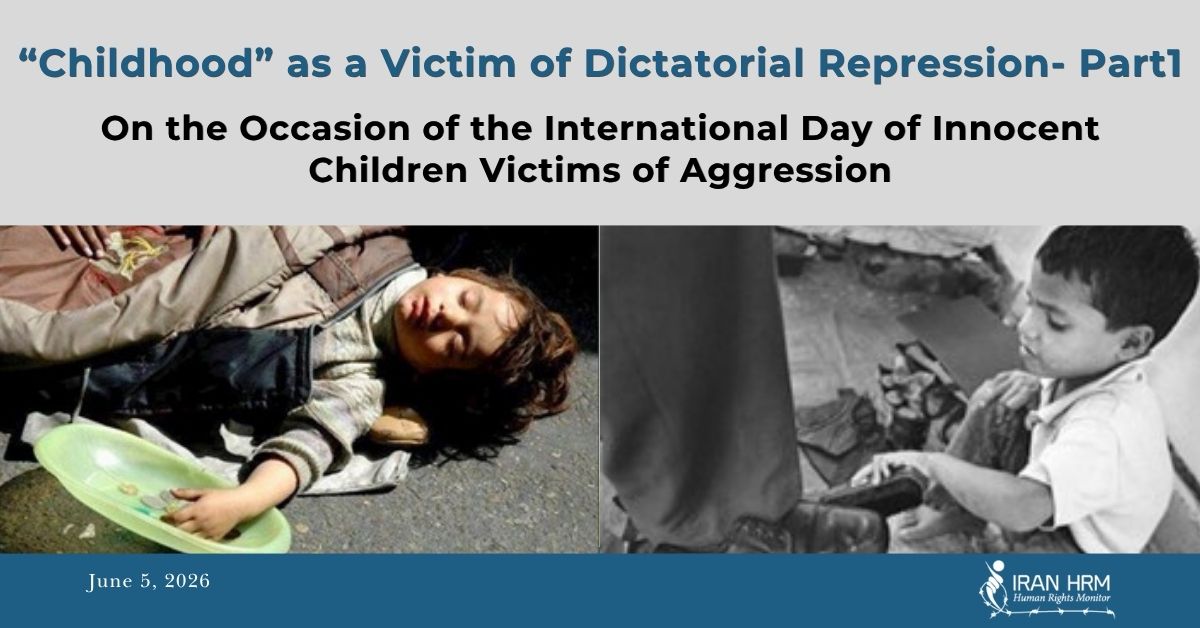
On the International Day of Innocent Children Victims of Aggression, is an opportunity to revisit the suffering of children deprived of their most basic human rights because of war, repression, poverty, and violent policies. In Iran, violence against children is not limited to war or street repression; it has become embedded in economic, educational, judicial, and social structures.

In today’s Iran, childhood is increasingly associated not with education, safety, play, and development, but with terms such as “child laborers,” “street children,” “children deprived of education,” “undocumented children,” “child fuel carriers and border porters,” “victims of child marriage,” “homeless children,” and “children affected by violence and addiction”; terms that, over decades of the rule of Velayat-e Faqih, have become part of Iran’s social and political vocabulary.
These crises are interconnected. Poverty, school dropout, child labor, gender discrimination, malnutrition, child marriage, and chronic deprivation in border regions have created a cycle of vulnerability exposing millions of children to exploitation, violence, and social exclusion.
Children in the Cycle of Poverty, Labor, and Educational Deprivation
The crisis facing children in Iran is not merely an individual or family issue; it is a direct reflection of economic collapse, expanding poverty, and the failure of state support systems. According to Iran’s Statistical Center, at least 929,798 children are excluded from the formal education system. Among them, 556,994 are between the ages of 15 and 17; an age at which many are forced into labor because of economic pressure on their families.
Iranian media have also acknowledged the direct relationship between poverty and school dropout. On February 3, 2025, the newspaper Shargh wrote: “One out of every 22 Iranian children are deprived of education.”
Mohammad-Mehdi Seyednasseri, a researcher on international child rights law, stated in the same newspaper that: “Around 40 percent of child laborers in Iran either do not attend school or have dropped out because of work.”
Farshad Ebrahimpour, a member of Parliament’s Education Commission, estimated in October 2024 that nearly: “Two million students” had not registered for school due to economic hardship.
The spread of child labor has become one of the clearest indicators of economic collapse in Iran. On December 3, 2022, Hamshahri newspaper wrote that some social activists estimate the number of child laborers at: “Up to 7 million.”
Earlier, former parliamentarian Nahid Tajeddin stated on September 27, 2017: “Some experts estimate the number of child laborers in Iran between 3 and 7 million.”
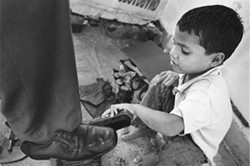 Despite the scale of the crisis, Hamshahri acknowledged on September 5, 2022: “Although 13 institutions are formally responsible for child labor, it is astonishing that no clear authority accepts responsibility for this social crisis.”
Girls are particularly vulnerable within this cycle. Hassan Mousavi Chelak, Deputy for Social Health at the Welfare Organization, announced on June 11, 2025, that: “One quarter of child laborers are girls.”
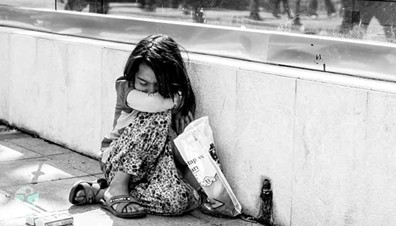 A Hamshahri report published on December 3, 2022, revealed that: 32.4 percent of working girls suffered illness, compared to 21.5 percent of boys;
- 12.7 percent of working girls experienced sexual abuse, compared to 2.75 percent of boys
- and 26.8 percent experienced beatings and humiliation.
ISNA News Agency also reported on May 3, 2021, that some working girls cut their hair short like boys to reduce the risk of sexual assault.
Malnutrition has also become a widespread crisis. Hadi Mousavi Nik, former Secretary-General for Welfare Studies at the Ministry of Labor, announced on July 10, 2023: “57 percent of Iran’s population suffers from malnutrition, including 14.5 million children.”
He added that nearly: “10 million of these children are under the age of 12.”
A faculty member at Yasuj University of Medical Sciences stated on November 26, 2023 that: “Malnutrition is the direct and indirect cause of 60 percent of child deaths in Iran.”
In deprived regions, the situation is even more severe. Ministry of Health data show that more than: “41 percent”
of children under five in rural areas of Sistan and Baluchestan suffer from chronic malnutrition and growth disorders.
The Parliamentary Education Commission also reported that the province’s educational average has fallen to: “7.74 out of 20.”
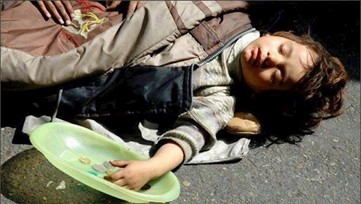 These figures are not merely educational and nutritional indicators; they reflect generational deprivation targeting children’s physical growth, learning capacity, and future prospects.
Border Children; From Deprivation to Death
A direct consequence of structural poverty is the push of children toward deadly occupations in border regions.
In Sistan and Baluchestan, many Baluch teenagers become fuel carriers instead of attending school; a path that for impoverished families is often not a choice, but the only means of survival. Rather than addressing the roots of poverty, the regime defines these children within the framework of “smuggling,” exposing them to pursuit, shootings, and death.
Tareq Terani, a 16-year-old Baluch teenager, lost his life on November 4, 2025, in the border region of Rask after border forces targeted a fuel-carrying vehicle. Official narratives described the operation as part of combating “smuggling networks,” but the deeper social reality behind the case was the severe poverty pushing Baluch children into fuel carrying.
In western Iran, Kurdish children and teenagers are trapped in the cycle of kolbari (cross-border carrying). Kolbari in Kurdistan and Kermanshah results from chronic deprivation, lack of employment opportunities, and the absence of state support.
Teenagers work in mountainous routes under severe cold, facing the risks of falls, freezing, landmines, border shootings, and pursuit by security forces.
Karzan Alizadeh, a 17-year-old kolbar from Kermanshah, died on January 14, 2026, in the mountains near Nosud. According to documented reports, he fell to his death after warning shots fired by border forces dispersed a group of kolbars.
Alongside kolbars and fuel carriers, undocumented children remain among the most vulnerable groups in Iran. The lack of identity documents deprives them of education, healthcare, vaccination, social support, and legal recognition.
Gender discrimination further intensifies deprivation in these regions. Poor girls in border provinces simultaneously face poverty, school dropout, child marriage, and unpaid domestic or informal labor. When educational costs rise or schools are too distant and unsafe, girls are often the first children removed from education.
Girls: Victims of Structural Violence and Child Marriage
Girls in Iran face violence that is reflected even in the legal system itself. Article 1041 of Iran’s Civil Code states: “The marriage contract of a girl before reaching the age of thirteen full solar years is subject to the permission of the guardian and the approval of the competent court…”
This article legally permits the marriage of girls under 13 with judicial and guardian approval.
Official statistics reveal the scale of the crisis. Iran’s Statistical Center recorded at least: “27,448 marriages involving girls under 15.”
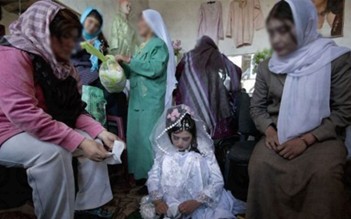 The Civil Registration Organization also reported: “1,474 births from mothers aged 10 to 14.”
Government data further show that between 2016 and 2021, more than: “131,000 girls under 15”
were forced into marriage.
In 2021 alone, over: “32,000 marriages of girls under 15” were officially registered. In 2022, another:
“26,974 girls under 15” were married, while: “1,390 girls under 15” became mothers.
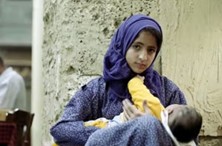 Officials and researchers repeatedly acknowledged that the real numbers are significantly higher. Ali Kazemi, advisor to the Deputy for Legal Affairs of the Judiciary, stated in March 2019: “Between 500,000 and 600,000 children marry annually in Iran.”
Mohammadreza Mahboubfar, a social harms researcher, described official statistics on August 25, 2021 as merely: “The tip of the iceberg,” estimating the actual scale of child marriage at: “five to six times higher than official figures.”
On August 27, 2021, he warned: “Every 24 hours, 100 marriages involving girls under 15 are registered in the country.”
As criticism intensified, Etemad newspaper reported on September 8, 2024, that authorities had halted the publication of some statistics related to child marriage and births to underage mothers.
Poverty and gender discrimination push girls into this cycle. In one documented case, “Mahtab R.,” a 13-year-old girl from the outskirts of Torbat-e Jam, was officially married on September 22, 2025, to a 29-year-old man with court approval. Judicial explanations in the case stated:
“The court confirmed physical maturity and the guardian’s full consent in accordance with religious interest.”
For many girls, marriage marks not the beginning of life, but the end of childhood.
Fatemeh Soleimani, a 12-year-old girl from Kermanshah, died by suicide after family pressure for marriage. Fatemeh Moradpour, a 15-year-old girl from Lorestan, hanged herself after being forced to marry a 40-year-old man. Shima Rameshk, a 14-year-old girl from southern Iran, ended her life only months after forced marriage.
Samira Sabzian was married at the age of 14, endured years of domestic violence, and was executed at the age of 30 while raising two children aged 15 and 11.
Human Rights Analysis; Systematic Violations of Children’s Rights
These facts demonstrate that the crisis facing children in Iran is not a collection of isolated harms, but a chain of simultaneous and systematic violations of fundamental children’s rights.
Children deprived of education are pushed into labor, malnutrition, fuel carrying, kolbari, or early marriage and pregnancy; effectively deprived of their rights to education, health, security, development, and human dignity.
The right to education is among the first violated rights. The exclusion of 929,798 children from school directly contradicts Article 28 of the Convention on the Rights of the Child, which obliges states to make primary education compulsory and accessible to all children.
Child labor, waste collection, street vending, kolbari, and fuel carrying also directly violate protections against economic exploitation and hazardous labor.
Widespread malnutrition, particularly in Sistan and Baluchestan, constitutes a violation of children’s rights to health and physical and mental development.
Child marriage is likewise a direct violation of children’s rights to independent development, free consent, and protection from gender-based violence. Article 1041 of Iran’s Civil Code, together with the large number of marriages involving girls under 15 and births from mothers aged 10 to 14, demonstrates that child marriage in Iran is not an exception, but a legalized and structural phenomenon.
Regional and ethnic discrimination adds another layer of rights violations. Baluch, Kurdish, undocumented, fuel-carrying, and kolbar children face poverty, educational deprivation, lack of public services, and border violence.
The deaths of Tareq Terani and Karzan Alizadeh reflect the human consequences of this structure of deprivation.
Conclusion and Transition to the Second Report
Children in Iran today are victims of a structure in which poverty, discrimination, anti-child laws, and the absence of social protection are deeply interconnected.
Children who should be in schoolwork instead in streets and border regions. Children who should receive safety and protection are pushed into fuel carrying and kolbari. Girls who should enjoy education and free development are forced into early marriage through officially sanctioned laws.
Official statistics, statements by Iranian authorities, and documented human stories demonstrate that the crisis facing children in Iran forms part of a deep and structural cycle depriving millions of children of their most basic human rights.
The ruling regime in Iran has not only failed to fulfill its obligations under the Convention on the Rights of the Child, but through discriminatory laws, concealment of statistics, ineffective protections, and the securitization of poverty in border regions, has itself become part of the machinery reproducing the crisis.
Yet the crisis facing children in Iran extends beyond poverty, deprivation, and social violence. Another alarming process has simultaneously expanded; one in which some children and teenagers are gradually transformed not merely into victims, but into ideological and security tools of the regime itself.
The second report in this series, titled “From Classroom to Barracks,” examines the militarization and ideological mobilization of children and teenagers in Iran.