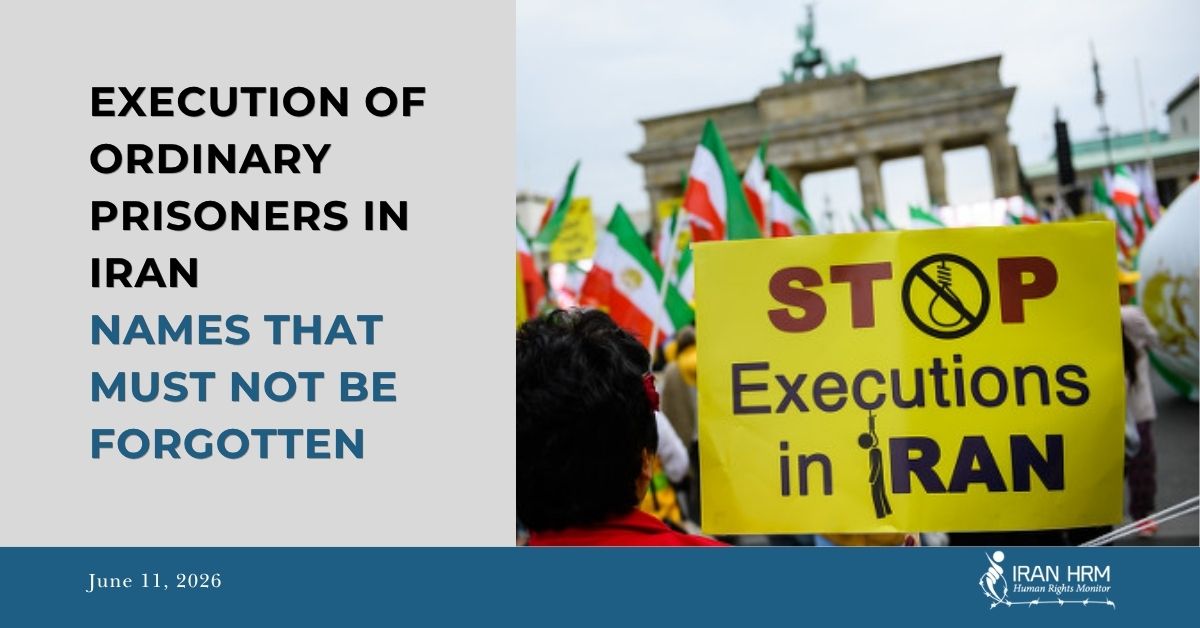
Although the Islamic Republic exploits the shadow and pretext of geopolitical challenges to level charges of espionage, enmity against God (moharebeh), and armed rebellion (baghi) against political prisoners and peaceful protesters in order to silence every critical voice, the shocking rate of executions in Iran against prisoners convicted of ordinary crimes must not be forgotten. This group of prisoners are themselves the primary victims of the regime’s flawed structural, social, and economic policies and the resulting absolute poverty, driven step-by-step toward delinquency.

Over a one-month period (from May 8 to June 8, 2026), the right to life was stripped from a vast number of ordinary crime prisoners; notably for charges where the possibility of a fair trial, due process, and an investigation into the root causes of the crime never existed. The forthcoming statistics represent only a fraction of the death sentences carried out regarding ordinary prisoners, the actual numbers of which are undoubtedly far higher than the names mentioned in this report due to information blockades and frequent internet shutdowns in Iran.
Detailed Statistical Breakdown of Executions in Iran (May 8 to June 8, 2026)
Execution of Ordinary Prisoners in Iran




























Perpetrators of the Deprivation of the Right to Life; A Structure that Normalizes Executions
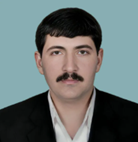
To understand how the death penalty has transformed into a mechanical process devoid of legal standards, reviewing the record of the officials executing these sentences is essential. A prime example of this is Esmatollah Jaberi, a former assistant prosecutor, judicial enforcement supervisor, and judicial enforcement judge at the Tehran Criminal Prosecutor’s Office. An examination of his performance yields a clear reflection of a judicial framework where speed outpaces justice, and where the right to life, independent investigations, and an effective defense are sacrificed for the sake of punishment execution statistics.
Jaberi’s direct presence and role in executing at least 350 death sentences led state media to refer to him as the “Execution Man” (Khabar Online, May 10, 2020). Although he claims to have successfully obtained pardons from the victims’ families (Oliya-ye Dam) in 180 cases, these statistics are themselves the greatest testament to the system’s structural failure. They demonstrate that many of these cases possessed a high potential for resolution from the very outset without requiring the gallows, yet the system was unwilling to halt the execution machine. His famous catchphrase during the controversial case of Shahla Jahed, stating: “Blessed is the killer who is executed,” perfectly illustrates the ruling ideology that perceives the death penalty not as a painful exception, but as a positive value.
- The Case of Shahla Jahed: A Symbol of Severe Ambiguities in Criminal Investigations
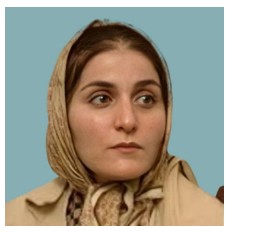
The case of Khadijeh (Shahla) Jahed was one of the most controversial contemporary criminal cases, in which Esmatollah Jaberi played a pivotal role in the execution process. Despite widespread opposition from legal observers, this case culminated in the gallows, while fundamental ambiguities—such as the failure to discover the murder weapon, glaring contradictions in eyewitness evidence, the condition of the victim’s clothing, and the crime scene—were never resolved. Shahla Jahed recanted her initial confessions in court, explicitly declaring that these admissions were extracted under severe psychological and emotional duress; however, the judiciary carried out the death sentence regardless of these deficiencies.
- The Execution of Behnod Shojaee: A Blatant and Flagrant Violation of the Convention on the Rights of the Child
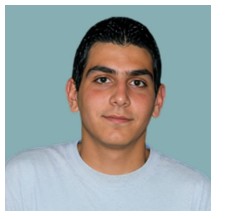 The most appalling chapter of Jaberi’s judicial record traces back to the execution process of Behnoud Shojaee. Behnoud was merely 17 years old at the time the crime occurred. Under the international Conventions on the Rights of the Child, to which Iran is a signatory, issuing and executing the death penalty for individuals who were under 18 years of age at the time of the offense is absolutely prohibited. Although the execution of his sentence was halted five times, he was ultimately hanged in October 2009, recording a stark example of the Iranian judicial system’s disregard for international treaties.
The Impasse of “Statement-Therapy”; The Necessity of Moving Beyond Paper Condemnations
Today, the surging rate of executions in Iran has surpassed the threshold of conventional warnings. Although in recent months prominent international figures and bodies, such as Volker Türk (the UN High Commissioner for Human Rights), Amnesty International, and the European Parliament, have condemned this wave of executions through statements, the objective reality inside Iranian prisons proves that mere “statement-therapy” and paper condemnations have lost their efficacy against the Islamic Republic’s machinery of repression.
The ruling government in Iran does not view the death penalty as an ultimate punitive tool for the most heinous crimes; rather, execution—whether weaponized against political activists or ordinary crime prisoners—forms the baseline of the “system’s survival strategy” to inject terror into the fabric of society and prevent any social explosion stemming from poverty and inefficiency. To halt this accelerating cycle of bloodshed, the global community and human rights organizations are compelled to move beyond customary expressions of concern and adopt material, practical measures.
The United Nations Human Rights Council and international courts must refer the dossier of systematic violations of the right to life in Iran to the UN Security Council as a structural crime. Any restructuring of political, economic, and diplomatic relations by democratic nations with the Islamic Republic must be made strictly conditional and contingent upon an “immediate and complete moratorium on the issuance and implementation of death sentences.” Until the international political and diplomatic cost of executions is raised for the regime, the killing machine will continue its work, devouring more lives of Iranian citizens and youth on a daily basis.