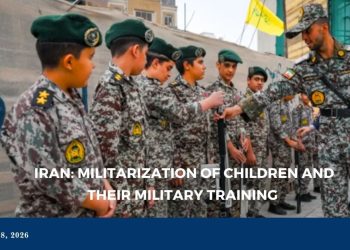
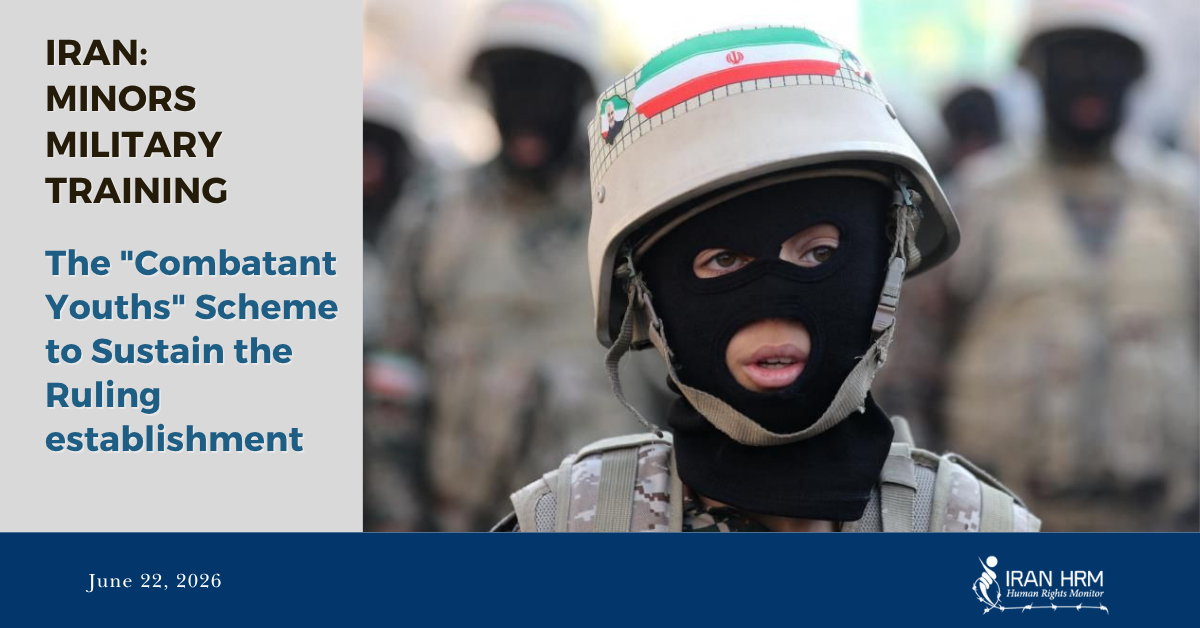
How does the Islamic Republic in Iran violate international conventions and the fundamental rights of children to preserve itself? Alarming reports of systematic violations of the rights of the child have re-emerged in a dangerous dimension. The issue of “weapon training for teenagers in Dishmok” (a town in Kohgiluyeh and Boyer-Ahmad Province) unveils a structural government program known as the “Combatant Youth” scheme. In this initiative, children and teenagers under the age of 18 are subjected to intensive military training, including the handling of heavy combat weapons—an action whose declared objective is “strengthening the spirit of national defense,” but which practically constitutes a flagrant violation of treaties to which Iran is a signatory.

1. The Field Dimensions of the “Combatant Youths” Scheme in Dishmok
Field reports from Dishmok district demonstrate that this program is not merely an ideological or educational course, but a fully militarized platform where:
- Children and teenagers are provided with intensive weapon-recognition training.
- Heavy, active combat weapons are placed in the hands of minors.
- Structured military and paramilitary training are administered to schoolchildren.
In recent years, similar programs under titles such as “Combatant Teenager” or “Defensive Training” have been observed in various parts of the country. However, the Dishmok report stands out due to the participation of very young children and the direct deployment of heavy weaponry. This approach clearly indicates the instrumental exploitation of minors, the violation of children’s rights, and the systemic militarization of educational spaces in Iran. Under the Convention on the Rights of the Child, signed and ratified by Iran, individuals under 18 are legally considered children, and their recruitment or preparation for military and paramilitary activities is strictly prohibited.
2. Documentation of the Official State Doctrine: The Full Report by ANA News Agency
 To comprehend the institutional scale of this phenomenon, it is vital to examine the statements of official state authorities. On April 2, 2026 (13 Farvardin 1405), the state-aligned ANA News Agency published an article titled “Moslemi: Teenagers are the Front-liners and Primary Actors in Defending the Revolution,” officially outlining the doctrine behind this military training. The complete text of the report is preserved below without alteration:
“The first meeting of the ‘Combatant Youths” National Headquarters was held with the participation of representatives from the Cultural Front of the Islamic Revolution and student organizations, including the Student Basij Organization, the Union of Islamic Associations of Students, and the Students’ Organization from across the country. In this meeting, Siavash Moslemi was introduced as the head of the Combatant Youths National Headquarters, and Doustdar was named the secretary of the headquarters.
Commander Moslemi, referring to the current sensitive conditions and the all-encompassing confrontation with the arrogant front, stated: ‘In conditions where the Zionist regime and criminal America have ruthlessly aggressed and encroached upon our country, our teenagers can be the most important actors on the streets to defend the Revolution.’
The head of the Combatant Youths National Headquarters further referred to the epic deeds of the eight years of Sacred Defense (Iran-Iraq War), pointing to the irreplaceable role of this demographic, and recalled: ‘During the Sacred Defense, nearly 550,000 students, despite their young age and the bans on deployment, altered their birth certificates to head to the battlefronts. The offering of 36,000 student martyrs is clear evidence of this depth of sacrifice.’
Emphasizing the continuity of this warrior spirit, he stated: ‘Today, exactly the same conditions of passion, intellect, and readiness to defend the homeland exist among our youth and teenagers; therefore, a teenager must not remain a mere onlooker but must increasingly transform into an active operative of the Revolution.’…
To achieve this objective, the head of the Combatant Youths National Headquarters announced the launching of a vast network under the title of ‘Combatant Youths Hangouts’ (Patogh-e Nojavan-e Mobarez) and said: ‘Combatant Youths hangouts must be established in all cities across the country. These hangouts will act as facilitators for the activities of activist teenagers in the field of defending the Revolution, planning and executing teenager-friendly and appealing initiatives.’
Detailing the structural plan of these hangouts, Moslemi stated: ‘The main goal of this project is to strengthen the active presence and operational engagement of teenagers in public squares and popular rallies. Our primary target audience consists of lower-secondary school students—with priority given to ninth graders—and upper-secondary school students. In the first phase, these hangouts will be set up for at least two weeks, operating for at least three hours daily in high-traffic squares and thoroughfares of cities.’…
Stressing the necessity of using creative, participatory, and gamified formats, he added: ‘Each hangout will feature at least five diverse booths. The space of these hangouts provides a platform for launching open dialogues, teenage circles, teaching necessary wartime skills, and organizing teenagers for community service in neighborhoods.’
Moslemi highlighted some of the most attractive measures designed for these hangouts, stating: ‘The programs must possess components of excitement, competition, and a sense of progression. These measures include journalism and narrative training, registration and training for offensive cyber operations against Zionist media, neighborhood surveillance and public intelligence training to identify infiltration agents, epic poetry recitation (Rajaz-khani) and field leadership by teenagers in rallies, creating spaces to exhibit artwork, as well as weapon handling training, air rifle shooting competitions, and epic photography.’…
He added: ‘This headquarters progresses through the synergy of the Cultural Front of the Islamic Revolution, the Students’ Organization, the Union of Islamic Associations of Students, the Basij, the Ministry of Education, municipalities, the Barekat Foundation, and other institutions. For platform support, the “Nojahan Platform” (Sakoo-ye Nojahan) is used to maintain continuous communication and competitive training. Furthermore, through coordination with television networks, the field activities of teenagers will receive national and provincial media coverage to serve as role models.’
It is worth noting that according to the finalized schedules, the executive steps of this project have commenced with the selection of core coordinators in each province, and soon, with a widespread call across schools, we will witness the launch of these hangouts in provincial centers and districts possessing the necessary infrastructure.”
Conclusion and Executive-Legal Actions (Human Rights in Practice)
It is highly anticipated that confronting this level of systematic violation of the Convention on the Rights of the Child must transcend symbolic resolutions and rhetorical condemnations, moving decisively into international legal mechanisms and executive actions. The organized state project in Iran, operating under national headquarters and urban hubs, represents an overt process aimed at turning schools into barracks and converting students into paramilitary infantry.
To halt this apparatus of recruitment and child military training, the following measures are essential and legally actionable under international frameworks:
- Activating Special Reporting Mechanisms to the UN Committee on the Rights of the Child (CRC): Given that Iran is a state party to this treaty, the aforementioned official state admissions—explicitly detailing the targeting of ninth graders for heavy arms and cyber warfare training—must be formally submitted to the Committee. This serves as irrefutable evidence of non-compliance with the Optional Protocol on the Involvement of Children in Armed Conflict (OPAC), compelling the Iranian government to face legal accountability.
- Referral to the UN Special Rapporteur on the Situation of Human Rights in Iran: The documented evidence regarding the instrumentalization of minors in state security doctrines (such as the “Combatant Youths” scheme) must be embedded as a core pillar of human rights violations in periodic reports submitted to the UN Human Rights Council, placing direct monitoring pressure on the ruling establishment.
- Holding Sponsoring Institutions Accountable via International Financial Levers: According to the official text, entities like the “Barakat Foundation,” local “municipalities,” and intermediary digital infrastructure (such as the Nojahan platform) serve as the financial and logistical backbones of this militarization. International bodies and NGOs must track the financial supply chains of these programs and subject their orchestrators to targeted, sector-specific sanctions for violating the fundamental rights of children.
- Independent Legal Documentation for Future Accountability: Compiling and preserving the names of senior officials steering these headquarters (such as Siavash Moslemi and provincial commanders) as perpetrators of “child soldier recruitment and training” builds a robust legal foundation. This facilitates potential future prosecutions in international tribunals or foreign courts under the principle of Universal Jurisdiction.
Educational environments must remain sanctuary spaces for growth, knowledge, and peace. Converting classrooms and public squares into military hubs not only jeopardizes the future of these children but stands as an explicit breach of international law, demanding concrete, coordinated, and resolute response from the global community.